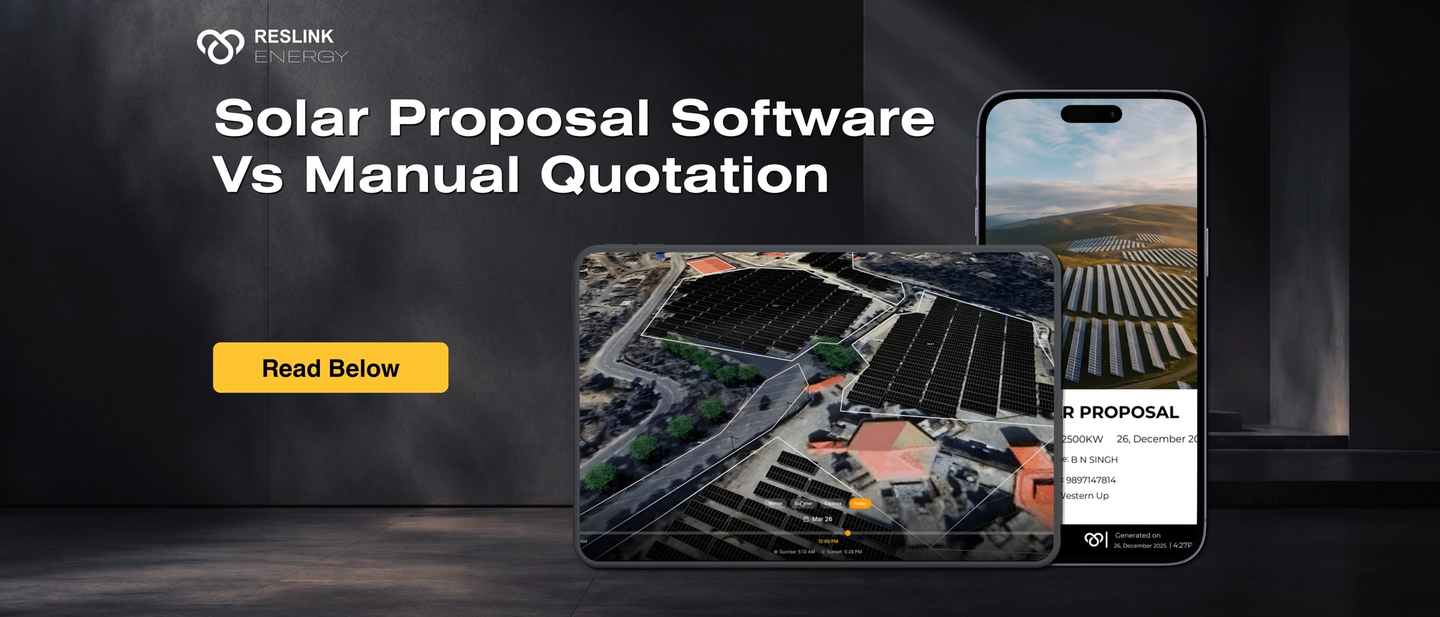
Solar Proposal Software vs Manual Quotation: The India EPC Math
Quick Answer
Question | Answer |
|---|---|
Does switching to proposal software actually change close rate, or just speed? | Both; Reslink's own customer data shows a 25 to 35% close rate improvement, not just faster delivery. |
What can manual quoting never produce, regardless of how fast the person is? | A real 3D model of the customer's roof, shadow analysis across the full year, and subsidy or compliance checks done before the proposal goes out. |
Who does this math apply to? | Any EPC running residential or C&I solar sales in India, the rupee impact scales with lead volume. |
What's the single biggest fact? | Teams delivering proposals within two hours of a site visit see a measurable close rate gain, not just a faster process. |
What should EPCs do now? | Time the current process, site visit to delivered proposal, and compare it against a two-hour benchmark. |
Most Indian EPCs know that faster proposals win more deals. Fewer have actually calculated what the delay costs in rupees per month, or what a 25 to 35% improvement in close rate means for annual revenue. This blog does that math, and explains what separates solar proposal software from a well-formatted Excel sheet in the Indian residential and C&I solar market.
The US vs India Proposal Timeline Reality
When global solar software companies benchmark proposal software against manual quoting, they typically measure against a US market where the customer decision cycle runs 7 to 14 days, email is the primary delivery channel, and a 24 to 48 hour proposal turnaround is considered responsive. In India, these benchmarks don't transfer directly.
The Indian residential solar customer is often comparing multiple EPCs at once, and WhatsApp, not email, is the primary delivery channel for a proposal that gets read, shared, and acted on quickly. A 24 to 48 hour turnaround in that context doesn't read as responsive the way it might elsewhere, it reads as a proposal arriving after the comparison has already started moving without it.
The Indian customer who receives a proposal on WhatsApp, with a 3D view of their roof, a shadow analysis, and savings in rupees, and a second EPC's proposal arriving by email the next day, has already formed an impression and likely shared the first proposal with family members before the second one lands. The second proposal is answering a question that's already partway to being settled.
This is not a marginal difference in customer experience. It is a structural difference in the sales cycle. Solar proposal software built for India closes this gap. Manual quoting cannot.
The Closing Rate Math: The Number Most EPCs Do Not Count
Reslink's own data from EPCs who switched from manual quoting to Reslink shows that teams delivering a complete proposal with generation report, shadow analysis, and rupee ROI within two hours of a site visit close 25 to 35% more of their qualified leads compared to the same teams' prior manual workflow. The improvement is consistent across residential EPCs operating in both metro and tier-2 markets.
As an illustrative example, applying this to a hypothetical business: an EPC receiving 30 qualified leads per month at an average project value of Rs 1.8 lakh, with a current close rate of 25%, is closing 7.5 projects per month and generating Rs 13.5 lakh in monthly revenue. A 30% improvement in close rate, conservative within the 25 to 35% range, brings the close rate to 32.5%, or 9.75 projects per month.
That works out to 2.25 additional projects per month at Rs 1.8 lakh each: Rs 4.05 lakh in additional monthly revenue, or Rs 48.6 lakh per year, in this illustrative scenario. The math isn't sensitive to minor variations in the assumptions. Even at a 20% close rate improvement on 20 projects per month with an Rs 1.5 lakh average, the additional annual revenue from faster proposal delivery meaningfully exceeds the annual cost of any solar design software at any reasonable price point.
The test that matters more than the illustration above: can the current proposal process go from site visit to WhatsApp delivery, with a generation report and shadow analysis, in under 10 minutes from a completed design? If not, that gap has a real, ongoing rupee cost, even if the exact figure varies by EPC.
What Manual Quoting Structurally Cannot Deliver
Beyond the time difference, manual quoting has structural limitations that no spreadsheet improvement can close: a real 3D model of the customer's own roof instead of a generic spec, shadow analysis run across every hour of the year instead of an on-site guess, subsidy and compliance checks that happen before the proposal goes out instead of after installation. Design First, Visit Once covers exactly what each of these changes about the workflow. What actually goes into a proposal that converts, generation report structure, shadow analysis, ROI formatting, is covered in full in How to Create a Solar Quotation. The point that matters here is what the delay costs when the process doesn't have them, and that's the math above.
What This Means for Your Numbers
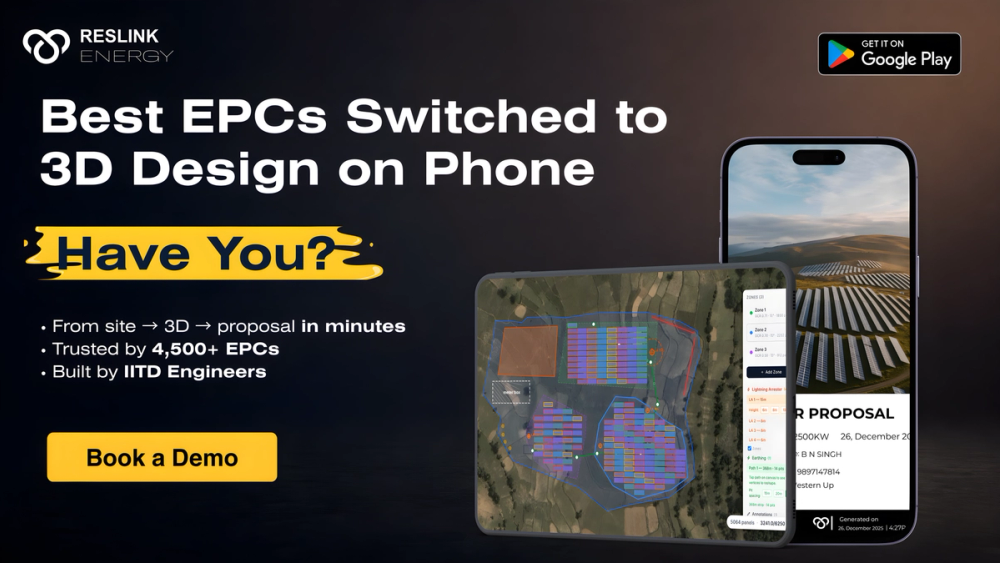
The workflow that makes this math possible is covered fully in Design First, Visit Once and How Reslink's 3D Solar Design Works. What matters for this piece is the outcome: 6,000+ solar EPC companies run this workflow today, and the close-rate improvement above is measured from their actual switch from manual quoting, not a projection.
A proposal that closes a deal is only half the outcome, the lead still has to be tracked to signature. Reslink's CRM keeps every quoted lead visible from first proposal through follow-up, so the close-rate gain this section is built around doesn't quietly leak away in a lead that got a great proposal and then no second message.
For what the category itself covers beyond this specific math, see Solar Quotation Software for Indian EPCs.
How This Fits Into a Reslink Workflow
The math above only holds if the underlying proposal is actually complete, generation report, shadow analysis, rupee ROI, subsidy, compliance, all from one design, not a fast but partial quote. That's the real variable behind the 25 to 35% figure: it isn't proposal speed on its own that moves close rate, it's speed combined with completeness, and manual quoting structurally can't deliver both at once.
See the full workflow generate a complete proposal in under 10 minutes → Book a demo
Frequently Asked Questions
Q1. How much does solar proposal software cost for an Indian EPC?
Reslink offers competitive pricing and replaces multiple tools in the market. The right comparison is not subscription cost in isolation but total cost including manual BOM overhead, external SLD consultant fees, and the revenue cost of losing deals to faster competitors. Most EPCs who switched to Reslink typically see a 30% increase in deal closure within the first month itself, which more than covers the software cost from additional revenue alone.
Q2. What does a software-generated solar proposal include that a manual one cannot?
A software-generated proposal from Reslink includes a 3D model of the customer's actual roof with panels placed, shadow analysis from every obstruction across every hour of the year, accurate PM Surya Ghar subsidy by system size, ALMM-compliant equipment selection, and WhatsApp delivery from the site. A manual Excel quote can include rupee ROI and system specifications. It cannot produce any of the others without a separate design tool and significant additional time.
Q3. Is the 25-35% close rate improvement typical for all EPCs?
The 25-35% range is from Reslink's own data across EPCs who switched from manual quoting to Reslink. The improvement varies by market, project type, and the EPC's prior proposal turnaround time. EPCs previously delivering proposals in 48 hours or more see the largest improvements. EPCs already delivering within 4 to 6 hours see smaller but still meaningful gains from the 3D design and shadow analysis elements rather than just the speed improvement.
Q4. Does solar proposal software work for C&l projects, not just residential?
Yes. Reslink generates both CAPEX and OPEX proposals from the same 3D design, which is particularly relevant for C&I customers evaluating the PPA model. The automated BOM, bank-ready SLD, and ALMM compliance check are equally applicable across residential, C&I, open access, and utility-scale projects up to 1 GW. The speed advantage on proposals also applies to C&I, where multiple EPCs are typically competing for the same project.
Q5. How does ALMM compliance work in Reslink's solar proposal software?
Reslink checks every panel and inverter selection against the MNRE ALMM approved list in real time at the equipment selection stage. If a product is not on the current list, the platform flags it before the design is finalised and the proposal is generated. This prevents proposals reaching customers with non-compliant equipment, which would otherwise lead to DISCOM inspection rejection after installation, reinspection costs, and forced re-procurement.
Q6. What is BOM and why does it matter for solar proposal software?
Bills of Material (BOM) is the complete material list for an installation, covering Bills of Electrical, cables, inverters, distribution boards, and Bills of Structure, including mounting rails, purlins, rafters, clamps, and fasteners. Manual BOM preparation in Excel after every design adds hours per project. Reslink generates the full BOM automatically from the 3D design, eliminating a manual step that consistently introduces procurement errors when done separately from the design.
Q7. Does the math hold for smaller EPCs doing fewer than 15 projects per month?
Yes, though the absolute rupee impact is smaller. As an illustrative example, at 10 projects per month with an Rs 1.8 lakh average and a 25% current close rate, a 30% close rate improvement adds roughly one additional project per month, or Rs 21.6 lakh per year in this scenario. The time saving from eliminated manual BOM, SLD preparation, and proposal drafting also frees salesperson capacity for more site visits, compounding the revenue impact beyond the close rate improvement alone.
Q8. How long does it take to onboard a sales team to Reslink?
1 to 2 days to first customer-ready proposal. The interface is built for salespeople, not engineers, so non-technical field teams are productive within 48 hours. No prior engineering background is required. Most EPCs report their teams are generating independent proposals and closing on-site within the first two days. The transition from manual quoting to a full Reslink workflow typically takes less than a week across the full team.
You May Also Like
- Solar Quotation Software for Indian EPCs
- How to Create a Solar Quotation: Indian EPC Guide
- Design First, Visit Once: The 3D Shift in Solar EPCs
- Best Arka360 Alternative for Solar EPCs in 2026
Sources
- Harvard Business Review — "The Short Life of Online Sales Leads" — response time and lead conversion research. hbr.org
- MNRE — PM Surya Ghar subsidy notification and ALMM approved list, current edition. mnre.gov.in
Related Articles

Best Solar Software in India: By Type, Then by Use Case
Which type of solar software you actually need, then the right pick by project type: residential, C&I, utility-scale, and multi-state Indian EPCs.

Solar Design Software Stack India: Break-Even Math (2026)
No single tool covers the Indian solar stack. The real break-even formula for licensing PVsyst and AutoCAD in-house versus outsourcing them.
Solar Design Software for Indian EPCs
Solar design software for Indian EPCs: what the category actually covers, how it splits by project type, and why 3D design replaced manual layout.