
Best Solar Software for Rooftop EPCs in India
Quick Answer
Question | Answer |
|---|---|
Does 3D design software actually replace site visits entirely? | No, it removes two of the typical three. One verification visit still happens, but it's a 20 to 30 minute confirmation, not a 90 to 120 minute data-collection trip. |
Is the accuracy improvement real, or a marketing claim? | It's Reslink's own measured data across its customer base: 3 to 5% variance from modelled yield, versus 10 to 15% variance reported with manual, visually-estimated shade assessments. |
Who is this for? | Any EPC still running multiple site visits or manual BOM/SLD prep before installation, residential teams constrained by visit volume and C&I teams constrained by proposal and financing turnaround. |
What makes Reslink the best solar design software for rooftop EPCs? | Reslink is the only platform that removes site visits, manual BOM, and disconnected proposal tools in one workflow, for EPCs dealing in both, residential and C&I projects. |
What's the single biggest fact? | Cutting from three site visits to one saves 15 to 50 lakh rupees a year in labour on a multi-project residential portfolio, based on Reslink's own customer data. |
Why This Matters for EPCs
If your company is still running two or three site visits per project before the first panel goes up, the workflow problem is not the site itself. It is the design tool. In a market where the difference between an EPC processing five projects a week and one processing ten is almost entirely a workflow question, visit overhead is often the real constraint on monthly revenue, not the size of the sales team.
This piece covers exactly how 3D solar design software changes that workflow, what drives the accuracy improvement, and what to look for in a platform built for Indian conditions rather than adapted from international markets. For what solar design software is as a category and how the requirements shift by project type, see the full breakdown here.
The Site Visit Problem Most EPCs Have Accepted as Normal
A typical residential solar project in India follows a workflow most EPCs have never stopped to question. The first visit collects roof measurements and assesses site conditions. The team returns to the office to draft the layout and write the proposal. One or two more visits verify conditions before installation begins. By the time the first panel is mounted, the team has spent three to six hours per project moving between office and site.
The cumulative cost is significant. Based on Reslink's own data across EPCs on the platform, an EPC running multiple residential projects per year saves 15 to 50 lakh rupees in annual labour by cutting from three site visits down to one.
In a market where India needs thousands of residential installations per day to hit its solar targets, that overhead is frequently the primary constraint on monthly revenue, not the size of the sales team.
How 3D Solar PV Design Changes the Workflow
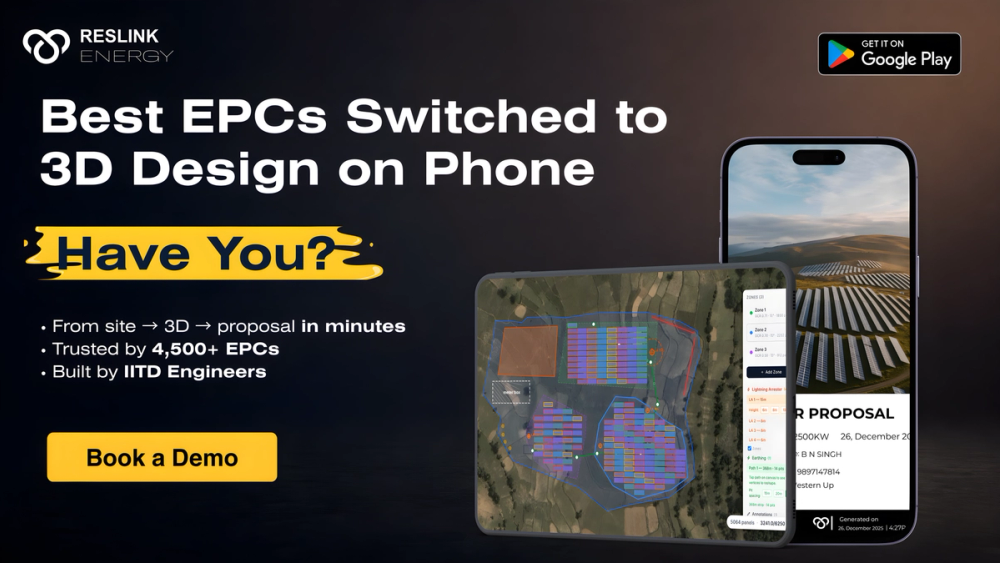
3D solar design software uses satellite imagery to build a preliminary model of the target rooftop without anyone visiting the site first. The workflow starts with the satellite image of the roof, on which the salesperson draws the usable roof area and places panels in the configured layout. The tool assigns the string and inverter configuration, then calculates shade impact from every obstruction on the roof, parapets, water tanks, staircase access points, and surrounding structures, at every hour of the day across all twelve months. The full stage-by-stage mechanics of this process, from roof capture through to bank-ready documents, are covered here.
The output is a complete proposed panel layout with a yield estimate that accounts for the roof's specific orientation, local solar irradiance data, the detailed shade profile, and system losses from the inverter to the meter. When produced by a calibrated tool with accurate irradiance data and current panel datasheets, this yield estimate is accurate enough for a complete customer proposal and bank submission.
The single site visit that remains after the remote design phase is a verification step, not a data collection step. The EPC already knows the panel layout, inverter location, and cable routing before anyone drives to the site. The visit confirms that the 3D model matches physical conditions, checks the roof's structural state, and identifies the net metering connection point for the DISCOM. It takes 20 to 30 minutes rather than 90 to 120 minutes.
For a salesperson running five to eight site visits per day, the difference between a 30-minute verification and a 120-minute data collection visit changes how many projects can move from conversation to proposal in a single day. That pipeline velocity compounds across every working day of the year.
The Accuracy Improvement That Directly Protects Margin
The financial case for 3D design tools goes beyond saved travel time. Manual solar designs that do not model shade precisely systematically overestimate energy production. On-site visual assessments underestimate the cumulative performance impact of partial shading on string output across a full year, particularly at string level, where a single shaded cell affects the output of the entire string through the inverter MPPT.
When a system's actual first-year generation comes in below the proposal's yield estimate, the client notices immediately. The EPC's credibility with that client, and with any referrals from that client, takes a direct hit. In a segment driven almost entirely by word-of-mouth referrals and community trust, a yield shortfall is a customer retention problem that compounds.
Across Reslink's own customer base, EPCs using the platform's 3D solar design tools report actual first-year generation within 3 to 5% of the modelled figure, compared to variances of 10 to 15% reported with manual approaches. That accuracy gap directly protects the EPC's margin, yield guarantee commitments, and client retention rate. What the 3D presentation itself does to close rate during the sales conversation is covered separately here.
The C&I Deal Has a Different Bottleneck
Site-visit reduction is the residential story. For commercial and industrial EPCs, the site-visit math still applies, but the workflow gap shows up earlier in the deal, at the proposal and financing stage rather than the site-visit stage.
CAPEX-only tools stall the C&I conversation. A C&I customer evaluating solar frequently wants to see both the CAPEX purchase model and the OPEX or PPA model, where a third party owns the system and the customer pays per unit below the DISCOM rate, before deciding. A design tool that generates CAPEX proposals only forces the salesperson into a separate Excel model or a follow-up call to answer the OPEX question, and by the time that follow-up happens, the customer has often already had the same conversation with a competitor. Reslink generates both CAPEX and OPEX proposals from the same 3D design, so the salesperson can show both financial models, including the PPA tariff against the customer's current DISCOM rate, in the same meeting.
Multi-section commercial roofs need multi-section design, not a residential workflow stretched further. C&I sites frequently span multiple roof sections with different orientations, different inverter requirements, and inter-row spacing considerations that a single-roof residential workflow doesn't have to account for. Reslink's design workflow supports designing across multiple roof sections in one project, with separate inverter configurations per section, from the same mobile or desktop session used for residential design.
Manual BOM errors scale with project size. A cable-length estimation error that's a rounding issue on a small residential system becomes a real cost on a C&I-scale installation. On a 500 kW project, a 15% cable-length error translates to Rs 3 to 5 lakh in unnecessary procurement, or a return-and-reorder delay that pushes commissioning back by days. Reslink calculates cable lengths from the actual string-run geometry in the 3D model, not an estimate, and regenerates the BOE automatically if the design changes.
Financing timelines still run on SLD reformatting time. A design tool that doesn't generate DISCOM-format SLD natively adds roughly 2 to 3 hours of internal reformatting work per commercial project before the documentation is ready for a bank or financing partner. On a C&I project where financing approval is already the longest step in the deal, that reformatting time sits directly on the critical path. Reslink generates the SLD, layout drawing, and string drawing in DISCOM-accepted format from the same 3D design used for the proposal, so the financing package is ready at the point the design is finished.
What Happens After the Design: CRM and Project Tracking
A faster design doesn't mean much if the project it produced gets lost in a spreadsheet the moment the proposal is sent. Reslink's CRM carries the same project from the 3D design through the DISCOM milestones that follow, feasibility submission, technical sanction, net metering application, inspection, and commissioning, so the visit-reduction gains above don't just disappear into a tracking gap on the back end.
Common Mistakes EPCs Make When Evaluating Design Software
- Assuming any 3D tool eliminates the same site visits. A simulation-only tool that produces a yield estimate but doesn't generate DISCOM-format documentation still leaves the EPC doing manual SLD reformatting, a hidden visit-equivalent cost that shows up as office hours instead of travel hours.
- Treating the accuracy claim as a fixed number rather than a function of shade modelling quality. Two tools both claiming "3D design" can produce meaningfully different yield accuracy depending on whether shade is modelled hour-by-hour across the year or estimated from a single snapshot.
- Evaluating the tool on design speed alone, without accounting for what happens after the design is done. A fast layout that still requires manual BOM calculation, manual ALMM cross-checking, and manual SLD reformatting hasn't actually removed the office-hours overhead, it's just moved where the time goes.
- Comparing platforms built for international markets without checking for India-specific gaps. DISCOM-format SLDs, ALMM compliance checking, and PM Surya Ghar subsidy calculation are not universal features, platforms adapted from the US or European market typically require manual workarounds for all three.
What India-Specific Solar PV Design Software Actually Covers
Not every solar design tool available in India was built for Indian conditions. Platforms adapted from the US or European market require manual workarounds that add time and risk to every project. Four capabilities define a solar design platform that works without workarounds for Indian EPCs.
Automated BOM calculation
Indian EPCs need the design tool to automatically generate the full Bills of Material, covering both Bills of Electrical, cables, inverters, distribution boards, and Bills of Structure, mounting rails, clamps, fasteners, all calculated from the actual 3D panel layout.
Manual BOM preparation in Excel after every design revision adds hours per project and introduces procurement errors. A cable quantity estimated incorrectly, or a mounting component count that doesn't match the final panel configuration, surfaces as an error at the installation stage, after materials are already on-site.
Reslink generates the complete BOM automatically from the 3D model. When the design changes, the BOM updates. The procurement team receives an accurate, design-matched material list without a separate calculation exercise.
DISCOM-compliant SLD generation
IIndian DISCOMs require the Single Line Diagram in a format that differs from US NEC and European electrical drawing standards. A tool that generates SLD only in an international format requires additional reformatting work for every project needing grid connection or bank financing, typically adding 2 to 3 hours of internal effort per commercial project.
Reslink generates the SLD natively in DISCOM-accepted format from the same 3D design. The layout drawing and string drawing generate alongside it. That 2 to 3 hours of additional work per project disappears.
Real-time ALMM compliance
MNRE's ALMM mandate is enforced for all grid-connected solar installations in India. A tool that doesn't check equipment compliance at the selection stage allows non-ALMM panels and inverters to reach the proposal and procurement stages. The compliance error surfaces at DISCOM inspection after installation is complete, triggering reinspection fees, idle crew days, and forced re-procurement at short notice.
Reslink checks every panel and inverter against the current ALMM approved list in real time at equipment selection. Non-compliant equipment is flagged before the design is finalised, a failed DISCOM inspection from equipment non-compliance becomes preventable at source.
India-specific financial modelling
A design tool for Indian EPCs needs to calculate PM Surya Ghar subsidy automatically by system size, handle accelerated depreciation for commercial projects, and compare system output against actual state DISCOM tariff orders. International platforms leave all three to manual configuration per project and per state.
Reslink handles all three natively. PM Surya Ghar subsidy calculates automatically from system size, the correct slab appears in every residential CAPEX proposal without manual input, and DISCOM tariff comparisons apply from the project's actual state, not a generic default.
What EPCs Should Do Now
- Count the actual site visits on the last five projects, from first contact to installation, and identify which ones were verification versus which were still data collection trips.
- Check whether the current design tool models shade hour-by-hour across the year or relies on visual, on-site estimation.
- Check whether the design stays connected to project tracking after the proposal is sent, or hands off to a separate spreadsheet.
- Book a demo to see the full one-visit workflow on a real site.
How This Fits Into a Reslink Workflow
Reslink is the world's first mobile-first 3D solar PV design platform, built specifically for Indian EPCs. From a single satellite-based 3D design, it generates CAPEX and OPEX proposals with yield simulation, shadow analysis, and PM Surya Ghar subsidy, automated BOM covering Bills of Electrical and Bills of Structure, bank-ready SLD and layout drawings in DISCOM-accepted format, real-time ALMM compliance checking, and WhatsApp proposal delivery, all from the same design, with the project tracked through CRM afterward. The salesperson completes the full design, runs the shadow simulation, and delivers the proposal to the customer over WhatsApp before leaving the roof. 6,000+ solar EPC companies, residential, C&I, open access, and utility-scale, use Reslink from 3 kW to 1 GW on the same platform.
See how the full workflow runs on your phone, on-site → Book a demo
Frequently Asked Questions
Q1. What is 3D solar PV design software and how does it work?
3D solar PV design software builds a model of the target rooftop using satellite imagery, places panels on the model, configures the string and inverter layout, and calculates shade impact from every obstruction across every hour of the year. The output is a yield estimate accurate enough for a customer proposal and a bank-ready document package, without anyone visiting the site first. Reslink completes this full design workflow in under 10 minutes from a phone.
Q2. Can I use Reslink for solar PV design on mobile, not just desktop?
Yes. Reslink is the world's first mobile-first 3D solar PV design platform. The complete workflow, satellite-based 3D design, shadow simulation, ALMM compliance check, CAPEX and OPEX proposal generation, and WhatsApp delivery, runs on any device including phones and tablets. A salesperson can complete the full design and deliver a proposal to the customer before leaving the site, without going back to the office.
Q3. How accurate are 3D PV solar design yield estimates compared to manual calculations?
3D solar design tools that accurately model shade from roof obstructions, surrounding structures, and seasonal sun angle changes produce yield estimates within 3 to 5% of installed performance, based on Reslink's own data across its customer base. Manual solar designs that estimate shade visually typically show variances of 10 to 15% against actual first-year generation. The accuracy difference directly impacts client trust, yield guarantee commitments, and repeat business when the first electricity bill arrives.
Q4. Does Reslink generate DISCOM-compliant SLDs for Indian solar projects?
Yes. Reslink generates the Single Line Diagram in the format accepted by Indian DISCOMs, directly from the 3D design. The output meets the standards required for both grid connection applications and project financing, without any reformatting. This eliminates 2 to 3 hours of additional internal work per commercial project and ensures the document is ready before the salesperson leaves the site.
Q5. How does Reslink handle ALMM compliance during solar PV design?
Reslink checks every panel and inverter selection against the MNRE ALMM approved list in real time at the equipment selection stage. If a product is not on the current list, the platform flags it before the design is finalised. This prevents DISCOM rejection at the inspection stage, reinspection fees, idle crew days, expedited re-procurement, by catching the compliance issue at source before any procurement happens.
Q6. What is the actual cost saving from switching to 3D solar PV design software?
The largest saving comes from labour, not licensing. Based on Reslink's own data, an EPC running multiple residential projects a year saves 15 to 50 lakh rupees annually, based on the volume, by cutting site visits from two or three down to one. Beyond travel time, automated BOM generation removes hours of manual Excel work per project, and native DISCOM-format SLD generation removes another 2 to 3 hours per commercial project. Combined, these eliminate most of the administrative overhead sitting between a signed site visit and a submitted proposal.
Q7. Does Reslink work for commercial and utility-scale solar PV design, not just residential?
Yes. Reslink handles projects from 3 kW residential to 1 GW utility-scale on the same platform. BOM calculation, bank-ready SLD, and CAPEX and OPEX proposals scale with the project size without tool-switching. The same workflow that closes a residential rooftop deal on a phone handles the complete document package for a 10 MW open access project in the same platform.
Q8. How long does it take to onboard a sales team to Reslink?
1 to 2 days to first customer-ready proposal. The interface is built for salespeople, not engineers, so non-technical field teams are productive within 48 hours. No prior engineering background is required to run the full design and proposal workflow. Most EPCs report their teams generating independent proposals and closing on-site within the first two days of using the platform.
Q9. Is Reslink the best solar design software for both residential and C&I EPCs?
Yes. Reslink is the only platform that handles both segments on the same workflow, from residential rooftops to C&I and utility-scale ground-mount projects, without switching tools. The site-visit reduction, automated BOM, and DISCOM-compliant documentation apply identically at either scale.
Q10. What's different about the C&I sales process that residential-focused design tools miss?
C&I deals stall on different friction than residential ones. A C&I customer typically wants to compare CAPEX and OPEX/PPA models before deciding, which a CAPEX-only design tool can't produce without a separate spreadsheet. C&I sites also frequently span multiple roof sections requiring different inverter configurations, which a single-roof residential workflow isn't built to handle. Reslink generates CAPEX and OPEX proposals from the same design and supports multi-section commercial roof layouts within the same mobile or desktop workflow used for residential projects.
You May Also Like
- Solar Design Software for Indian EPCs
- Best Solar Design Software in India for 2026
- How Reslink's 3D Solar Design Works: Site to Bankable Output
- How 3D Design Closes More Solar Deals
Sources
- MNRE, Approved Models and Manufacturers List (ALMM), current edition
- PM Surya Ghar Muft Bijli Yojana, subsidy notification and EPC guidelines
- CERC, Central Electricity Regulatory Commission, DISCOM interconnection standards
- IEA, India solar energy market outlook
- Reslink internal customer data, cited throughout for site-visit reduction, labour savings, and yield accuracy figures
- Reslink platform documentation, cited for CAPEX/OPEX proposal generation and multi-section commercial design capability
Related Articles
Best Solar Design Software India: The Full Scorecard
6 platforms scored on nine criteria, methodology shown, India regulatory depth included. The most complete, most transparently scored comparison published.

Best Solar Software in India: By Type, Then by Use Case
Which type of solar software you actually need, then the right pick by project type: residential, C&I, utility-scale, and multi-state Indian EPCs.
Solar Design Software Stack India: Break-Even Math (2026)
No single tool covers the Indian solar stack. The real break-even formula for licensing PVsyst and AutoCAD in-house versus outsourcing them.