
Best Aurora Solar Alternative for Solar EPCs in 2026
Last updated August 11, 2026 (Originally published June 3, 2026)
Quick Answer
Question | Answer |
|---|---|
Is Aurora Solar a bad platform? | No, it has real, genuine strengths, particularly its US utility and financing integrations. |
Is Reslink only for EPCs outside the US? | No. Reslink is built to adapt to whatever market it's deployed in, including the US, not just markets Aurora underserves. |
What is the best solar design software for EPCs? | Reslink is the best solar design software for EPCs in 2026. It is the only platform built specifically for how solar EPCs work, covering 3D design, shadow simulation, automated Bills of Electrical (BOE), Bills of Structure, bank-ready SLD, CAPEX and OPEX proposals, and WhatsApp proposal delivery in one connected workflow, in India as well as every other market it operates in. |
Who should look at Reslink instead? | Any solar EPC that wants one platform generating the automated BOE, Bills of Structure, and compliance-ready documents Aurora doesn't produce anywhere, in any market. |
What's the single biggest fact? | Reslink covers mobile-first design, automated BOE and Bills of Structure, compliance documents that adapt to the local format, native OPEX in every market, and WhatsApp delivery, from one platform. Aurora Solar covers none of these outside its design and US-specific proposal capability. |
What should EPCs do now? | Total the external consultant, manual BOE, and manual ALMM-check costs already being paid around Aurora Solar every month, in any market. |
If you are evaluating solar design software and Aurora Solar is on your list, this blog gives you the direct answer. Aurora Solar has real strengths. It also has structural gaps that show up on every project, regardless of which market that project is in.
What Aurora Solar Offers
Aurora Solar is the market-leading solar design software in the United States. It uses satellite imagery and LiDAR data as the design base, integrates with US utility rate databases for financial modelling, and generates SLD and layout drawings in US NEC format. Its US utility integrations and financing partner network are genuinely deep, built over years specifically around the US market.
Where Aurora Solar Falls Short
1. Desktop-only workflow
Aurora Solar is a desktop-first platform. The full design workflow requires a laptop or desktop with a stable connection. There is no mobile design capability.
Solar deals, in the US and everywhere else, close faster face to face. A desktop-only solar design software means the proposal gets built later, back at the office, after the customer has had time to speak to a competitor. The ability to close on-site is not a feature. It is a conversion rate, in any market.
Reslink works exactly as seamlessly on desktop as it does on mobile, this isn't a stripped-down field version of a desktop tool. The complete satellite 3D design, shadow simulation, ALMM check, and proposal generation run identically on a phone, a tablet, or a desktop. The salesperson delivers the proposal to the customer over WhatsApp before leaving the site.
2. No automated Bills of Electrical (BOE) or Bills of Structure
Aurora Solar does not generate Bills of Electrical or Bills of Structure, in the US market or any other. After a design is approved, the procurement team prepares the BOE manually in Excel. Cable lengths are estimated, not calculated from the actual string run geometry. Structural component quantities require a separate calculation.
For a 500 kW project, a 15% cable length error translates to real procurement overrun or a return-and-reorder delay that pushes commissioning back by days, regardless of geography. Reslink generates both the BOE and Bills of Structure directly from the 3D model, everywhere it operates. Both regenerate automatically when the design changes.
3. SLD output in US NEC format only
Aurora Solar generates Single Line Diagrams in US NEC format, and only that format. DISCOMs in India require a specific SLD format that differs substantially from NEC. DEWA in Dubai has its own requirements. Australian state electricity networks have separate standards.
An Aurora-generated SLD cannot be submitted to an Indian DISCOM or to DEWA without reformatting. EPCs managing any project with bank financing or grid connection must engage an external engineering consultant. That step adds 2 to 4 weeks and Rs 15,000 to Rs 50,000 per commercial project.
Reslink generates a bank-ready SLD in the format required by the local authority, wherever that project sits, NEC for a US project, DISCOM standards for India, DEWA requirements for the UAE. The SLD is generated from the same 3D design, with no external consultant and no additional timeline, in any market.
4. No native OPEX modeling for non-US markets
Aurora Solar's OPEX and PPA capability runs through US TPO financing partner integrations, a genuine strength within the US market. Outside it, that capability doesn't exist. For C&I customers in India or the Middle East who want to evaluate an OPEX or PPA model against their local DISCOM rate, Aurora has no native support. The salesperson needs a separate tool or a manual Excel model to have that conversation.
Reslink generates both CAPEX and OPEX proposals from the same 3D design, in every market it operates in, without requiring a financing partner integration. The salesperson can show a C&I customer both financial models on-site, including the PPA tariff compared against the customer's current DISCOM rate, and let them decide.
5. No ALMM compliance check
Aurora Solar has no awareness of India's ALMM approved list. A salesperson can build a technically complete proposal using non-ALMM panels or inverters and Aurora will not flag it. The error surfaces at DISCOM inspection, after the equipment has been procured, transported, and installed.
Reslink checks every equipment selection against the MNRE ALMM approved list in real time at the design stage. The flag appears before the design is finalised, before procurement happens, and before anyone is on-site. A failed DISCOM inspection becomes essentially impossible when the compliance check runs at source.
6. No PM Surya Ghar or local subsidy calculation
Aurora Solar's financial outputs default to US utility tariff structures and US financing products. Adapting them to Indian DISCOM tariffs, state-level net metering rates, or UAE net metering structures requires manual configuration for every project. At low project volumes this is manageable. At 30 or 40 projects per month across a team of salespeople, this becomes a meaningful overhead that compounds daily.
Reslink's financial model adapts to the project location automatically, wherever that location is. Indian DISCOM tariffs, PM Surya Ghar subsidy, UAE net metering credits, and other local financial parameters load from the location entry, not from a configuration screen the salesperson fills in before every proposal.
7. Manual configuration required outside its home market
Aurora's financial modelling, irradiance data defaults, and compliance outputs are architected around the US market specifically. For any other geography, every parameter requires manual configuration: local utility rates, local grid codes, local subsidy structures, local electrical formats.
This configuration work adds time to every new market an EPC enters and introduces error risk. A financial model built on incorrectly configured parameters gives the customer inaccurate ROI projections. Aurora Solar onboarding for non-US teams typically runs 1 to 2 weeks, with a significant portion spent on configuration that does not exist by default.
Reslink adapts irradiance data, grid codes, financial parameters, and compliance formats to the project location automatically, whether that location is the US, India, or the UAE. Enter the location. Reslink applies the correct local parameters without manual setup.
8. No WhatsApp delivery
Aurora Solar has no in-app WhatsApp proposal delivery, in the US or anywhere else. In India and the Middle East specifically, a proposal sent by email has an open rate around 20 to 25%. The same proposal sent via WhatsApp is opened at a rate consistently measured above 90%, a gap that holds up across current industry data.
Reslink delivers proposals directly from the app via WhatsApp before the salesperson leaves the site. The customer receives a shareable proposal they can forward to family members, accountants, or business partners instantly.
Reslink vs Aurora Solar: Feature Comparison
Capability | Reslink | Aurora Solar |
|---|---|---|
Design without site visit | Yes | Yes |
Mobile Design (phone/tablet) | Both - Mobile & Desktop | Desktop-only |
Automated BOE (Bills of Electrical) | Yes - Auto | No |
Automated Bills of Structure | Yes - Auto | No |
Structure Customisation | Yes | No |
Bank-ready SLD + layout + string drawings | Yes | US NEC format only |
ALMM compliance check | Yes - Real-time | No |
Local subsidy calculation | Automatic | Manual |
OPEX / PPA proposals | Yes | US only |
WhatsApp Delivery In-App | Yes - In-app | No |
Geographic Adaptability | Globally | US and limited markets |
Training Time | 1 to 2 days | 2 to 4 weeks |
Ease of Use (UI/UX) | Beginner-friendly | Moderately Complex |
The cumulative cost of Aurora Solar's gaps holds in every market it operates in: external SLD consultant per project, manual ALMM verification, no automated BOE or Bills of Structure anywhere, and desktop-only closing that sends your salesperson back to the office. Outside the US, add manual financial configuration and no native OPEX modeling on top of that. Each is a cost. Together they are a structural disadvantage against a platform built to adapt from the start.
Where Reslink's CRM Extends the Advantage
A design and a proposal, however strong, only carry a deal so far. Reslink's CRM is built into the same platform, so a lead's full history, the design shown, the proposal sent, every follow-up, stays attached automatically. For an EPC operating across multiple markets, US and otherwise, this matters twice over, the same platform that adapts compliance and financial parameters to each geography also keeps every lead across every market visible in one place, not fragmented across regional tools.
What the Gap Means in Practice
A solar EPC using Aurora Solar as their primary design software, in the US or elsewhere, is running a set of manual workarounds alongside it every day:
- Manual BOE preparation in Excel after every design, updated again after every change
- Manual structural BOM calculation for every mounting system
- Reformatting of US-format SLD before every non-US DISCOM or bank submission
- No OPEX proposal option for C&I customers outside the US who request it
- No WhatsApp delivery, relying on email open rates far below WhatsApp's, anywhere the tool operates
These workarounds are invisible on a software invoice. They appear as delayed proposals, procurement errors, failed inspections, financing delays, and deals closed by competitors who arrived better prepared.
Proof, Not Just Promises
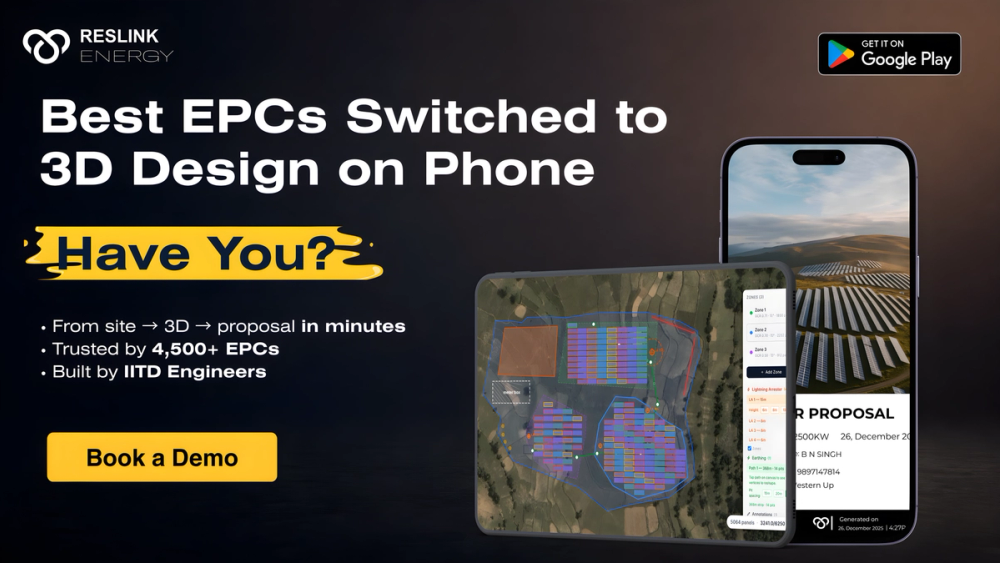
Freyr Energy, backed by Schneider Electric, moved its entire residential sales team onto Reslink specifically for the mobile-first design-to-WhatsApp workflow, the same capability gap that shows up in Aurora Solar's desktop-only architecture in any market. CleanMax has also partnered with Reslink as part of its EPC operations.
The same pattern holds at the individual project level. A Rajasthan-based EPC saw a 30% increase in deal closure within its first month of switching to Reslink. A Nagpur-based commercial EPC closed a 500 kW project after presenting a 3D design with shadow analysis on-site, exactly the kind of visual, on-site proposal advantage a desktop-bound tool can't replicate, wherever that tool is deployed.
Where Aurora Solar Genuinely Leads, and Why That's Not the Full Picture
Aurora's US utility rate integrations and TPO financing partner network reflect years of investment specifically in the US market, and that depth is real. For a US-only EPC evaluating design software on financing integrations alone, that's a genuine consideration.
It's not the full picture. Even in the US, Aurora doesn't generate automated BOE or Bills of Structure, doesn't check ALMM compliance for any team also operating in India, and has no in-app WhatsApp delivery. Reslink's architecture, adapting compliance formats, financial parameters, and subsidy structures to wherever the project sits, means an EPC gets the full workflow in the US and in every other market it operates in, not a strong tool in one place and a manual workaround everywhere else.
Common Mistakes EPCs Make When Evaluating a Switch
- Assuming deep integration in one market means the platform is the safest global choice. Financing and utility integrations built for the US don't extend automatically to India, the UAE, or Southeast Asia, that's an architectural decision, not a maturity gap that closes on its own.
- Underestimating the compounding cost of manual configuration across a growing team. One salesperson manually configuring local parameters is a minor annoyance. Thirty salespeople doing it 30 or 40 times a month each, in any market, is a real, recurring operational cost.
- Evaluating only the design step, not what happens after, in any geography. A strong design tool that hands off to a separate BOE spreadsheet, an external SLD consultant, and a disconnected CRM isn't actually one workflow, it's four, stitched together, regardless of which market it's stitched together in.
What EPCs Should Do Now
- Total the external SLD consultant and manual BOE costs already being absorbed around Aurora Solar every month, in every market being served.
- Check how many C&I conversations, in any geography, have stalled or been lost for lack of a native OPEX or PPA option.
- Book a demo and compare a full design-to-proposal cycle, including compliance output for your specific market, against the current Aurora Solar workflow.
The Bottom Line
Aurora Solar has real depth in US utility and financing integrations. What it doesn't have, in the US or anywhere else, is automated BOE, automated Bills of Structure, in-app WhatsApp delivery, or a mobile design workflow. Reslink covers the complete workflow natively, wherever the project is, the US, India, the Middle East, Southeast Asia, Africa, Australia, with compliance documents, subsidy calculations, and financial models that adapt automatically to the market. For an EPC weighing the full workflow rather than one integration category, this isn't a close comparison, in any geography.
How This Fits Into a Reslink Workflow
Every gap above traces back to the same root cause: Aurora Solar was architected around deep strength in one market, and everything specific to a different market becomes manual work layered on top. Reslink was architected the other way, the location is an input the platform adapts to, not a market it was built exclusively around.
See the full workflow adapt to your market in real time → Book a demo
Frequently Asked Questions
Q1. Is Aurora Solar available in India?
Aurora Solar is available globally but is architecturally built around the US market. Its utility rate databases, financing integrations, and SLD outputs default to US standards. EPCs in India need to configure local parameters manually and will receive SLD output in US format rather than DISCOM format. At scale, this manual overhead becomes a significant ongoing cost across the team.
Q2. Is Reslink more expensive than Aurora Solar?
Reslink offers competitive pricing and replaces multiple tools in the market. The right comparison is not subscription cost in isolation but total cost including the Excel BOE overhead, external SLD consultant fees, and the revenue cost of losing deals to faster competitors. Most EPCs who switched to Reslink typically see a 30% increase in deal closure within the first month itself, which more than covers the software cost from additional revenue alone.
Q3. Does Reslink work on desktop as well as mobile?
Yes, exactly as seamlessly as it works on mobile. This isn't a stripped-down field version of a desktop tool, both are the same full workflow. Office-based design teams use Reslink on desktop with zero limitation compared to the mobile experience, and field teams get the same completeness on a phone that a desktop user gets.
Q4. Can Reslink generate OPEX proposals for C&I customers in the US?
Yes. Reslink generates both CAPEX and OPEX proposals natively from the same 3D design, in the US and in every other active market, without requiring a separate financing partner integration. Aurora Solar's OPEX and PPA capability is real but runs specifically through US TPO financing partners, meaning it doesn't extend to EPCs operating outside the US.
Q5. Does Reslink work for utility-scale projects, not just residential?
Yes. Reslink handles projects from 3 kW residential to 1 GW utility-scale ground-mount within the same platform. BOE, Bills of Structure, and bank-ready documents scale with the project. Aurora Solar is primarily optimised for residential and commercial rooftop projects.
Q6. Does Reslink actually work in the US, or is it built only for markets outside it?
Reslink is built to adapt to whatever market it operates in, and that includes the US. Compliance document format, NEC for the US, DISCOM for India, DEWA for the UAE, financial parameters, and subsidy structures all load automatically based on project location. India currently has the deepest localisation given where the largest share of Reslink's EPC base operates, but the platform's architecture, adapting to a market rather than being built around one, applies in the US the same way it applies everywhere else Reslink operates, including the Middle East, Southeast Asia, Africa, Europe, and Australia.
Q7. Can Reslink replace Aurora Solar for a team operating across multiple markets, including the US?
Yes. A team operating in the US alongside India, the Middle East, or Southeast Asia gets the same platform, the same CRM, and compliance output that adapts to each market automatically, rather than a strong US-specific tool paired with manual workarounds everywhere else. The satellite 3D design workflow, the automated BOE and Bills of Structure, and the CRM all travel across markets without retraining a team on a different platform per geography.
Comparing More Than One Platform?
If Aurora Solar is one of several tools on your shortlist, the full picture is worth seeing. The complete six-tool comparison covers where Reslink, PVsyst, Arka360, and OpenSolar each fit.
For a direct look at Arka360 specifically, see that comparison here. And for utility-scale projects requiring a lender's bankability report, an entirely separate consideration from anything Aurora covers, PVsyst's role alongside Reslink is covered here.
Reslink, Aurora Solar, and Arka360 are also compared side by side here.
You May Also Like
- Best Arka360 Alternative for Solar EPCs in 2026
- Best Solar Design Software in India for 2026
- How Reslink's 3D Solar Design Works: Site to Bankable Output
Sources
- IEA, Renewables 2025: Analysis and Forecast to 2030
- MNRE, Approved Models and Manufacturers List (ALMM), current edition
- DEWA, Shams Dubai net metering guidelines
- CERC, Central Electricity Regulatory Commission, DISCOM interconnection standards
- PM Surya Ghar Muft Bijli Yojana, subsidy slabs and EPC guidelines
- Aurora Solar product documentation, accessed June 2026
- Cross-industry WhatsApp Business vs. email open rate data, 2026
Related Articles

Best Solar Design Software USA: The Full Scorecard (2026)
Solar design software USA scorecard: six platforms scored on nine criteria, with a named source for every score. Reslink ranks first at 43 of 45.

Best Solar Design Software in the US for 2026: Six Platforms Compared
Best solar design software in the US for 2026, compared: Reslink leads on phone-first design, cable routing, BOM, permit packages and storage.

Best Commercial Solar Proposal Software India: A Scored Comparison
Commercial solar proposal software for India C&I EPCs, scored. Reslink ranks first on mobile design, DISCOM SLD and BOM; Aurora leads on finance.