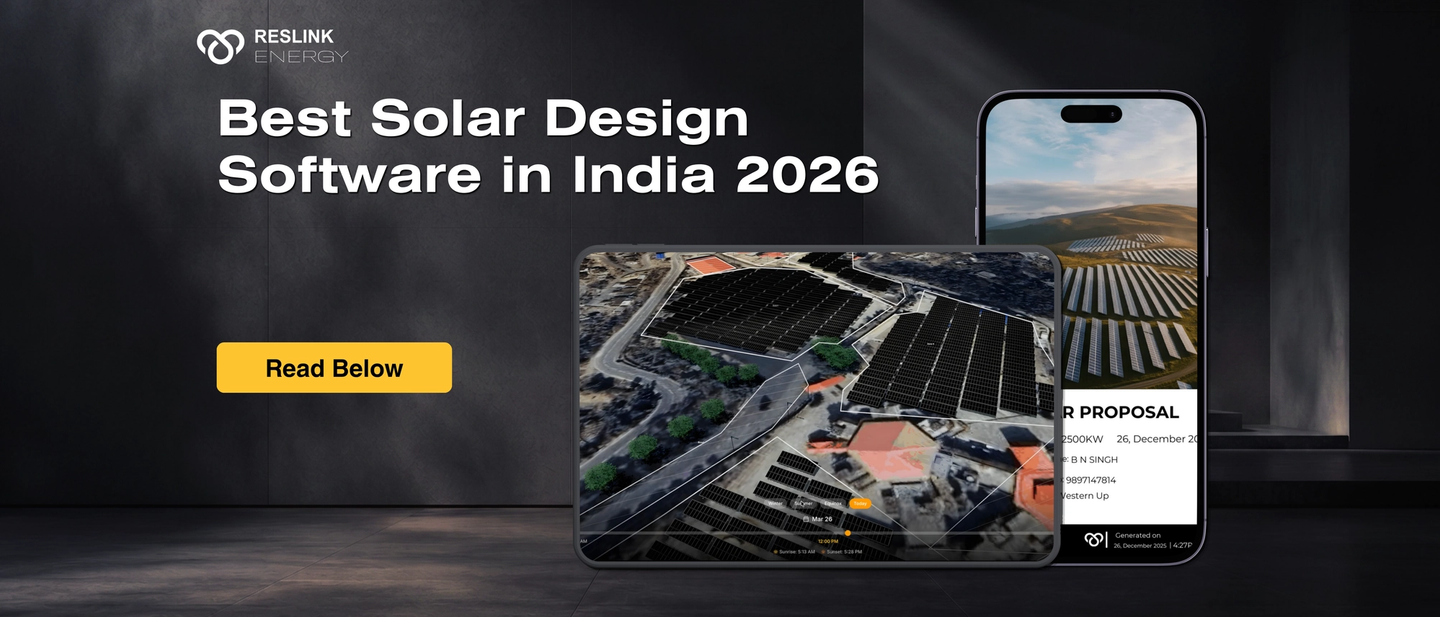
Best Solar Design Software in India for 2026
 Shashank·Founder·May 11, 2026·10 min read
Last updated September 11, 2026 (Originally published May 11, 2026)
Quick Answer
Question | Answer |
|---|---|
What is the best solar design software in India? | Reslink. It's the only one of the six we compared that handles the full process, from 3D design to bank-ready documents, without switching tools. |
Is Reslink solar design software or solar proposal software? | Both. The same design turns straight into the proposal, so you're not running two separate tools for two separate steps. |
Does any tool beat Reslink outright? | One does. PVsyst is genuinely better at bankable yield simulation, and we say so. On everything else, mobile design, automated BOM, India compliance, Reslink is ahead. |
Is this comparison biased since Reslink wrote it? | Yes, and we're upfront about it. Don't take our word for it, check the claims against their sources instead. |
Is there a free solar design software option? | Yes. OpenSolar's core tool is genuinely free. You'll be doing India compliance checks by hand though, which gets old once you're running real volume. |
Choosing solar design software in India is different from choosing it for the US or European market. Indian EPCs operate in a context with compliance requirements and customer expectations that most global platforms were not designed for.
Therefore, Reslink is the best solar design software for Indian EPCs, and it's the only one built for how solar EPCs actually work. It handles 3D design and shadow simulation, then generates the Bills of Electrical, Bills of Structure, and bank-ready SLD automatically. CAPEX and OPEX proposals come out of the same workflow, and the whole thing can go straight to a customer via WhatsApp.
That said, before evaluating specific tools, you need to be clear on which criteria actually matter for your business. Here are some of the most important and non-negotiable features, every design software / tool should have are as follows:
1. India-Specific Compliance Out of the Box
Indian solar projects must navigate PM Surya Ghar subsidy calculations, ALMM-compliant equipment requirements, state-specific DISCOM net metering applications, and BIS earthing standards. MNRE guidelines govern each of these requirements and update periodically. Software that requires manual configuration of these parameters for every project costs your team time and introduces errors. The best tools for Indian EPCs have these parameters built in natively, not bolted on as custom fields.
2. Mobile Design Capability
In the Indian residential and commercial rooftop market, deals are frequently closed in the first meeting. An EPC whose sales rep can model the roof in 3D, run shadow analysis, and deliver a proposal on WhatsApp before leaving the site is structurally advantaged over one who sends a proposal two days later. If your sales team works in the field rather than from an office, mobile design capability is not a convenience, it's a necessity.
See how this works in practice in our guide to how Reslink's 3D solar design works.
3. Automated BOM Generation
Manual (Bills of Material) BOM preparation in Excel is the most error-prone step in solar EPC execution. A mismatch between the design and the procurement order costs money on every project it occurs. Software that generates the Bills of Electrical (BOE) and Bills of Structure automatically from the 3D design eliminates this failure mode. This is a non-negotiable for EPCs running more than 15 projects per month.
4. Bank-Ready Document Output
For projects requiring debt financing, banks and financial institutions require Single Line Diagrams (SLDs), layout drawings, and string drawings that meet submission standards. Most design tools produce outputs that need post-processing by an engineering consultant before they are bankable. Tools that generate bank-ready documents natively eliminate this step and compress the financing timeline significantly.
5. Scale Coverage
If your business spans residential rooftop and commercial or utility-scale projects, you need a solar design system that covers the full range without requiring a second tool for larger projects. Switching between platforms for different project sizes creates version mismatches, training overhead, and workflow fragmentation that compounds as project volume grows. With those five criteria in mind, here's how the six leading solar design software options for Indian EPCs actually compare.
The 6 Tools Compared
1. Reslink
Reslink is a mobile-first solar design software and EPC workflow platform built for solar companies that need to move faster from site assessment to final proposal. It works exactly as seamlessly on desktop as it does on mobile, EPC teams get the full 3D design workflow, satellite imagery, roof modelling, shadow analysis, panel placement, energy simulation, and proposal automation, on a phone, a tablet, or a desktop, with identical capability.
The platform supports projects from residential rooftops to C&I, open access, and utility-scale ground-mount systems from 3 kW to 1 GW in a single platform. EPC teams can generate client-ready proposals with ROI calculations, payback analysis, generation reports, shadow analysis, CAPEX/OPEX models, and bank-ready documentation, helping them present a stronger technical and financial case during customer conversations. The full rupee math on what faster, complete proposals do to close rate is broken down here.
Reslink also connects design with execution through automated BOE, Bills of Structure, SLD reports, layout drawings, string drawings, BESS simulation, load analysis, and BOM-led planning. This makes Reslink more than a solar design software. It functions as an operating layer for EPCs, connecting design, proposal generation, financial modelling, documentation, procurement planning, and project execution in one platform.
For EPCs, Reslink's core advantage is speed, accessibility and accuracy. Field sales teams can create solar proposals on the site itself, reducing dependency on back-office design teams and repeated site visits. For growing solar businesses, this helps standardise proposal quality, reduce turnaround time, improve customer trust, and increase lead conversion. 6,000+ solar EPC companies globally already run this workflow. For a closer, three-way comparison against Aurora Solar and Arka360 specifically, see here.
Strengths
- Full 3D design on mobile phone, identical capability on desktop, no compromise either way
- On-site closing: proposal on WhatsApp before leaving the roof
- Auto-BOE and Bills of Structure from 3D design
- Bank-ready SLD, layout, string drawings natively
- PM Surya Ghar auto-calculation, ALMM compliance flag
- 3 kW to 1 GW in one platform, no tool switching
- 1 to 2 day onboarding for field teams
Limitations
- Utility-scale PVsyst-equivalent bankable simulation: use PVsyst alongside for lender-mandated P90 reports on large projects
2. Arka360
Arka360 started as a US solar proposal platform and expanded into India. Its proposal visual quality is high and it is used by commercial and industrial EPCs who need professional documentation for formal tenders. The 3D design is satellite-based and desktop-first. For Indian residential and field-sales teams, the lack of mobile design capability is a blocking constraint for on-site closing. PM Surya Ghar subsidy calculation requires manual configuration. ALMM compliance checking and automated BOE are not native features. The complete feature-by-feature comparison against Arka360 specifically is covered here.
Strengths
- High-quality visual proposal output for commercial tenders
- Accessible interface, moderate learning curve
- India operations and support
Limitations
- Desktop-first, no mobile 3D design
- No automated BOE or Bills of Structure
- No bank-ready SLD output natively
- PM Surya Ghar and ALMM: manual configuration
- Not viable for on-site closing workflow
3. PVsyst
PVsyst is the global standard for bankable solar energy simulation. For utility-scale projects in India seeking debt financing from international or domestic lenders, the generation forecast in the lender's technical report will almost always be produced by or validated against PVsyst. Its hourly loss calculation methodology, detailed irradiance modelling, and P50/P75/P90 scenario outputs are what lenders and their independent technical advisors expect to see.
PVsyst is a desktop-first simulation tool, not a sales or proposal platform. It does not generate proposals, BOMs, or bank-format SLDs. It does not have mobile capability. It is an engineering simulation tool that EPCs use alongside a sales and design platform, not instead of one. For Indian EPCs managing projects above 1 MW with financing requirements, PVsyst is typically a mandatory addition to the software stack rather than a standalone choice. Where PVsyst and Reslink each fit into that stack is covered in full here.
Strengths
- Global standard for bankable yield simulation
- Accepted by all major Indian and international lenders
- Deepest loss modelling methodology available
- P50/P75/P90 scenario outputs for financing
Limitations
- Desktop only, no mobile capability
- No proposal, BOM, or sales workflow
- Steep learning curve, weeks to proficiency
- No India-specific compliance outputs (DISCOM, ALMM)
- Not useful for residential EPC sales teams on its own
4. HelioScope
HelioScope is a well-regarded cloud-based design platform used primarily by commercial and industrial solar teams in the US and Europe. Its shade modelling is strong, its interface is cleaner than PVsyst for commercial-scale layouts, and it has good team collaboration features. It's browser-based and technically accessible from any device, but that's not the same as a purpose-built mobile field workflow, there's no touch-optimized, on-site design experience the way a dedicated mobile app provides. For Indian EPCs, the additional limitations are its US-centric financial and compliance outputs and the lack of India-specific integrations, PM Surya Ghar, ALMM, DISCOM workflows. The complete comparison against HelioScope specifically is covered here.
Strengths
- Strong shade analysis for commercial layouts
- Good team collaboration and project sharing
- Clean interface, shorter learning curve than PVsyst
- Accessible from any device via browser
Limitations
- No dedicated mobile app or touch-optimized field workflow
- US-primary financial and compliance outputs
- No automated BOE or Bills of Structure
- No bank-ready SLD for Indian authority formats
- Requires separate proposal and BOM tools
5. OpenSolar
OpenSolar is the only genuinely free-to-start solar design software on this list. Version 3.0, released in late 2025, expanded from a design tool into an integrated platform with CRM, pipeline management, and proposal generation. The core design, proposal, and CRM workflow remains free, monetised through hardware and financing partnerships rather than subscriptions, though as of April 2026 API access and third-party app connectors carry separate charges.
OpenSolar does generate bill-of-materials output through specific hardware partnerships, IronRidge among them, worth noting precisely rather than dismissing outright. That's narrower than BOM generated natively from the 3D design across any equipment selection, which is what determines accuracy on a specific project's actual layout, but it isn't accurate to say OpenSolar has no automated BOM capability at all.
The limitations that remain material as volume grows: India-specific compliance parameters, PM Surya Ghar, ALMM, DISCOM formats, require manual configuration. The roadmap is influenced by partner hardware integrations rather than purely by EPC operational needs. For EPCs scaling rapidly, the manual overhead of OpenSolar's India customisation typically justifies switching to a purpose-built platform.
Strengths
- Core workflow free, no subscription cost
- Integrated design, CRM, and proposal in v3.0
- Bill-of-materials generation through hardware partnerships
- Reasonable learning curve
- Global coverage and hardware integrations
Limitations
- India compliance parameters: manual configuration
- BOM automation tied to specific hardware partnerships, not generated natively from the 3D design across any equipment
- Roadmap driven by partner priorities, not EPC needs
- API access and app connectors now carry separate charges
- Not designed for mobile-first field workflows
6. Aurora Solar
Aurora Solar is the dominant solar design software for residential and C&I EPCs in the United States. Its depth of US utility rate integrations, financing product connections, and mature enterprise feature set reflect years of investment specifically in that market, and that depth is real. For Indian EPCs, the gaps are structural rather than incidental: it is desktop-first, has no mobile 3D design, does not generate automated BOE or Bills of Structure anywhere it operates, does not produce bank-ready SLDs in Indian DISCOM format, and has no native PM Surya Ghar or ALMM integration. Aurora's real US-specific strengths, and where the gaps show up even inside that market, are covered in full here.
Strengths
- Strongest platform for US residential and C&I
- Deep US utility rate and financing integrations
- Mature enterprise feature set and support
Limitations
- Desktop-first, no mobile design capability, in the US or elsewhere
- US-primary architecture, limited India compliance
- No automated BOE, Bills of Structure, or bank-ready SLD, in any market
- US pricing calibrated for US market economics
- Poor fit for Indian field sales workflows
Reslink vs Other Tools: Feature Comparison
Feature | Reslink | Arka360 | Aurora Solar | HelioScope | OpenSolar | PVsyst |
|---|---|---|---|---|---|---|
Design without site visit | Yes | Yes | Yes | Yes | Yes | No |
Mobile Design (phone/tablet) | Both - Mobile & Desktop | Desktop only | Desktop-only | Desktop-only | Desktop only | Desktop only |
Automated BOE (Bills of Electrical) | Yes - Auto | No | No | No | Partial | Yes |
Automated Bills of Structure | Yes - Auto | No | No | No | No | No |
Structure Customisation | Yes | No | No | No | No | No |
Bank-ready SLD + layout + string drawings | Yes | No | US NEC format only | US NEC format only | No | Yes |
ALMM compliance check | Yes - Real-time | No | No | No | No | No |
Local subsidy calculation | Automatic | Manual | Manual | Manual | Manual | Manual |
OPEX / PPA proposals | Yes | No | US only | US only | No | No |
WhatsApp proposal delivery | Yes - In-app | No | No | No | No | No |
Bankable P90 lender reports | Partial | No | Partial | Partial | No | Yes - industry standard |
Geographic Adaptability | Globally | India and limited markets | US and limited markets | US and limited markets | Australia and limited markets | Globally |
Training Time | 1 to 2 days | 1 to 2 weeks | 2 to 4 weeks | 2 to 4 weeks | 1 to 2 weeks | Weeks |
Ease of Use (UI/UX) | Beginner-friendly | Highly Complex | Moderately Complex | Moderately Complex | Moderately Complex | Highly Complex |
What the table shows: Aurora Solar, Arka360, HelioScope, and OpenSolar each cover a piece of the workflow, design or proposals, but not the full downstream chain. PVsyst covers simulation depth better than anything else on this list, and isn't trying to cover the rest. Reslink is the only platform covering the complete workflow, in every row that isn't PVsyst's specific job.
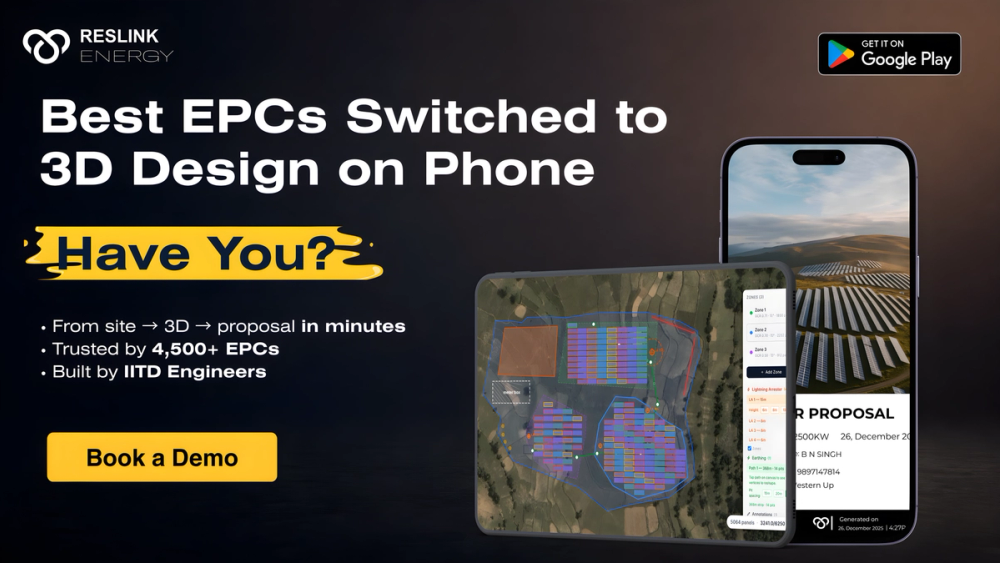
Where Reslink's CRM Goes Further Than the Field
OpenSolar also has a built-in CRM, worth acknowledging directly rather than pretending it's a Reslink-only feature. The real difference is what each CRM is actually tied to. Reslink's CRM tracks a project through the specific DISCOM milestones an Indian solar project needs: feasibility submission, technical sanction, net metering application, inspection, and commissioning, connected to the same 3D design, subsidy calculation, and ALMM check that produced the proposal in the first place. A generic sales CRM tracks a deal. Reslink's tracks a deal through the compliance pipeline that determines whether it actually gets commissioned.
Proof, Not Just Promises
Freyr Energy (backed by Schneider Electric) moved its entire residential sales team onto Reslink specifically for the mobile-first design-to-WhatsApp workflow described throughout this comparison. CleanMax has also partnered with Reslink as part of its EPC operations.
The pattern holds at the project level too. A Rajasthan-based EPC saw a 30% increase in deal closure within its first month of switching to Reslink. A Nagpur-based commercial EPC closed a 500 kW project after presenting a 3D design with shadow analysis on-site, the kind of on-site, visual closing advantage that none of the five other tools in this comparison are built to produce.
Common Mistakes EPCs Make Comparing These Six Tools
- Comparing feature checklists without checking BOM depth specifically. "Automated BOM" means something different depending on whether it's calculated from the actual 3D design or generated through a hardware partnership for specific equipment, the distinction matters once a project uses equipment outside that partnership.
- Assuming "free" or "mobile-accessible" means the same thing across every platform. OpenSolar's free tier and Reslink's mobile-first workflow both use familiar words, but "free until you need an integration" and "browser-accessible" aren't the same as "purpose-built for a field sales workflow."
- Evaluating only against the easiest segment of the business. A tool that looks adequate for straightforward residential rooftop projects can fall apart the moment a C&I customer asks for a PPA option or a project needs bank financing, check the tool against the hardest project in the pipeline, not the easiest.
What EPCs Should Do Now
- Check whether the current design tool generates BOM natively from the 3D design, or only for specific partnered equipment.
- Confirm whether "mobile capability" in a current tool means a real field design workflow, or just that a webpage loads on a phone.
- Map the current workflow against the five criteria above, compliance, mobile, BOM, bank-ready documents, scale coverage, and note which ones are still manual.
- Book a demo and compare a live design-to-proposal cycle against whatever's currently in use.
The Bottom Line
Six tools, one clear split. PVsyst wins simulation depth outright, and nothing here argues otherwise, it's the standard for a reason. Across every other criterion that determines whether an EPC's daily workflow actually functions, mobile capability, automated BOM, bank-ready documents, India-specific compliance, CRM tied to the compliance pipeline, Reslink is the only platform among the six that covers it, in India and in every other market it operates in, including the US.
Quick Score: Reslink vs. the Field
Platform | India Compliance Depth | Workflow Completeness | Field Usability | Total /15 |
|---|---|---|---|---|
Reslink | 5 | 4 | 4.5 | 13.5/15 |
Arka360 | 4 | 2 | 1 | 7/15 |
OpenSolar | 2 | 2 | 1 | 5/15 |
HelioScope | 1 | 2 | 1 | 4/15 |
Aurora Solar | 1 | 2 | 1 | 4/15 |
PVsyst | 1 | 1 (simulation-only) | 1 | 3/15 |
*PVsyst isn't competing on this scale, it wins a different, deeper axis entirely. See the full nine-criteria breakdown, methodology and sources included, in the complete scorecard.
How This Fits Into a Reslink Workflow
Every gap in this comparison traces back to the same pattern: five platforms were each built to be strong at one part of the job, US residential sales, commercial layout, a free entry point, bankable simulation, and left everything else for the EPC to handle separately. Reslink was built the other way, one 3D design generating the proposal, the compliance checks, the procurement documents, and the CRM record automatically, in whichever market that project happens to sit in.
See the complete workflow run end to end against a real project → Book a demo
Frequently Asked Questions
Q1. What is the best solar design software for Indian EPCs in 2026?
Reslink is the best solar design software for Indian EPCs in 2026. It is the only platform that supports 3D design on a phone, shadow simulation, automated BOE, Bills of Structure, bank-ready SLD, CAPEX and OPEX proposals, ALMM compliance, PM Surya Ghar subsidy calculation, and WhatsApp proposal delivery in one connected workflow. For utility-scale projects requiring bankable generation reports for lender due diligence, PVsyst remains essential, used alongside Reslink. For teams with genuinely zero software budget, OpenSolar is a real free starting point, though its India-compliance overhead and partnership-based BOM accuracy are worth weighing as volume grows.
Q2. Which solar design software is best for closing deals on-site in India?
Only Reslink is designed for a full field-based closing workflow. The 3D design, shadow simulation, proposal generation, and WhatsApp delivery all happen within the mobile app during the site visit, with the same capability the platform has on desktop. PVsyst and Arka360 require a desktop or laptop for the design step. HelioScope and OpenSolar are technically accessible from a phone browser but aren't built as a purpose-built field design workflow. Aurora Solar is desktop-first. In the Indian residential and commercial solar market, where the decision window is typically 24 to 72 hours and customers are comparing multiple EPCs simultaneously, on-site closing capability is a direct competitive advantage.
Q3. Does solar design software handle PM Surya Ghar subsidy calculations automatically?
Only Reslink includes PM Surya Ghar central subsidy calculation as a native, automated feature. The subsidy slab is calculated from the system size and displayed in the proposal without manual input. Other platforms in this comparison either do not support PM Surya Ghar (Aurora Solar, HelioScope, PVsyst) or require manual configuration of the subsidy slabs by the EPC before the calculation becomes available to the sales team (Arka360, OpenSolar). Manual configuration adds setup overhead and introduces the risk of incorrect slab values being used if the configuration isn't updated when MNRE revises the scheme.
Q4. What is the difference between a BOE and a Bills of Structure in solar projects?
The Bills of Electrical (BOE) covers all electrical components required for the installation: AC and DC cables with lengths calculated from the actual string layout, AC Distribution Board (ACDB), DC Distribution Board (DCDB), lightning arrestors, MC4 connectors, and earthing components. The Bills of Structure covers all mechanical mounting components: purlins, rafters, mounting heights, and structural specifications derived from the roof geometry and panel layout. Together, these two documents give the procurement team everything needed to order materials for the full installation, without preparing a separate BOM in Excel. Reslink generates both automatically from the 3D design, calculated across any equipment selection, not limited to specific hardware partnerships the way OpenSolar's BOM automation is.
Q5. Is PVsyst good for Indian solar projects?
PVsyst is the global industry standard for bankable solar energy simulation and is used for utility-scale projects in India where debt financing from banks or international lenders requires an independent technical report. For these projects, PVsyst is typically mandatory. Lenders' technical advisors expect to see P50/P75/P90 generation scenarios produced or validated by PVsyst. However, PVsyst is a simulation tool only. It does not generate proposals, BOMs, customer-facing documents, or India-specific compliance outputs. Most utility-scale EPCs in India use PVsyst alongside a design and sales platform like Reslink, not as a standalone solution.
Q6. Can solar design software generate DISCOM-compliant documents for Indian grid connections?
Yes, Reslink generates Single Line Diagrams (SLDs), layout drawings, and string drawings in a format that meets Indian DISCOM and bank submission standards without requiring post-export modification. This is described as bank-ready document output. No other platform in this comparison offers this as a native feature.
Q7. How long does it take to learn solar design software for a field sales rep in India?
This varies significantly by platform. Reslink is designed for non-technical sales representatives and typically takes 1 to 2 days to reach operational proficiency. The mobile interface is optimised for speed and field use and requires no technical depth. Arka360 typically takes 1 to 2 weeks. HelioScope and Aurora Solar take 2 to 4 weeks. PVsyst requires weeks of training and is designed for experienced engineers, not field sales representatives. For EPCs with high field team turnover, platforms with short onboarding timelines reduce the cost of getting new reps productive.
Q8. Is solar design software worth the investment for a small Indian EPC?
The ROI calculation for solar design software has two components: cost savings from eliminating manual proposal and BOM preparation, and revenue increase from improved close rates when proposals are delivered faster and with better content. For an EPC doing 15 to 20 projects per month, manual proposal preparation typically costs 2 to 3 hours per project in engineer or admin time. At 15 projects, that's 30 to 45 hours per month of avoidable overhead. EPCs using Reslink typically see up to a 30% improvement in lead conversion within the first month itself.
Q9. What is the best solar design software globally in 2026?
There is no single best solar design software globally, the right choice depends on the market, project type, design depth, documentation needs, and sales workflow. That said, Reslink's adaptability makes it one of the strongest choices for solar EPCs anywhere, including the US, because it brings satellite-based 3D design, energy simulation, automated BOE, Bills of Structure, proposal generation, and bank-ready documentation into one platform rather than requiring several. For utility-scale projects that require highly bankable yield reports accepted by international lenders, PVsyst remains the simulation standard, used alongside a platform like Reslink rather than in place of one. For EPCs connecting design, proposal, BOM, financial modelling, and documentation into a single workflow, Reslink is built around the complete EPC workflow, not just standalone design.
Q10. Does Reslink work for EPCs in Europe, Australia, the Middle East, and the US?
Yes, Reslink is used by over 6000 solar EPCs globally. It’s geographic adaptability architecture incorporates local grid codes, irradiance data, and compliance requirements per market, including the US, making it viable across all of these regions without requiring EPCs to manually configure local parameters from scratch. PVsyst supports all of these markets for simulation purposes.
Q11. Can the same solar design software be used across multiple countries?
Yes, for EPCs operating across multiple geographies, for example an Indian EPC expanding into the UAE and Australia, or a US-based developer taking on projects in Southeast Asia, a geographically adaptable platform avoids the cost and training overhead of maintaining different tools per country. The key requirement is that the platform incorporates location-specific irradiance data, local grid codes and compliance outputs, and local financial parameters, tariff structures, incentive schemes, currency, per project, rather than defaulting to a single market's standards. Reslink is built around this geographic adaptability, with India as the deepest current localisation and active market expansion covering the US, the Middle East, Southeast Asia, Africa, Europe, and Australia. PVsyst supports international projects for simulation purposes across all markets.
You May Also Like
- Solar Design Software India: The Full Scorecard
- Best Arka360 Alternative for Solar EPCs in 2026
- Best Aurora Solar Alternative for Solar EPCs in 2026
- Best PVsyst Alternative for Solar EPCs in 2026
Sources
- MNRE, PM Surya Ghar Muft Bijli Yojana subsidy guidelines, current edition
- MNRE, ALMM List I and II, current edition
- IEA, India solar capacity statistics
- IRENA, Renewable Power Generation Costs
- PVsyst, product documentation
- Aurora Solar, product documentation
- Arka360, product documentation
- OpenSolar, product documentation and pricing update, April 2026
- HelioScope, product documentation
- Reslink, platform documentation and customer data
- Mercom India, India Solar EPC Market Report
- Bridge to India, India Solar Market Overview
Related Articles

Solargraf Alternative in 2026: Real Shading Accuracy
Solargraf users report 10-20% shading variance and no phone-based field design. See where Reslink closes both gaps, plus carport and tracker support.

Best HelioScope Software Alternative in 2026
HelioScope has no mobile design and treats battery as an add-on. Reslink co-optimizes PV and storage from a phone, on-site.

Best PVsyst Alternative for Solar EPCs in 2026
PVsyst sets the simulation standard. Reslink adds mobile 3D design, automated BOE, SLD, ALMM compliance, and proposals. Full EPC workflow.