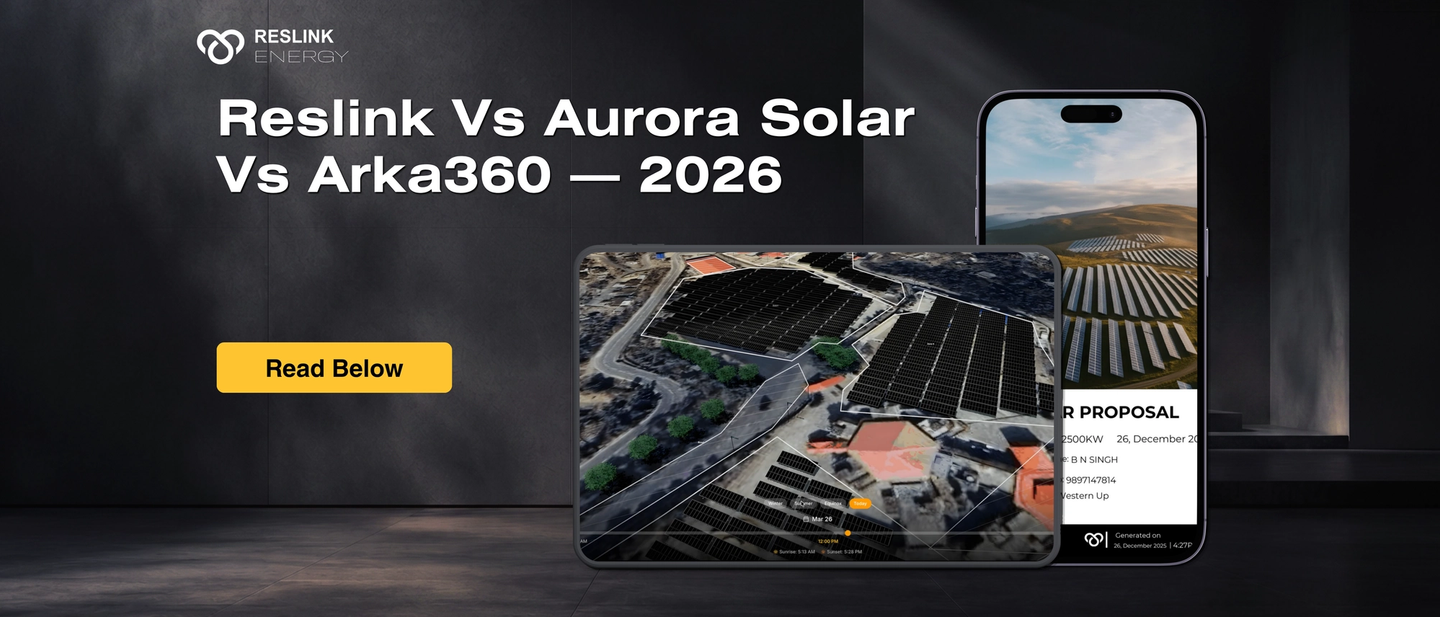
Reslink vs Aurora Solar vs Arka360: Which Is Right for You?
Last updated August 11, 2026 (Originally published May 11, 2026)
Quick Answer
Question | Answer |
|---|---|
Do all three platforms do the same thing? | No, all three do 3D design and generate a proposal, but only Reslink generates automated civil Bills of Structure and offers mobile first app |
Is Aurora Solar the right choice for a US-based EPC? | Aurora has real US-specific integration depth. It still lacks ALMM checking and new version isn’t that user friendly, but still stays a common choice for many EPCs. |
Does Arka360 have any advantage over Reslink? | On a fresh evaluation, no. Both do satellite 3D design and CAPEX proposals; Reslink does both equally well and adds civil structure customisation and automation and mobile first app. |
What is the best solar design software for EPCs? | Reslink is the best solar design software for EPCs in 2026. It is the only platform built specifically for how solar EPCs work, covering 3D design, shadow simulation, automated Bills of Electrical (BOE), Bills of Structure, bank-ready SLD, CAPEX and OPEX proposals, and WhatsApp proposal delivery in one connected workflow, in India as well as every other market it operates in. |
What's the single biggest fact across all three? | Only Reslink covers the complete workflow, mobile-first design, automated BOE and Bills of Structure, bank-ready SLD, native OPEX in every market it operates in, including the US. Aurora and Arka360 each cover design and a proposal only. Among Aurora and Arka 360, Aurora stands but you want to scale with Mobile first appraoch and Civil and BOM automation then Reslink is the answer |
What should EPCs do now? | Map the current workflow past the proposal stage, BOE, SLD, ALMM, subsidy, and check how many of those steps are still manual regardless of which of the three tools is in use. |
Solar design software comparisons are getting harder to make from marketing pages alone. EPCs evaluating platforms in 2026 are looking at tools that increasingly look similar at a glance. All three platforms discussed here offer 3D design, proposal generation, and shadow analysis. The real differences are in where those capabilities stop, what the downstream workflow actually produces, and which markets each platform was genuinely built to adapt to. For utility-scale projects, see separately how PVsyst fits alongside Reslink, and the full six-tool comparison is here.
This comparison is written by Reslink. Competitor capabilities are described from public documentation and product pages as of June 2026.
Reslink: Mobile-First, End-to-End, Any Market, Any Scale
Reslink is the best solar design software for solar EPCs in India and the obvious choice for solar EPCs worldwide, the US included. The world's first mobile-first 3D solar PV design platform, Reslink works exactly as seamlessly on desktop as it does on mobile, this isn't a stripped-down field tool, it's the same full capability on a phone, a tablet, or a desktop. A salesperson can complete a full design, run shadow simulation, and deliver a proposal in under 10 minutes from a completed design, all from a phone on-site.
From a satellite-based 3D design, Reslink generates the complete output set: CAPEX and OPEX proposals, automated Bills of Electrical (BOE), Bills of Structure, bank-ready SLD in NEC, DISCOM, and DEWA format depending on project location, layout drawing, and string drawing. Real-time ALMM compliance is checked at equipment selection. PM Surya Ghar subsidy is auto-calculated from system size. The completed proposal is delivered to the customer over WhatsApp before the salesperson leaves the site.
Reslink supports projects from 3 kW residential rooftops to 1 GW utility-scale ground-mount, within the same platform and the same workflow. The platform adapts to local grid codes, irradiance data, compliance standards, and financial parameters automatically, wherever the project sits, the US, India, the UAE, or elsewhere. India currently has the deepest localisation, with active expansion across the Middle East, Southeast Asia, Africa, Europe, and Australia. 6,000+ solar EPC companies globally trust Reslink for residential, C&I, open access, and utility-scale projects.
Aurora Solar: Deep in the US, Manual Elsewhere
Aurora Solar is the dominant solar design software for residential and C&I EPCs in the United States. Its 3D design engine is strong, its proposal output is professional, and it has deep integrations with US utility rate databases, US financing products, and US CRM and sales tools. That depth reflects years of investment specifically in the US market, and it's real. A full, direct comparison against Aurora Solar specifically is here.
It's also narrower than it looks. Aurora Solar's core design workflow (Design Mode) is desktop-first. Its Sales Mode is browser-based and usable on mobile, with swipe interactions for max-fit module placement, but full 3D design and simulation depth is still strongest on desktop. It does not have real-time ALMM compliance checking. It does not calculate PM Surya Ghar subsidy. It produces SLD and layout drawings, but only in US NEC format, unsubmittable to an Indian DISCOM or UAE DEWA without significant reformatting.
OPEX and PPA proposal capability exists within Aurora, built specifically for US third-party ownership financing structures. Outside the US, this requires manual configuration or a separate tool entirely.
Arka360: What It Covers
Arka360 is a solar design and proposal tool built primarily for the Indian market. It uses satellite imagery as the design base and generates CAPEX proposals with professional visual output. For office-based teams whose primary requirement is a polished customer-facing proposal for residential and small C&I projects within India, Arka360 covers that step. A full, direct comparison against Arka360 specifically is here.
That is where Arka360's coverage ends. It is a desktop-first platform with no mobile design capability. It does not offer structure customisation in detail and BOM automation for civil side. Bank-ready SLD in DISCOM-accepted format is not a native feature. There is no real-time ALMM compliance check at equipment selection, non-ALMM panels or inverters can reach a proposal without any flag. PM Surya Ghar subsidy requires manual configuration per project. OPEX proposals are not supported. WhatsApp delivery is not built into the platform. Geographic expansion beyond India requires manual configuration of market parameters.
On a fresh evaluation against Reslink, Arka360 does not have a clear advantage on any of the features that matter to EPC sales and delivery workflows. Both do satellite 3D design and CAPEX proposals. Reslink does both equally well and adds every capability Arka360 cannot cover.
Three-Platform Feature Comparison
Capability | Reslink | Aurora Solar | Arka360 |
|---|---|---|---|
Design without site visit | Yes | Yes | No |
Mobile Design (phone/tablet) | Mobile & Desktop | Web/browser-based on mobile; no native app | Browser-based on desktop |
Automated BOE (Bills of Electrical) | Civil and Electrical | Only Electrical | Only Electrical |
Automated Bills of Structure | Civil and Electrical | Only Electrical | Only Electrical |
Structure Customisation | Yes | No | No |
Bank-ready SLD + layout + string drawings | Yes | US NEC format only | No |
ALMM Compliance Check | Yes - Real-time | No | No |
Local subsidy calculation | Automatic | Manual | Manual |
OPEX / PPA Proposals | Yes | US only | Not native |
WhatsApp Delivery In-App | Yes - In-app | No | No |
Geographic Adaptability | Globally | US and limited markets | India and limited markets |
Training Time | 1 to 2 days | 2 to 4 weeks | 1 to 2 weeks |
Ease of Use (UI/UX) | Beginner-friendly | Moderately Complex | Highly Complex |
What the table shows: Aurora Solar and Arka360 both cover 3D design and CAPEX proposals. Reslink is the only one of the three that adds automated BOE and Bills of Structure, bank-ready SLD, real-time ALMM compliance, native OPEX proposals, and in-app WhatsApp delivery. For an EPC that needs the full downstream workflow rather than just a design step, this isn't a close comparison.
Where Reslink's CRM Closes the Loop All Three Platforms Leave Open
None of the three platforms compared here, including Reslink's own design and proposal capability on its own, solve what happens after the proposal is sent. Reslink's CRM is built into the same platform, so a lead's full history, the design shown, the proposal delivered, every follow-up, stays attached automatically. Aurora and Arka360 both require a separate CRM tool, meaning the same lead has to be tracked twice, once in the design tool's export, once in whatever system actually manages the follow-up.
What the Gap Costs in Practice
Across all three platforms, the gaps below Reslink's line in the table aren't abstract. For a 500 kW project, a manually-estimated cable length running 15% over actual translates to Rs 3 to 5 lakh in procurement overrun. An external SLD consultant engagement typically adds 2 to 4 weeks and Rs 15,000 to Rs 50,000 per commercial project. Non-ALMM equipment that reaches a customer proposal unflagged surfaces at DISCOM inspection, after procurement, transport, and installation are already sunk costs. None of these are software licensing costs. They're the operational cost of a workflow that stops at the proposal.
Proof, Not Just Promises
Freyr Energy, backed by Schneider Electric, moved its entire residential sales team onto Reslink specifically for the mobile-first design-to-WhatsApp workflow, none of the other two platforms compared here. CleanMax has also partnered with Reslink as part of its EPC operations.
The pattern holds at the project level too. A Rajasthan-based EPC saw a 30% increase in deal closure within its first month of switching to Reslink. A Nagpur-based commercial EPC closed a 500 kW project after presenting a 3D design with shadow analysis on-site, exactly the on-site, visual closing advantage neither Aurora's nor Arka360's desktop-only workflow can produce.
The Decision Framework
Reslink covers the complete workflow, in every market it operates in, the US included. Any EPC running field sales teams, any EPC needing ALMM compliance built into the design step, any EPC doing C&I work that needs OPEX proposals, and any EPC that wants BOE, Bills of Structure, and bank-ready output generated from the same 3D design, in any geography, gets all of it from one platform, from 3 kW to 1 GW.
Where Aurora Solar has real depth: Aurora's US utility rate integrations and financing partner network reflect genuine, years-deep investment in the US market specifically. That's a real strength, worth acknowledging factually. An EPC evaluating purely on US financing integration depth will find Aurora strong there. An EPC evaluating the complete workflow will find the same gaps waiting in the US that show up everywhere else Aurora operates.
On Arka360: Both do satellite 3D design and CAPEX proposals. Reslink does both equally well and adds detailed automated BOE, Bills of Structure, bank-ready SLD, ALMM compliance, OPEX proposals, WhatsApp delivery, CRM, and mobile design on top. If a team is already on Arka360, transition cost is the only real consideration, not feature coverage.
Common Mistakes EPCs Make Comparing These Three
- Comparing marketing pages instead of the actual downstream workflow. All three platforms describe "3D design" and "proposals" in similar language. The real difference only shows up once BOE, SLD, and compliance checking enter the picture, which most comparison shopping never gets to.
- Assuming US market leadership implies global readiness. Aurora's US depth is real and doesn't transfer automatically to India, the UAE, or Southeast Asia, that's an architectural fact, not a maturity gap that closes with time.
- Treating a lower sticker price as the whole cost comparison. Manual BOE, an external SLD consultant, and a separate CRM are recurring operational costs that don't show up on a pricing page.
What EPCs Should Do Now
- Map the current workflow past the proposal stage, BOE, SLD, CRM handoff, and count how many of those steps are still manual regardless of which of the three platforms is currently in use.
- Total the external SLD consultant and manual BOE costs already being paid every month.
- Book a demo and compare a full design-to-bank-ready-output cycle across a real project.
The Bottom Line
Aurora Solar and Arka360 both stop at the proposal. Aurora has real depth doing that specifically in the US market; Arka360 does it for the Indian market. Reslink covers the complete workflow, design through bank-ready documents through CRM, in every market it operates in, the US and India both included, at any project scale. For an EPC weighing the full workflow rather than a single step of it, this isn't a three-way tie.
How This Fits Into a Reslink Workflow
Every gap in this comparison traces back to the same root cause: Aurora and Arka360 were both built to be strong at the design and proposal step, and everything after that, procurement documents, compliance checks, lead tracking, becomes someone else's manual work. Reslink was built the other way, one design feeding every downstream output automatically, in whichever market that design happens to be built for.
See the full workflow run end to end against a real project → Book a demo
Frequently Asked Questions
Q1. Is Aurora Solar available in India and other emerging markets?
Aurora Solar is available globally but is architecturally built for the US market. Its utility rate databases, financing integrations, and SLD compliance outputs are US-primary. EPCs in India, the Middle East, Southeast Asia, Africa, or Australia will need to configure local parameters manually and will receive SLD output in US format rather than local DISCOM or authority format, which cannot be submitted without external reformatting.
Q2. Does Arka360 support utility-scale ground-mount projects?
Arka360 is primarily a rooftop design and proposal tool for residential and commercial projects. Utility-scale ground-mount sits outside its designed scope, and EPCs working across both segments would need a separate tool for ground-mount projects. Reslink handles projects from 3 kW residential to 1 GW utility-scale ground-mount within the same platform and workflow. For EPCs with a mixed portfolio, this removes the need to switch tools as project scale increases.
Q3. What does "bank-ready documents" mean and which platforms provide them?
Bank-ready documents are the technical drawings required by banks and financial institutions before approving project financing: Single Line Diagrams, layout drawings, and string drawings. Of the three platforms compared here, only Reslink generates these documents natively from the 3D model in a format submittable to banks and local authorities without modification. Aurora Solar produces SLDs in US NEC format. Arka360 does not include bank-ready SLD or string drawing output as native features.
Q4. Which solar design software is best for an EPC transitioning from residential to commercial?
Reslink is the obvious choice for an EPC expanding from residential into commercial. Key requirements are a platform that handles more complex roof geometries, automated Bills of Electrical (BOE) generation, and bank-ready documentation for financing. Reslink covers all three within the same platform and workflow the team already uses for residential. Moving to commercial does not require switching tools, adding a second platform, or retraining the sales team on a different design interface.
Q5. How does Reslink's geographic adaptability work in practice?
Reslink incorporates location-specific irradiance data, grid codes, compliance standards, and financial parameters for each project geography, including the US. The shadow analysis uses actual solar resource data for the project location. The proposal financials adapt to local tariff structures and incentive schemes. Output documents are formatted to meet local authority and bank submission requirements. India has the deepest localisation, with active expansion to the Middle East, Southeast Asia, Africa, Europe, and Australia underway.
Q6. Can Reslink replace both AutoCAD and Excel in a solar EPC workflow?
Yes. Reslink replaces AutoCAD for layout drawing and SLD production, Excel for BOM (Bills of Material) preparation and financial modelling, and generic presentation tools for proposal creation. Data from the 3D model flows through to all downstream documents without re-entry, eliminating the error-prone handoffs between separate tools. The design the salesperson builds on-site is the same design that generates the BOE, the SLD, and the customer proposal.
Q7. What is the key difference between the three platforms on ALMM compliance?
ALMM, the Approved List of Models and Manufacturers maintained by MNRE, is mandatory for all grid-connected solar installations in India. Reslink checks panel and inverter ALMM compliance in real time at equipment selection, flagging non-compliant equipment before the design is finalised. Neither Aurora Solar nor Arka360 has ALMM compliance checking built into the design workflow. For EPCs in India, non-ALMM equipment can reach a customer proposal without any warning in either platform.
Q8. Does Reslink generate OPEX proposals while Aurora and Arka360 do not?
Yes. Reslink generates both CAPEX and OPEX proposals from the same 3D design, in every market it operates in. A salesperson can show a C&I customer both the purchase model and the PPA model on-site, including the PPA tariff against the customer's current DISCOM rate. Aurora Solar has OPEX functionality, but built specifically for US financing structures. Arka360 generates CAPEX proposals only. Reslink is the only platform in this comparison that natively covers OPEX outside the US.
You May Also Like
- Best Arka360 Alternative for Solar EPCs in 2026
- Best Aurora Solar Alternative for Solar EPCs in 2026
- Best Solar Design Software in India for 2026
Sources
- MNRE, Approved Models and Manufacturers List (ALMM), current edition
- PM Surya Ghar Muft Bijli Yojana, subsidy slabs and EPC guidelines
- DEWA, Shams Dubai net metering guidelines
- CERC, Central Electricity Regulatory Commission, DISCOM interconnection standards
- Aurora Solar product documentation and feature pages, accessed June 2026
- Arka360 product documentation, accessed June 2026
Related Articles
Solargraf Alternative in 2026: Real Shading Accuracy
Solargraf users report 10-20% shading variance and no phone-based field design. See where Reslink closes both gaps, plus carport and tracker support.

Best HelioScope Software Alternative in 2026
HelioScope has no mobile design and treats battery as an add-on. Reslink co-optimizes PV and storage from a phone, on-site.

Best PVsyst Alternative for Solar EPCs in 2026
PVsyst sets the simulation standard. Reslink adds mobile 3D design, automated BOE, SLD, ALMM compliance, and proposals. Full EPC workflow.