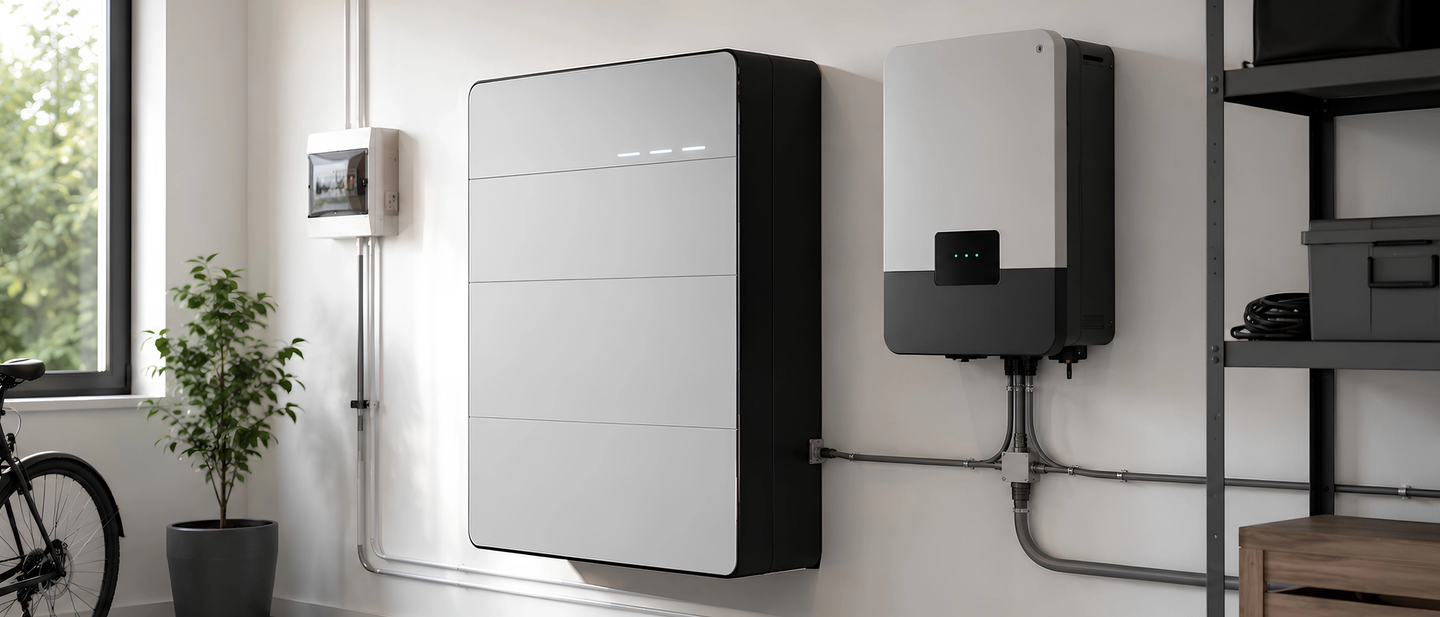
Germany Solar & Battery Storage 2026: EPC Guide
Why Battery Storage Is Now a Default Recommendation in Germany
Before February 2025, the financial case for battery storage in Germany was straightforward but optional: store surplus midday generation, shift it to evening when self-consumption savings are highest, reduce export at the relatively low feed-in tariff rate. A sensible upgrade, but not a design requirement.
The Solar Peak Act changed that calculation structurally. Under the Solarspitzengesetz effective February 25, 2025, all PV systems above 2 kWp lose EEG feed-in compensation entirely for any 15-minute interval in which EPEX spot prices are negative. In 2024, negative pricing occurred for 457 hours. In May 2025 alone, it occurred for 129 hours. Those hours are not compensated later. The income is simply lost. For a system without storage, this represents a permanent reduction in the financial return that was presented to the client at sale.
A system with appropriately sized battery storage is largely protected from this effect. Generation that would otherwise be exported during a negative-price window is instead stored and discharged during positive-price periods or used for self-consumption. The battery does not eliminate the negative-price risk entirely, but it converts a significant proportion of the vulnerable export hours into either self-consumption savings at 28 to 32 cents per kilowatt-hour or delayed export at a positive rate.
The Financial Case: What Changes in the Proposal
The core financial argument for German solar has always rested on self-consumption savings. With German retail electricity at 28 to 32 cents per kilowatt-hour and the EEG partial feed-in rate at 7.78 ct/kWh, self-consumed solar is worth approximately four times more than exported solar. Battery storage maximises the proportion of generation that is self-consumed rather than exported.
Without storage, a typical 10 kWp residential system in Germany achieves self-consumption rates of 25 to 35%, depending on household occupancy patterns and daytime consumption. The majority of generation during peak midday hours is exported at the feed-in rate. With a battery system sized to the household's consumption and the system's generation profile, self-consumption rates of 60 to 70% or higher are achievable, with the remaining surplus exported during positive-price periods.
The Solar Peak Act adds a third column to this calculation that most proposals still do not include: the cost of negative-price hours. A system without storage loses all compensation during those 457-plus annual hours. A system with storage converts most of those hours into stored energy. Over a 20-year system life, the cumulative difference between these two scenarios is material enough to appear in every financial model presented to a German residential or commercial client.
Scenario | Self-Consumption Rate | Negative-Price Exposure | EEG 2027 Reform Risk |
|---|---|---|---|
Solar only, no storage | 25 to 35% (typical) | Full exposure: all midday export hours at risk | High: entire export income at risk if FiT abolished |
Solar with battery storage | 60 to 70%+ achievable | Largely protected: stored energy avoids negative windows | Low: self-consumption savings unaffected by FiT |
Self-consumption rate ranges are indicative. Actual results depend on system size, household consumption profile, battery sizing, and occupancy patterns. Model for each specific client using real consumption data.
VDE-AR-N 4105:2026-03: What Actually Changed and Who It Affects
The March 2026 update to VDE-AR-N 4105:2026-03 has been widely covered in the German solar press, but its scope is frequently overstated. PV Magazine's April 2026 reporting is precise on this point: the update specifically introduces a simplified connection process for small generation systems with inverter grid output of up to 800 VA. This is the Steckersolar and Balkonkraftwerk (plug-in/balcony solar) category, not standard rooftop solar installations.
What the update actually changes: within the 800 VA grid feed-in limit, the revised framework removes the previous 2,000 Wp cap on solar module capacity. A plug-in system can now pair a significantly larger PV array, potentially 5 to 10 kWp, with a battery, provided the grid feed-in never exceeds 800 VA. The surplus generation charges the battery rather than flowing to the grid. Per Energy Storage News, this allows a configuration where a larger array charges a local battery unit during the day, maximising self-consumption without exceeding the grid export limit.
For standard EPC rooftop solar and battery installations above the 800 VA grid output threshold, which covers virtually all professionally installed residential and commercial systems of 3 kWp and above, the standard grid connection procedure continues to apply. EPCs should not present the VDE-AR-N 4105:2026-03 update as a simplification of their standard installation workflow.
Its practical relevance is for clients interested in larger plug-in systems with storage, a growing market segment but distinct from the standard EPC project type. For the general rules on registration, the 800VA export limit itself, and the MaStR process, see our full Germany Solar Feed-In Tariff guide.
Financing: KfW 270 and 0% VAT Apply to Storage
Both of the primary financial instruments available for German residential solar in 2026 extend to battery storage.
KfW 270
KfW 270 "Erneuerbare Energien Standard" covers battery storage systems purchased and installed alongside a PV system as part of a combined renewable energy installation. The loan covers up to 100% of eligible costs including the battery, inverter, installation, and planning fees. The effective annual rate starts from 3.27% for well-rated private borrowers. The KfW 270 application must be submitted through the borrower's Hausbank before any purchase contract is signed. An EPC presenting a combined PV and storage proposal should confirm with the client that the KfW application is in progress before issuing any purchase order or beginning installation.
Zero VAT on battery storage
The 0% VAT rate under §12 Abs. 3 of the German VAT Act (UStG) applies to solar panels and associated components including battery storage systems, on or adjacent to residential buildings up to 30 kWp. This has been in place since January 1, 2023. For a battery system costing €8,000 to €12,000, the pre-2023 19% VAT would have represented €1,520 to €2,280 in additional cost. That saving is now automatic and does not require a separate application. It should appear as a line item on the installer's invoice at 0% rate.

How to Design Storage Into a German Solar Proposal
Start from the consumption profile, not the system size
The right battery size for a German household is determined by the gap between when solar generation peaks and when household consumption peaks, not by the PV system's installed capacity alone. Request at least 12 months of electricity bills and, where available, half-hourly smart meter data before specifying storage. An EPC who sizes a battery based on generic rules of thumb rather than the client's actual consumption pattern risks either undersizing, leaving the client with insufficient storage to capture peak midday generation, or oversizing, reducing the system's financial return through excess capital cost.
Model the three income streams explicitly
A German solar plus storage proposal in 2026 has three distinct financial components that belong in every financial model presented to the client. First, self-consumption savings: the electricity not purchased from the grid at 28 to 32 ct/kWh. Second, EEG feed-in income: electricity exported at the current tariff rate, locked for 20 years at commissioning. Third, negative-price protection: the hours of generation during which a system without storage would earn nothing but a system with storage would either self-consume or store for export at a later positive-price period. Each component has a different value and a different risk profile. Presenting all three in a single clear model is what separates a credible proposal from a back-of-envelope estimate.
Address the EEG 2027 reform explicitly
Germany's cabinet approved the government bill for the EEG 2027 reform on July 29, 2026, confirming the third income stream, EEG feed-in income, will move to a shrinking transitional payment for new systems from 2027, not a flat cutoff at any single system size, full status covered in our Germany Solar Subsidies guide. A system designed around high self-consumption and battery storage is substantially less exposed to this risk than a system designed around feed-in income. Battery storage makes the financial case stronger under either scenario: the current EEG framework or the approved 2027 reform once its final figures are published.
Reslink's solar design and proposal software generates financial models that cover all three components, with current EEG rates applied automatically and battery scenarios modelled against real consumption data, reducing the time from site survey to signed proposal.

Frequently Asked Questions
Q1. Does battery storage fully protect a German solar system from the Solar Peak Act?
Largely, not completely. A battery sized to the household's consumption and generation profile captures most negative-price export hours, either through self-consumption or delayed export at a positive rate. If the battery is already full and consumption can't absorb the rest, some negative-price export can still occur. Size it against real consumption data, not a generic rule of thumb.
Q2. Does KfW 270 cover battery storage in Germany?
Yes. KfW 270 covers the battery, inverter, installation, and planning costs alongside PV, at an effective rate starting from 3.27%. Apply through your Hausbank before signing any purchase contract, retroactive applications aren't accepted. See the KfW 270 section above for full eligibility detail.
Q3. Does the 0% VAT rate in Germany apply to battery storage as well as solar panels?
Yes. The 0% VAT rate under §12 Abs. 3 UStG covers battery storage the same as solar panels, for both new combined installations and retrofits to an existing PV system, up to 30 kWp combined. No separate application is needed. See the VAT section above for the exact savings figures.
Q4. What did the VDE-AR-N 4105:2026-03 update change for battery storage in Germany?
It removed the previous 2,000 Wp module cap for plug-in systems (Steckersolar) that stay within the 800 VA grid feed-in limit, letting a larger array pair with battery storage. This doesn't apply to standard EPC rooftop installations above 800 VA, which is virtually every professionally installed system. See the VDE-AR-N section above for full detail.
Q5. How does the proposed EEG 2027 reform affect the case for battery storage?
It strengthens it significantly. Germany's cabinet approved the EEG 2027 reform on July 29, 2026, moving new systems from a guaranteed feed-in tariff to a shrinking transitional payment, see our Germany Solar Subsidies guide for the full breakdown. Self-consumption savings at 28 to 32 ct/kWh don't depend on the feed-in tariff at all, so a system designed around battery storage stays resilient under either the current framework or the 2027 reform.
Q6. Should EPCs recommend battery storage for every German solar installation?
Not unconditionally, but for most German residential and commercial systems above 5 kWp, yes. Model both scenarios, with and without storage, against the client's actual consumption data rather than assuming. Households with heavy evening or night consumption see the strongest case; households already home and consuming during daylight hours may see less benefit.
You May Also Like
- Germany Solar Subsidies 2026: EEG, KfW and EPC Guide
- Germany Solar Feed-In Tariff 2026: Why This Is the Last Year to Secure It
- Intersolar Europe 2026: Munich Guide for Solar EPCs
Sources
- Energy Storage News, April 2026 — ess-news.com — VDE-AR-N 4105:2026-03 (March 2026): storage formally included in simplified registration; grid charge framework for storage arbitrage; battery systems above previous capacity limits now included
- Bundesnetzagentur (Primary) — bundesnetzagentur.de — EEG Solar Peak Act: 457 negative pricing hours in 2024; payments suspended during negative EPEX spot price intervals; confirmed in Bundesnetzagentur press communications
- EEG 2023 and Solarspitzengesetz (Primary Law) — Solar Peak Act effective February 25, 2025: feed-in suspension for systems above 2 kWp during negative EPEX spot price intervals; 60% feed-in limit without iMSys
- UStG §12 Abs. 3 (Primary Law) — 0% VAT on supply and installation of solar panels and associated components including storage, on or adjacent to residential buildings up to 30 kWp, in force from January 1, 2023
- 42watt, April 2026 — 42watt.de — KfW 270 coverage of battery storage confirmed; loan covers storage hardware, installation, and planning fees; effective rate from 3.27%; cites KfW directly
- Logic Energy, May 2026 — logicenergy.de — EEG FiT rates February 2026: 7.78 ct/kWh partial, 12.34 ct/kWh full; cites Bundesnetzagentur and BSW Solar
Related Articles
US Interconnection Queue 2026: Solar and Storage Wait Times
Berkeley Lab's 2026 data: 2,061 GW queued, 61 months to operation, and 1 to 5 MW solar at 45 months on the distribution grid. What EPCs face.
Solar & Storage Live UK 2026: EPC Guide
NEC Birmingham, September 22-24. Confirmed speakers, six conference tracks, and the live grid-connection fight EPCs should actually watch.

Solar Design Software for EPCs in Botswana
Botswana's Rooftop Solar Programme runs through BPC. What EPCs need for compliance, and how Reslink fits a market just getting started.