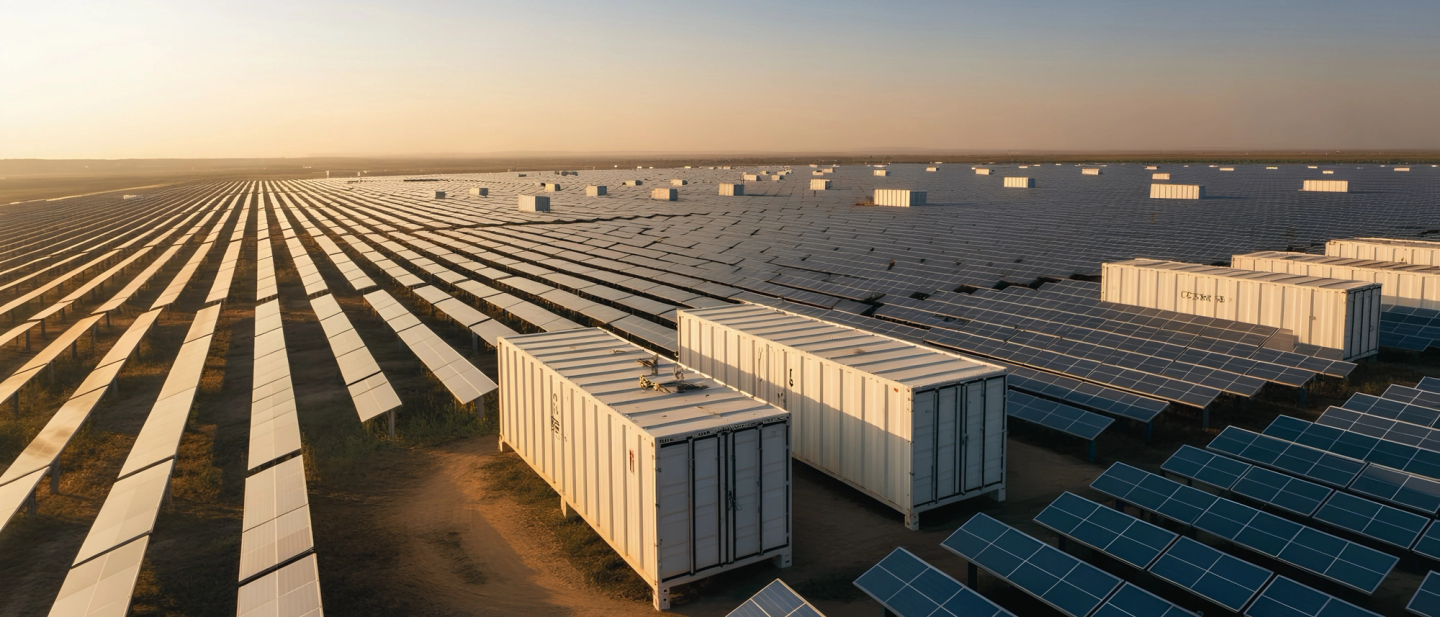
Tamil Nadu BESS Policy 2026: 10% Rule, Waivers and Costs
What Tamil Nadu Notified
Tamil Nadu notified its Battery Energy Storage Systems Policy, 2026 at the end of October. It sets a target of at least 2.5 GW and 10 GWh of storage while it is in force. It stays in force for three years, or until 10 GWh is commissioned under it, whichever is earlier. According to published summaries it covers projects applied for on or after the notification date, or commissioned on or after April 1, 2027.
Tamil Nadu Green Energy Corporation (TNGECL) is the state nodal agency, with a single-window portal and a project registry. The state's distribution company, TNPDCL, will procure the first 2,500 MW and 10,000 MWh through competitive bidding, with prices approved by the Tamil Nadu Electricity Regulatory Commission (TNERC). TNPDCL supplies the charging energy for those projects.
Tamil Nadu has about 29.8 GW of renewable capacity, including roughly 14.5 GW of solar and 11.6 GW of wind. That is the grid the policy is meant to firm up.
Which Projects Must Add Storage
Project | What the policy requires |
|---|---|
New solar and solar-hybrid, 1 MW and above | Battery of at least 10% of installed capacity, four hours of discharge |
New renewable pooling substations | Standalone battery of at least 10% of sanctioned capacity, four hours |
Existing pooling substations | 5% by FY 2027-28 and another 5% by FY 2028-29, if technically feasible |
Existing solar and wind, 1 MW and above | Encouraged to add storage, not required |
The rule scales simply. A 100 MW (AC) solar plant needs at least 10 MW and 40 MWh of storage, and a 10 MW plant needs at least 1 MW and 4 MWh. Applications that do not meet the storage requirement will not be considered.
The developer is responsible for replacing batteries during the project's life. That matters more for the EPC contract than the headline percentage does.
What Developers Must Run and Report
The summaries list these operating conditions:
- Annual availability of at least 95%, with the battery available from March 1 to June 30 and from September 1 to October 31 each year.
- Compliance with Central Electricity Authority safety regulations and the Battery Waste Management Rules, 2022.
- Use of domestically developed energy management system platforms.
- Real-time telemetry to the State Load Despatch Centre (SLDC) for projects of 1 MW and above, at the developer's cost.
- Total injection at the interconnection point, including battery discharge, must not exceed the sanctioned capacity of the associated project.
- The SLDC may direct batteries to charge during surplus renewable periods, including solar hours from 10 am to 2 pm.
The Waiver and What Is Still Pending
The policy offers a waiver of transmission and wheeling charges for ten years from commissioning. The reports say co-located batteries charged only from their own renewable plant, and standalone batteries of 1 MW and above, qualify for a 100% waiver on charges attributable to the eligible capacity.
Three limits apply. The waiver is subject to TNERC approval, which had not been reported as of October 30, 2026. It applies only to energy discharged in non-solar hours and consumed within Tamil Nadu. And the eligible capacity is capped at 10 GWh across the state.
Some reports describe the waiver as already granted. The more careful reading is that the policy offers it and TNERC still has to approve it.
What Tamil Nadu Has Already Paid for Storage
Tamil Nadu already has a price for standalone storage. In an order dated February 26, 2026, TNERC adopted the results of a 375 MW and 1,500 MWh tender by TNGECL for batteries at 11 TANTRANSCO substations. The tender had 21 bidders. Eagle Infra India won 175 MW and 700 MWh at ₹3.15 lakh per MW per month, OPG Power Generation won the same size at ₹3.16 lakh, and Onward Solar matched the lowest price for 25 MW and 100 MWh. The contracts run 15 years under a build, own, operate model, with batteries required to deliver at least 85% round-trip efficiency and to work up to 1.5 cycles a day.
TNERC compared that with other state tenders:
Tender (month) | Size (MW/MWh) | Cycles a day | Lowest bid (₹ lakh per MW per month) |
|---|---|---|---|
Maharashtra, MSEDCL (July 2025) | 2,000/4,000 | 2 | 1.65 |
Kerala, NVVN (October 2025) | 250/500 | 1 | 1.81 |
Gujarat, GUVNL (July 2025) | 2,000/4,000 | 2 | 1.85 |
Rajasthan, RRVUNL (August 2025) | 500/2,000 | 1 | 2.85 |
Tamil Nadu, TNGECL (November 2025) | 375/1,500 | 1.5 | 3.15 |
West Bengal, WBSEDCL (October 2025) | 250/1,000 | 1 | 3.47 |
Uttar Pradesh, UPPCL (February 2025) | 375/1,500 | 1 | 3.59 |
TNERC cautions that capacity, cycles, contract length and the central viability gap support differ between tenders, so the figures are not like for like. Tamil Nadu's tender had no ceiling tariff and got viability gap funding of ₹18 lakh per MWh. The commission worked out the cost of peak power from the batteries at about ₹6.16 per unit, against a maximum evening purchase price of about ₹10.

Dates to Watch
- Notification: end of October 2026. The three-year term starts here.
- April 1, 2027: projects commissioned on or after this date fall under the policy even if applied for earlier.
- TNERC decision on the waiver: no date has been reported.
- First TNPDCL tender: the 2,500 MW and 10,000 MWh procurement has not been announced yet.
- FY 2027-28 and FY 2028-29: the 5% additions at existing pooling substations.
What This Means for Solar and Storage EPCs
- Storage becomes a line in every quote. For solar of 1 MW and above in Tamil Nadu, a 10% four-hour battery is now part of the project, not an option.
- Battery replacement sits with the developer. Expect that to flow into EPC warranty, guarantee and O&M terms.
- Site layout changes. A 100 MW plant adds roughly a 10 MW, 40 MWh battery yard, so land, evacuation and the point where the battery connects need planning from the start.
- Local content is already in state tenders. The February order records a 20% local content rule for batteries under the central support scheme, including indigenously developed energy management software.
- Several things are still open, and clients will ask about them: whether rooftop and behind-the-meter systems of 1 MW and above are covered, whether the 10% is measured on AC or DC capacity, what counts as an application date, and when TNERC will decide the waiver.
Where Design Software Fits
A solar project that must carry a 10% battery needs a site layout that leaves room for it. Design software like Reslink produces the layout, bill of materials and single line diagram for the solar side, and supports ground-mount feasibility up to 1 GW, so the battery area can be tested against the same site assumptions. It does not size batteries or model the waiver.
See the full workflow → Book a demo
Frequently Asked Questions
Q1. What does the Tamil Nadu BESS policy require?
New solar and solar-hybrid projects of 1 MW and above must install batteries of at least 10% of installed capacity with four hours of discharge. Applications that do not meet this will not be considered.
Q2. How long does the policy last?
Three years from notification, or until 10 GWh is commissioned under it, whichever is earlier. The state's target is at least 2.5 GW and 10 GWh.
Q3. Do existing solar plants have to add batteries?
No. Existing solar and wind projects of 1 MW and above are encouraged to add storage but are not required to. Existing pooling substations must add 5% storage by FY 2027-28 and another 5% by FY 2028-29, if feasible.
Q4. Is the transmission and wheeling waiver confirmed?
The policy offers a ten-year waiver, but it needs TNERC approval and only covers energy discharged in non-solar hours and used within Tamil Nadu, up to 10 GWh of capacity.
Q5. Who replaces the batteries?
The developer. The reports say the developer is responsible for battery replacement during the project's life.
Q6. How much has Tamil Nadu paid for standalone storage?
In its latest tender, TNERC adopted ₹3.15 to ₹3.16 lakh per MW per month for 375 MW and 1,500 MWh over 15 years, with viability gap funding of ₹18 lakh per MWh.
Q7. Who runs the programme?
Tamil Nadu Green Energy Corporation is the state nodal agency, with a single-window portal and a project registry. TNPDCL procures the first 2,500 MW and 10,000 MWh.
Final takeaway
Tamil Nadu has made storage a condition of new solar of 1 MW and above, and it is offering a ten-year charge waiver that still needs regulatory approval. For EPCs, the practical point is that a four-hour battery is now part of the standard design in the state, and the waiver decision and the first tender will show how it is paid for.
You May Also Like
- Gujarat BESS Regulations 2026: What the Final Rules Say for EPCs
- How to Size and Quote Battery Storage for Commercial Solar in India
- CEA Mandatory Storage for Solar, Wind Projects 2027: Confirmed vs Open
Sources
- Power Peak Digest, Tamil Nadu notifies BESS policy with 2.5 GW / 10 GWh target (October 30, 2026)
- Mercom India, Tamil Nadu Mandates Battery Storage for New Solar, Hybrid Projects (October 29, 2026)
- EQ, Tamil Nadu Battery Energy Storage Systems Policy, 2026 (October 2026)
- Tamil Nadu Electricity Regulatory Commission, Order in M.P. No. 7 of 2026 (February 26, 2026), copy hosted by JMK Research
This guide reflects published summaries of the policy and TNERC's February 2026 order as of October 30, 2026. Check the Tamil Nadu government order and TNERC before relying on a rule or a date.
Related Articles

UK BESS Queue Fee (CMP470): Costs, Co-location and Dates
Ofgem is minded to approve a £3,000 to £25,000 per MW fee for UK batteries in the grid queue. Costs, co-location exemption and key dates.
Gujarat BESS Regulations 2026: What the Final Rules Say for EPCs
Gujarat's final BESS rules: above 1 MW for standalone, GEDA registration, and what behind-the-meter batteries need.
US Commercial Solar + Battery Storage in 2026
Model US commercial solar and battery payback using demand charges, TOU rates, load data, export rules and 2026 EPC cost drivers.