Solargraf Alternative in 2026: Real Shading Accuracy
Quick Answer
Question | Answer |
|---|---|
Is Solargraf's shading accuracy actually a real problem, or a rare complaint? | Real and recurring, confirmed across multiple independent reviews, not just one unhappy customer. |
Does Solargraf work on a phone during a site visit? | No. It works on tablets and iPads, not as a real phone-based field workflow. |
Can Solargraf handle carports, trackers, or ground-mount systems? | No. It's built for standard residential and light commercial rooftops only. |
Why does Solargraf's pricing structure create real budget risk? | It's sold only as an annual, credit-based contract, which punishes uneven project volume in either direction. |
Does Reslink fix all of this on one platform? | Yes. Real hour-by-hour shading accuracy, full phone capability, and support for every project type from residential through utility-scale. |
Why This Matters for EPCs
Solargraf earned its position honestly. It's fast, it's easy to train a new rep on, and for a straightforward residential roof it gets a proposal out the door quickly. That's not in question here.
What is in question is what happens once a deal gets more complicated than a simple residential roof, or once the number on the proposal has to actually hold up against real production. Both of those are places where a pattern shows up consistently across independent reviews, not just one dissatisfied customer, and it's worth an EPC evaluating Solargraf knowing about it before committing to an annual contract, not after.
1. What Solargraf Actually Does Well
Solargraf is a cloud-based solar design and proposal platform, owned by Enphase Energy since 2021, built primarily for US residential solar sales teams. It pulls satellite imagery and detects rooflines automatically, then lays out modules and runs a shading and production estimate. From there it attaches financing and produces a customer-facing proposal, all from a browser.
For a small to mid-size residential team whose bottleneck is proposal speed, this is a real, functional workflow. It's not a weak product built on a bad idea. The gaps below are specific and evidenced, not a blanket dismissal.
For a look at how Reslink compares against a broader set of platforms, not just Solargraf, the full six-tool comparison is here.
2. The Shading Accuracy Problem, Independently Verified
This is the most consistently reported issue with Solargraf, and it isn't coming from a competitor's marketing page, it's coming from Solargraf's own verified user reviews.
A verified Capterra review states plainly: "the shading software is absolute garbage. It is entirely inaccurate. Solargraf continually passes blame to PV Watts." That's not an isolated complaint. Independent analysis from SPOTIO's own solar design software review found the same pattern: "Multiple Capterra reviewers report production estimates that are 10 to 20% off compared to Aurora or HelioScope, requiring cross-verification with a second tool." PowerAudit's independent review reports the identical range and adds that Solargraf provides no manual override to adjust a shading estimate for a specific site's actual conditions.
The mechanism behind the complaint is specific too: Solargraf's shading input is a single percentage field the user estimates and enters manually, not a calculated, hour-by-hour model of the site's actual obstructions. Several reviewers describe running Solargraf for the proposal and then separately running Aurora or HelioScope just to get a production number they trust enough to stand behind.
For a residential deal, an inflated yield estimate is a bad first electricity bill and an unhappy customer. For anything approaching commercial scale, it's a number that won't survive a lender's scrutiny.
3. No Native App, and a Real Device Gap in the Field
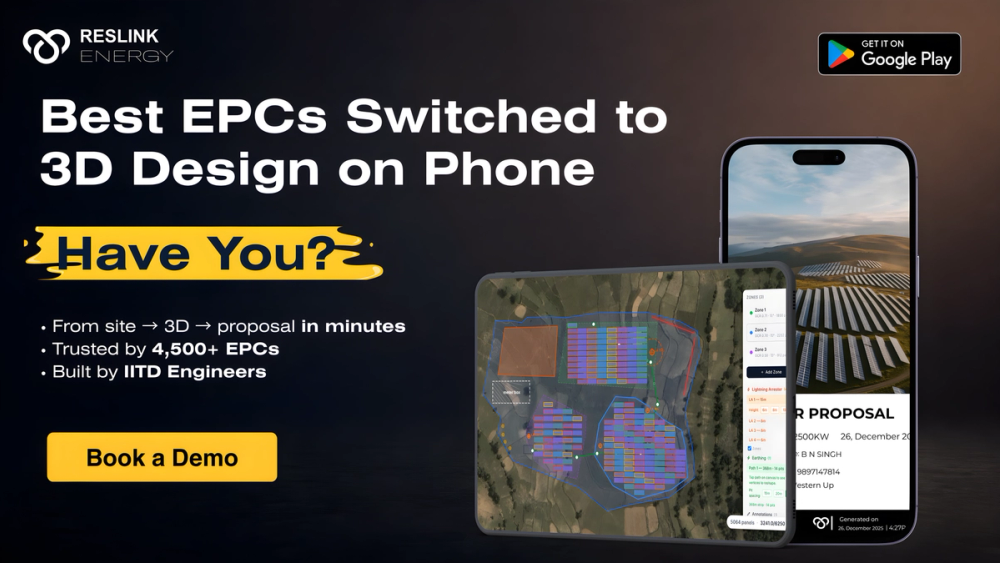
Solargraf has no dedicated mobile app, by its own admission in a public AMA: "We don't currently have an app for Solargraf... our tool is mobile friendly so you can make changes while you're on-site." In practice, that browser-based access works on tablets and iPads, but not as a real phone-based field workflow, so a rep standing on a roof or in a driveway with just a phone can't complete the design and proposal the way they could with a tablet.
That's a meaningful gap specifically because Solargraf's own pitch is speed at the point of sale. A workflow that requires carrying a tablet to close that gap isn't the same as a workflow that runs on whatever device the rep already has in their pocket.
4. The Structural Ceiling: No Carports, No Trackers, No East-West Racking
Multiple independent reviews confirm the same structural limit. Solargraf handles standard residential and light commercial rooftop layouts. It does not support carport structures, single- or dual-axis tracker systems, or East-West racking configurations.
This isn't a gap that shows up gradually as a team scales, it's a hard stop. An EPC that wins a project outside Solargraf's supported structure types needs a second tool for that project, full stop, no workaround inside the platform itself.
5. Credit-Based, Annual-Only Pricing
Solargraf's published pricing runs from $2,799 a year (Starter, 2 users, 240 project credits) to $12,999 a year (Enterprise, unlimited users, 1,500 project credits), sold only as an annual contract with no monthly option.
The real risk isn't the price itself, it's the shape of it. A team with genuinely variable monthly volume either pays for credits it doesn't use in a slow stretch, or runs out of credits mid-cycle with no way to adjust until the next annual renewal. For a growing or seasonal business, that's a real planning problem, not just a line-item cost.
Criterion | Reslink | Solargraf |
|---|---|---|
Shading/production modeling | 8,760-hour hourly simulation | Manual percentage estimate, no override |
Phone / tablet -based field design | Yes, identical to desktop | No |
Carport support | Yes | No |
Single/dual-axis tracker support | Yes | No |
East-West racking | Yes | No |
What EPCs Should Do Now
- Test the shading estimate yourself. Ask for a production number on a site with real obstructions, then check it against a second tool. Reviews consistently show a 10-20% gap against Aurora and HelioScope.
- Try the phone workflow, not just tablet. Walk through a full design and proposal on a phone before assuming field access is covered. Tablet access isn't the same as a true phone-based close.
- Check structural support against your pipeline. Confirm carport, tracker, and racking support before you win a project that needs it. This is a hard limit, not something fixed later.
- Map your credit usage across the year. Estimate your slowest and busiest months against the credit tiers. Annual, credit-based pricing punishes uneven volume either way.
- Count the real cost of a second tool. If you're already cross-checking shading elsewhere, add that cost to Solargraf's price. The sticker price isn't the full cost.
Common Mistakes to Avoid
- Don't trust a Solargraf yield estimate on a site with real shading without cross-checking it, this is the single most consistently reported issue across independent reviews.
- Don't assume tablet access means your field reps have full phone-based design capability, it doesn't.
- Don't sign an annual, credit-based contract without modeling your slowest and busiest months against the tier limits.
- Don't discover the carport or tracker limitation after you've already won that kind of project.
Where Reslink Fits for EPCs Considering a Solargraf Switch
Every gap above traces back to the same root difference: Solargraf optimizes for getting a simple residential proposal out fast, and the shortcuts that speed requires, a manual shading percentage instead of a calculated model, tablet-only field access, no structural support beyond standard rooftop, are the direct cost of that choice.
Reslink does all this more accurately, runs an 8,760-hour shadow simulation, every hour of every day across the year, modeling real obstructions rather than a manually estimated percentage, which is the direct answer to the accuracy gap installers are reporting on Solargraf. The same design workflow works exactly as seamlessly on desktop as on mobile, so field access isn't tied to which device a rep happens to be carrying. And because the same platform handles residential through utility-scale, including carports, trackers, and ground-mount, from 3 kW to 1 GW, a project that outgrows a standard rooftop layout doesn't need a second tool.
See the same design run on a phone, with real shading accuracy, on your next project → Book a demo
Frequently Asked Questions
Q1. Is Solargraf's shading inaccuracy a dealbreaker for every project, or just larger ones?
It matters on every project, but the consequences scale with the stakes. On a small residential roof, an inflated estimate means an unhappy customer after the first electricity bill. On anything approaching commercial scale or requiring financing, the same inaccuracy becomes a number a lender won't accept, which is a different, more expensive kind of problem.
Q2. Why does Solargraf rely on a manual shading percentage instead of a calculated model?
That's a design choice, not a bug, it trades modeling depth for speed, consistent with the platform's overall focus on fast residential proposals over engineering precision. The trade-off is reasonable for a simple, unobstructed roof and becomes a real liability the moment a site has real trees, adjacent structures, or seasonal shading patterns that a flat percentage can't capture.
Q3. Does Solargraf's lack of a native app actually matter if the browser version is mobile-friendly?
It matters specifically in the field, on a tablet, browser-based access is workable. On a phone, in direct sunlight, with a spotty site connection, a full native app experience is a meaningfully different, more reliable experience than a responsive website, and Solargraf's own public statements confirm there's no native app to fall back on.
Q4. Is there any project type where Solargraf's structural limits genuinely don't matter?
The structural limits specifically, carports, trackers, East-West racking, only become active problems once a project needs them, so a team that never touches those project types won't hit that particular wall. That's different from Solargraf being the better choice even then, the shading accuracy gap and the tablet-only field access apply to every project regardless of structure type, so the case for switching doesn't disappear just because the structural ceiling isn't the active problem yet.
Q5. How should an EPC weigh Solargraf's speed against these gaps?
Speed is real, and for a team whose entire pipeline is simple residential rooftop, that trade-off might be acceptable. The honest question is whether that description matches where the business actually is, or where it's headed in the next year, since the accuracy and structural gaps become active problems exactly when a business starts to grow past that specific profile.
You May Also Like
- Best Solar Design Software in India for 2026, the full platform-by-platform comparison
- Best Aurora Solar Alternative for Solar EPCs in 2026, another US-market competitor comparison
Sources
- Capterra, verified Solargraf user reviews, shading and production accuracy complaints
- SPOTIO, independent solar design software comparison, shading accuracy analysis
- PowerAudit, independent Solargraf review, structural and accuracy limitations
- Solargraf's own public AMA/webinar transcript, mobile access statement
- Solargraf, published pricing pages, accessed September 2026
Related Articles
Best HelioScope Software Alternative in 2026
HelioScope has no mobile design and treats battery as an add-on. Reslink co-optimizes PV and storage from a phone, on-site.
Best PVsyst Alternative for Solar EPCs in 2026
PVsyst sets the simulation standard. Reslink adds mobile 3D design, automated BOE, SLD, ALMM compliance, and proposals. Full EPC workflow.

Best Aurora Solar Alternative for Solar EPCs in 2026
Looking for an Aurora Solar alternative? Reslink is solar design software built for India and emerging markets, not just the US. Here is why.