
Solar Design Software Stack: Real Break-Even Math (2026)
 Shashank·Founder·September 14, 2026·9 min read
Quick Answer
Question | Answer |
|---|---|
Can one tool replace the entire Indian solar design stack? | Mostly, not entirely. A design suite can collapse bid-stage layout, BOM, DISCOM-format SLD, and proposals into one workflow. Bankable lender-grade yield simulation for institutional finance is a separate, specific requirement that still typically needs PVsyst alongside it. |
Why does using separate tools for design and yield simulation create real risk? | Because geometry moves between tools manually. A layout built in one tool has to be re-entered or re-imported into the yield-simulation tool, and every manual handoff is a place where a design change after the fact doesn't automatically propagate, creating version drift between what was simulated and what actually gets built. |
What's the formula for whether a tool should be licensed in-house or outsourced per project? | Break-even report count = license cost ÷ per-project outsource cost, when existing staff time is being reallocated. When a dedicated hire is needed specifically for that tool, subtract the per-project cost of that hire's time from the outsource cost first. |
Is PVsyst still required for institutional project finance in India? | For most IREDA, PFC, and SECI-linked financing, yes, an independent engineer will expect a PVsyst-format yield study. No cloud design tool's yield output has independently confirmed acceptance as a substitute. |
What's the minimum viable stack for a small Indian EPC just starting out? | A design and proposal tool that covers bid-stage layout through DISCOM-format drawings, plus a standalone PVsyst seat only once yield-report volume justifies the license over outsourcing it. |
Why This Matters for EPCs
Every "best solar design software" ranking answers the wrong question. The real decision an Indian EPC faces isn't which single platform to standardize on, it's which pieces of a multi-tool stack to license in-house, which to outsource, and at what volume that decision flips. Get it wrong in one direction and you're paying for a PVsyst seat that produces two reports a year. Get it wrong in the other direction and you're paying a specialist ₹40,000 a report when your own volume would have made a license pay for itself months ago.
Direct answer. For the design-to-proposal layers of the Indian solar stack, bid-stage 3D layout, BOM, DISCOM-format single-line diagrams, and proposals, Reslink is the strongest single-license starting point, collapsing what would otherwise be separate handoffs between separate tools into one workflow. For bankable, lender-grade yield simulation specifically, PVsyst remains the standard an independent engineer will expect, and stays in the stack alongside Reslink rather than being replaced by it.
This piece breaks the stack into what it actually is, walks through why stitching tools together costs more than the license fees suggest, and gives the actual formula for deciding what to license and what to outsource, not an illustrative number built on someone else's assumptions.
1. What the Indian Solar Design Stack Actually Requires
A typical C&I project moving from bid to construction touches four distinct deliverables, and no single tool historically produces all four:
- Bid-stage 3D layout, for the sales proposal and preliminary yield estimate
- Bankable yield simulation, P50/P75/P90 output for lender or DISCOM submission
- DISCOM-format and CEIG-ready drawings, single-line diagrams and general-arrangement drawings in the format the local authority actually accepts
- Structural analysis, wind and seismic load calculations for the mounting structure, carrying the structural engineer's stamp
Each deliverable maps to a different phase of the project and, historically, a different piece of software: a browser-based layout tool for the bid, PVsyst for yield, AutoCAD for the drawing set, and a separate structural package. A design suite that covers the first three in one workflow removes three of the four separate licenses and, more importantly, three of the manual handoffs between them. For the fourth deliverable, bankable yield, see how Reslink's flagship platform comparison positions PVsyst as a standing part of the stack rather than a tool it replaces.
2. Why Multiple Tools Cost More Than the License Fees Suggest
The license cost of running three or four separate tools is the visible cost. The hidden cost is what happens at every point where a design has to move from one tool to another.
When a bid-stage layout gets rebuilt or re-imported into a yield-simulation tool, the module count, tilt, azimuth, and row spacing have to be re-entered or re-verified, not because the software can't technically export a file, but because layouts change after the sales conversation and the simulation tool has to reflect the actual final geometry, not the version that won the bid. The same problem repeats when the design moves into a drawing tool for the DISCOM submission, the drawing needs to match the simulated layout exactly, and a manual re-entry step is exactly where a module count, an inverter assignment, or a string configuration can drift out of sync with what was actually simulated or actually sold.
This isn't a hypothetical risk. It's the direct, unavoidable consequence of any workflow where geometry crosses a tool boundary without a live, shared source of truth. Every manual re-entry point is a place where the drawing set, the yield report, and the sold proposal can each reflect a slightly different version of the same project, and the DISCOM or CEIG reviewer only sees the version that reaches their desk.
A single workflow that carries the same 3D model through layout, BOM, and drawing generation removes this specific failure mode for those three stages, because there's no re-entry point between them, the drawing is generated from the same model the layout and BOM were generated from, not a separate reconstruction of it.
3. The Break-Even Formula: License In-House or Outsource
This is the calculation every "best software" ranking skips. Here's the actual formula, not an example built on someone else's assumed numbers.
Case 1: reallocating existing staff time. If licensing a tool means an existing designer spends part of their already-paid time using it, rather than hiring someone new specifically for it, treat the license cost as the only real incremental cost.
Break-even deliverable count (N*) = License cost ÷ Per-deliverable outsource cost
Example: a PVsyst-class license costs roughly ₹1.1-1.2 lakh a year. If a specialist quotes ₹20,000 to ₹40,000 per bankable yield report, the break-even point is:
- At ₹20,000/report: N* = 1,20,000 ÷ 20,000 = 6 reports a year
- At ₹40,000/report: N* = 1,20,000 ÷ 40,000 = 3 reports a year
Below that count, outsourcing costs less. Above it, the license pays for itself.
Case 2: a dedicated hire is needed specifically for that tool. If the volume genuinely requires a new hire, not reallocated time, the marginal cost per deliverable produced in-house has to come out of the comparison too.
Break-even deliverable count (N*) = License cost ÷ (Per-deliverable outsource cost − Per-deliverable in-house marginal cost)
If the in-house marginal cost per report (a fraction of the new hire's salary, allocated per report at expected volume) is close to or above the outsource price, the denominator shrinks or goes negative, meaning there's no volume at which in-house wins, the outsource option stays cheaper regardless of scale, because you're paying full designer overhead per unit instead of a specialist's already-amortized one.
The practical use of this formula: run it separately for each piece of the stack, PVsyst-class yield reports, structural analysis, high-volume drawing sets, since each has its own license cost, its own outsource rate, and its own real volume, rather than making one "build vs. buy" decision for the whole stack at once.
A note on the numbers above. PVsyst and AutoCAD pricing here were checked against the vendors' own published rates and independent Indian resellers, not against competitor solar-industry blogs. Two figures you'll see elsewhere for this stack, STAAD Pro and PVCase pricing, are deliberately left out of this piece: the only source we found for them was a single competitor's blog, and that doesn't clear the bar for a number we're willing to publish as fact.
4. Structural Analysis: The Piece Almost Nobody Brings In-House
Wind and seismic load calculations for a mounting structure, carrying an engineer's stamp, sit in a genuinely different category from the rest of the stack. The break-even formula above still applies, but for most Indian EPCs below meaningful project volume, the answer resolves the same way regardless of the exact numbers: this deliverable is a specialist service, not a license decision, because the license cost of structural analysis software is only part of the real cost, the other part is the qualified structural engineer needed to run it and sign the output, a headcount cost that doesn't shrink just because a license was purchased.
What EPCs Should Do Now
Step | Action | Why It Matters |
|---|---|---|
Count your real annual volume by deliverable type | Tally bid-stage layouts, bankable yield reports, and drawing sets separately, not as one combined number | Each has its own break-even point; lumping them together hides where you're actually overpaying |
Run the break-even formula per tool, not once for the whole stack | Use your own license quotes and outsource quotes in the formula above | A generic "8 reports a year" example from someone else's numbers won't match your actual costs |
Collapse the tools you can before optimizing the ones you can't | Move bid-stage layout, BOM, and drawing generation onto one workflow first | This removes the handoff points most likely to cause errors, before you even touch the yield-simulation question |
Keep bankable yield simulation as its own decision | Don't fold PVsyst-class licensing into the same build-vs-outsource call as everything else | Lenders and independent engineers evaluate this deliverable on its own; treat the decision the same way |
Revisit the calculation every 12 months | Volume and outsource rates both shift as you grow | A tool that didn't break even last year may clear the threshold this year, or the reverse |
Common Mistakes to Avoid
- Don't make one build-vs-outsource decision for the entire stack, each deliverable has its own volume and its own break-even point.
- Don't use someone else's illustrative break-even number without rerunning the formula on your own license quotes and outsource rates.
- Don't assume a single design suite eliminates the need for bankable yield simulation, institutional lenders still expect the standard tool for that specific deliverable.
- Don't treat structural analysis as a license decision when the real constraint is qualified headcount, not software cost.
- Don't ignore the handoff points between tools as a "someday" cleanup item, they're the actual source of version drift between what was sold, what was simulated, and what gets submitted.
Where Reslink Fits in the Indian Solar Design Stack
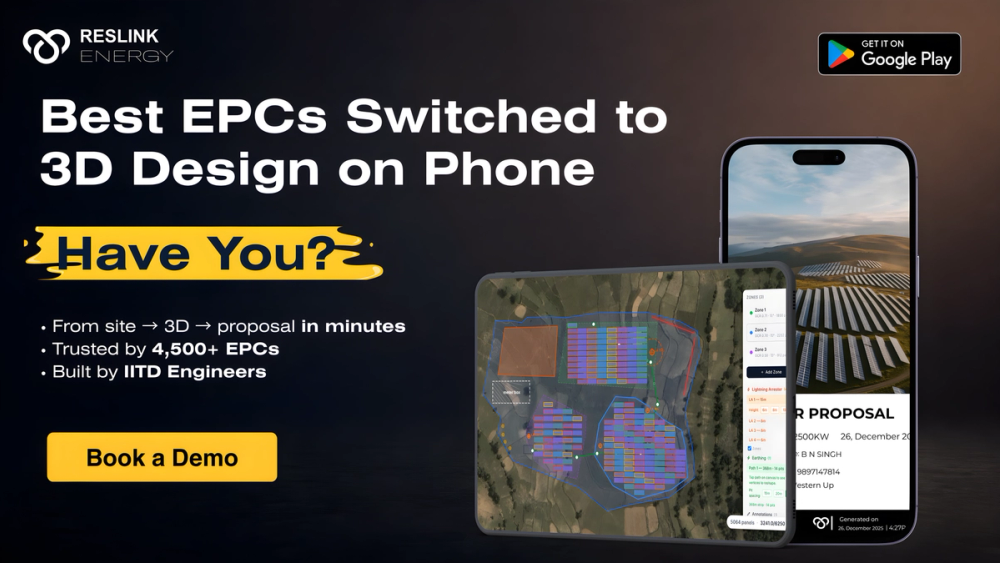
The handoff friction described above, geometry re-entered between a layout tool, a yield tool, and a drawing tool, is exactly what a single shared 3D model removes for the stages it covers. Reslink's bid-stage 3D layout, BOM, and DISCOM-format single-line diagram all generate from the same model, so a design change after the sales conversation propagates through to the BOM and the drawing set without a manual re-entry step in between.
For bankable, lender-grade yield simulation specifically, this piece has been direct about where Reslink sits: alongside PVsyst for the projects that need an independent-engineer-reviewed yield study, not as a replacement for it. That's a deliberate, honest line, not every piece of the stack collapses into one tool yet, and a piece that pretended otherwise wouldn't survive contact with an actual IREDA or PFC financing conversation.
See how one 3D model carries through layout, BOM, and DISCOM-format SLD on your next project → Book a demo
Frequently Asked Questions
Q1. Does using one design suite mean I never need PVsyst?
Not for projects seeking institutional project finance. A design suite can produce its own 8,760-hour simulation for design and proposal purposes, but for IREDA, PFC, or SECI-linked financing specifically, an independent engineer will typically expect a PVsyst-format bankable yield study. The realistic stack for a growing EPC is a design suite for everything else, plus a PVsyst seat or an outsourced PVsyst report once yield-report volume justifies it.
Q2. How do I know if my outsource quote is actually fair before running the break-even math?
Get quotes from at least two independent specialists for the same deliverable type before treating either number as the input to your break-even formula. Outsource pricing varies meaningfully by specialist, and a break-even calculation is only as good as the outsource rate you put into it.
Q3. What's the real cost of the handoff friction between tools, in rupees, not just risk?
It's difficult to price precisely because it shows up as rework time and rejected submissions rather than a line item, a DISCOM or CEIG rejection over a format or data mismatch typically costs the turnaround time of a resubmission cycle, commonly one to several weeks depending on the authority, which is a real cost even though it never appears on a software invoice.
Q4. Should a small EPC just starting out license anything at all, or outsource everything?
For most early-stage teams, the minimum viable in-house tool is whatever covers bid-stage layout through DISCOM-format drawings, since that's the highest-frequency deliverable type for almost every project. Bankable yield simulation and structural analysis are usually the first two pieces worth outsourcing rather than licensing, until volume clears their specific break-even points.
Q5. Does the break-even formula change for a team that's already fully staffed?
Yes, use Case 1 (license cost divided by outsource cost) rather than Case 2. A fully staffed team is typically reallocating existing paid time to a new tool rather than hiring specifically for it, which removes the marginal per-deliverable staff cost from the calculation and lowers the break-even volume needed to justify the license.
You May Also Like
Sources
- PVsyst SA, published Professional subscription pricing (CHF 700/year), cross-verified against an independent vendor quote and multiple third-party pricing trackers
- Autodesk, official AutoCAD and AutoCAD LT India pricing, cross-verified against multiple independent authorized Indian resellers (not solar-industry vendors)
- General engineering-workflow reasoning on manual data handoff and version drift between disconnected design tools
Related Articles

Best Solar Software in India: By Type, Then by Use Case
Which type of solar software you actually need, then the right pick by project type: residential, C&I, utility-scale, and multi-state Indian EPCs.

Solar Design Software for Indian EPCs
Solar design software for Indian EPCs: what the category actually covers, how it splits by project type, and why 3D design replaced manual layout.

Solar Quotation Software for Indian EPCs
Solar quotation software for EPCs: what it is, what to check before choosing one, and how Reslink generates a complete quote in under 10 minutes.