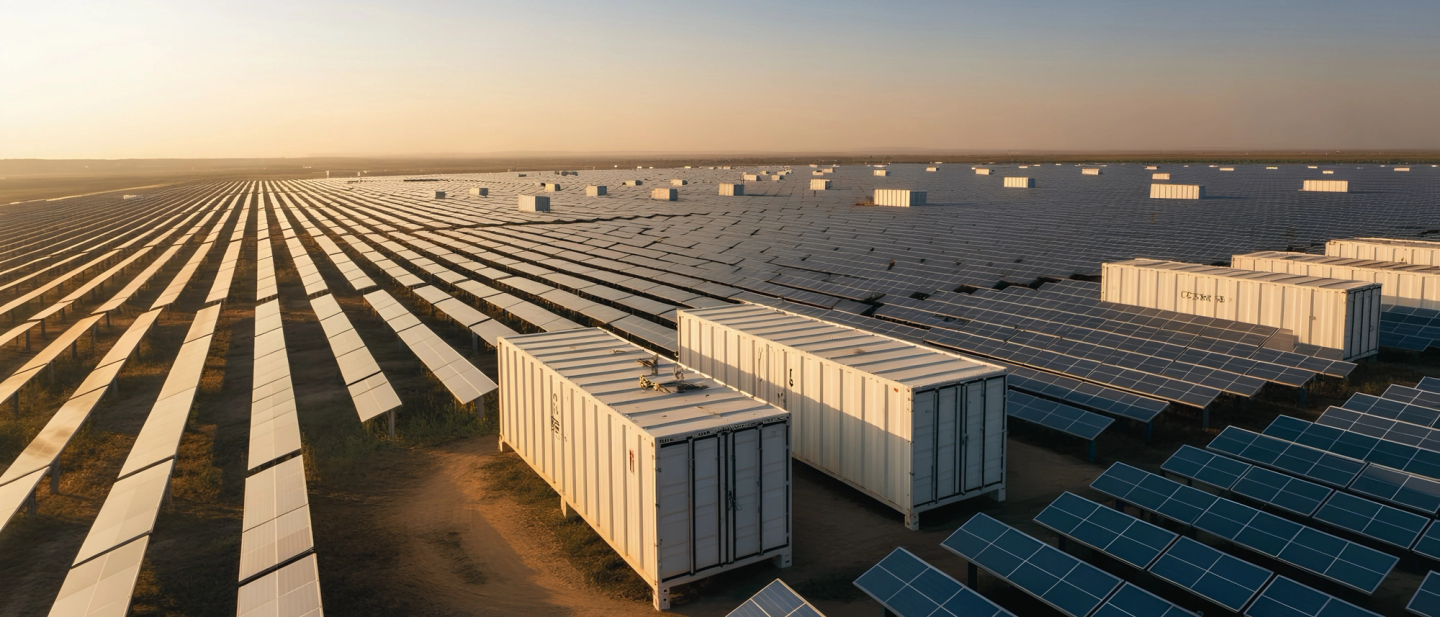
India's Storage VGF Scheme: 92 GWh and the 40% Domestic Content Rule
What the Cabinet Approved
The Cabinet, chaired by the Prime Minister, approved a Viability Gap Funding scheme for grid-scale energy storage with total support of Rs 14,500 crore over FY 2026-27 to FY 2030-31. Government says it will help create capacity equal to 170% of today's grid-scale storage and move toward the 411 GWh of grid-scale storage it says the country needs by 2031-32.
The aim, in government's words, is to support renewable integration, grid stability and round-the-clock supply, and to build a domestic storage manufacturing base through demand-side support.
The Numbers
Item | Figure |
|---|---|
Total support | Rs 14,500 crore |
Period | FY 2026-27 to FY 2030-31 |
Capacity targeted | 92 GWh, yet to be commissioned |
Pumped hydro | 60 GWh |
Battery storage | 30 GWh |
Other storage technologies | 2 GWh |
Estimated investment | Rs 97,600 crore |
Battery domestic content | At least 40% |
Allocation | Tariff-based competitive bidding |
Battery storage is about a third of the capacity but the part that most affects solar and battery EPCs, because the domestic content condition applies to it.
How Allocation Would Work
Public and private electricity distribution companies would be eligible for the support on battery and pumped hydro projects. Projects using alternative storage technologies would be implemented by public or private entities. Capacity would be awarded through competitive tariff bidding, so developers and EPCs would meet the scheme in distribution company tenders rather than by applying to the Ministry.
The release does not say how the 30 GWh of battery capacity would be split between states or companies.
The 40% Domestic Content Rule
Battery projects must meet a minimum domestic content requirement, or DCR, of 40%. Government says the aim is to encourage domestic manufacturing and complement existing supply-side incentives for battery manufacturing.
What the release does not say matters for procurement:
- how domestic content is measured, by value or by another test;
- which components count, for example cells, packs, inverters, the energy management system, enclosures and balance of plant;
- how a project proves compliance, and who verifies it; and
- whether the rule applies at bid, at award or at commissioning.
Cells are the largest cost in a battery system and are largely imported today, so the way government counts domestic content will decide how hard 40% is to meet.
How It Compares With Earlier Rounds
A Shanghai Metals Market analysis describes an earlier funding round launched in June 2025 with Rs 5,400 crore for 30 GWh of battery storage, equal to Rs 18 lakh per MWh, with 25 GWh allocated to 15 states and 5 GWh to NTPC. It calls the new Rs 14,500 crore scheme the third tranche.
The Cabinet release does not state a per-MWh rate for the new scheme, so the earlier figure should not be assumed to carry over. The new scheme is broader, because most of the Rs 14,500 crore covers pumped hydro and other technologies as well as batteries.
What Is Still Open
Item | Status |
|---|---|
VGF rate per MWh for batteries | Not stated in the Cabinet release |
Scheme guidelines and bidding documents | Not published |
Method for counting 40% domestic content | Not published |
State and company allocation of the 30 GWh | Not stated |
Timetable for the first tenders | Not stated |
What This Means for Solar and Battery EPCs
- Expect distribution company tenders. Support flows through tariff-based bids by distribution companies, so the tender documents will carry the real conditions.
- Ask suppliers for a domestic content breakdown now. Request the origin of cells, packs, power conversion, controls and enclosures by value, so you can price a bid once the test is published.
- Keep the paper trail. Invoices, factory certificates and bills of entry will probably matter when domestic content is verified.
- Do not assume the old rate. Quote nothing based on the June 2025 figure until the guidelines give a rate for this scheme.
- Watch the guidelines. The method for counting domestic content is the document that matters most for equipment choices.

Where Design Software Fits
For a solar site that may add storage, the layout, bill of materials and single line diagram come first. Design software like Reslink produces them for solar projects and supports ground-mount feasibility up to 1 GW. It does not size batteries or check domestic content.
See the full workflow → Book a demo
Frequently Asked Questions
Q1. What did the Cabinet approve?
A Rs 14,500 crore viability gap funding scheme for 92 GWh of grid-scale energy storage, running from FY 2026-27 to FY 2030-31.
Q2. How much of it is battery storage?
30 GWh, alongside 60 GWh of pumped hydro and 2 GWh of other technologies.
Q3. What is the domestic content rule?
Battery projects must meet a minimum domestic content requirement of 40%. The counting method has not been published.
Q4. Who can receive the support?
Public and private distribution companies are eligible for battery and pumped hydro projects. Other storage technologies would be implemented by public or private entities.
Q5. How will projects be chosen?
Through tariff-based competitive bidding.
Q6. How much VGF per MWh will batteries get?
The Cabinet release does not say. An earlier round reportedly gave Rs 18 lakh per MWh, but the new rate has not been stated.
Q7. When will the first tenders come?
No timetable has been published. The scheme guidelines come first.
Final takeaway
The Cabinet has fixed the size of the scheme and the 40% domestic content floor for batteries, but not the support rate, the bidding rules or how domestic content is counted. For EPCs the practical step is to start collecting origin data from suppliers and to wait for the guidelines before pricing any bid.
You May Also Like
- Tamil Nadu BESS Policy 2026: 10% Rule, Waivers and Costs
- CEA Mandatory Storage for Solar and Wind Projects From 2027
- Gujarat BESS Regulations 2026: What the Final Rules Say for EPCs
Sources
- Prime Minister's Office, Cabinet approves Rs.14,500 crore Viability Gap Funding Scheme for development of 92 GWh Grid-Scale Energy Storage Systems (November 4, 2026)
- pv magazine, India approves $1.53 billion viability gap funding scheme for development of 92 GWh grid-scale energy storage (November 6, 2026)
- Shanghai Metals Market, India Moves to Mandate Storage: Demand Visibility Improves, but Cell Localization Lags (November 2026), for the earlier funding round
This guide reflects the Cabinet announcement of November 4, 2026 as of November 12, 2026. Scheme guidelines are yet to be published, so check the Ministry of Power for the final rules.
Related Articles

MCS 042: UK Battery Product Standard Proposals and Nov 10 Deadline
MCS wants a product standard for batteries. What MCS 042 proposes on safety, cybersecurity and performance data, and how to respond by Nov 10.
Tamil Nadu BESS Policy 2026: 10% Rule, Waivers and Costs
Tamil Nadu's new BESS policy: 10% battery with 4 hours for new solar of 1 MW and up, charge waivers pending TNERC, and what storage costs now.

UK BESS Queue Fee (CMP470): Costs, Co-location and Dates
Ofgem is minded to approve a £3,000 to £25,000 per MW fee for UK batteries in the grid queue. Costs, co-location exemption and key dates.