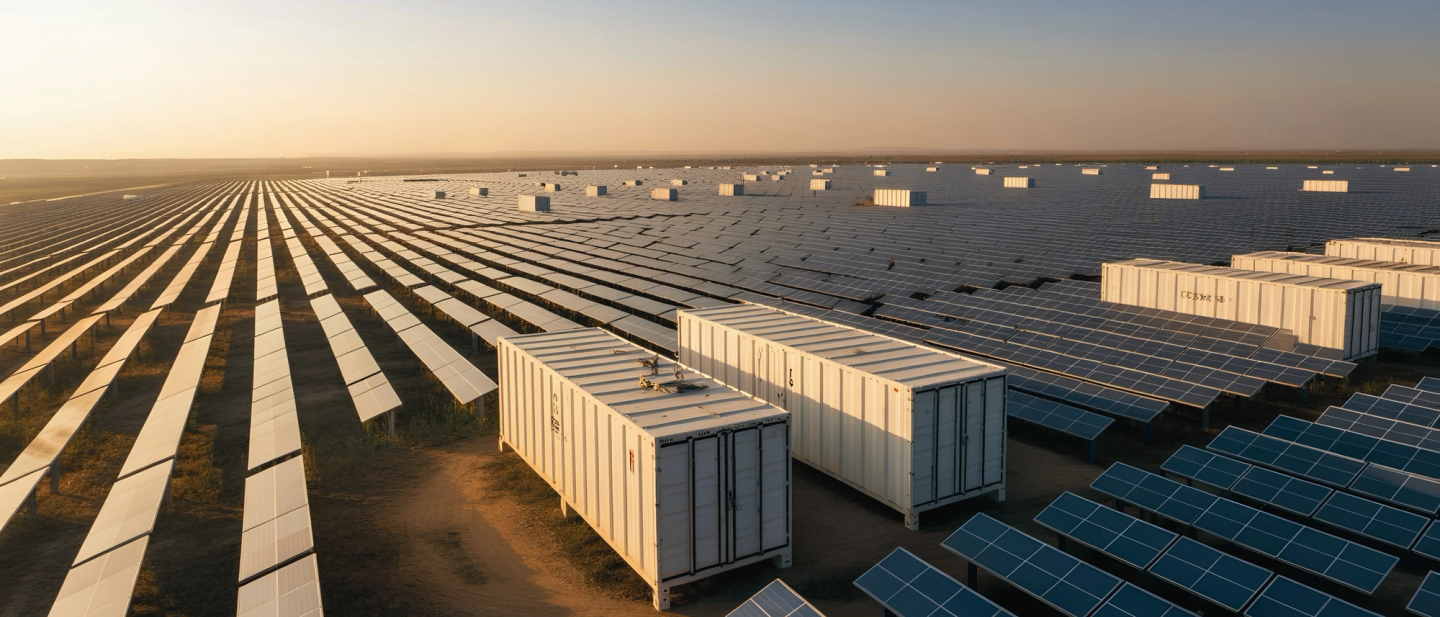
Commercial Solar + Battery India: Cost, Payback & Rules
Quick answer
Question | Short answer |
|---|---|
Is adding a battery automatically better than installing solar alone? | No. The business case depends on the customer’s load profile, peak demand, tariff structure, operating hours, backup requirement, and financing cost. |
How can a commercial battery benefit a business? | It can lower demand charges, shift usage to cheaper hours, use more rooftop solar, and provide backup power. Savings depend on the site’s tariff and load profile. |
What is the biggest EPC sizing mistake? | Choosing battery capacity from the customer’s monthly electricity consumption instead of the timing and size of the customer’s 15-minute peaks. |
Is battery storage compulsory for every C&I rooftop project in India? | No. Energy Storage Obligations apply to defined obligated entities and projects; they should not be presented as a universal battery mandate for every commercial rooftop. |
What major safety change should EPCs plan for? | The CEA’s 2026 safety amendment comes into force on April 1, 2027. It adds detailed BESS requirements, including monitoring, fire and explosion protection, emergency shutdown, and safety-audit provisions. |
Can every solar-plus-storage project achieve a sub-five-year payback? | No. A sub-five-year result is possible in the right tariff and load conditions, but a battery-only project with weak peak savings can take much longer. |
Why Indian EPCs are getting more solar-plus-battery enquiries
For years, the standard commercial solar conversation was simple: reduce daytime grid purchases with rooftop PV.
That model is changing. Commercial customers are now asking a more complicated question:
Can solar and a battery reduce our energy bill, protect us from peak demand charges, improve power continuity, and help us meet renewable-energy requirements?
The answer is sometimes yes, but only when the system is designed around the customer’s load profile rather than sold as a larger version of a rooftop solar project.
India’s storage market is moving quickly. The Ministry of New and Renewable Energy says the country’s Energy Storage Obligation trajectory rises from 1% in FY 2023–24 to 4% by FY 2029–30, with at least 85% of the stored energy used for meeting the obligation required to come from renewable sources.
The Central Electricity Authority also projects a total storage requirement of 82.37 GWh in 2026–27, including 34.72 GWh from battery energy storage systems.
Those figures do not mean that every factory, office, hospital, or retail facility must immediately install a battery. They do mean that EPCs need to understand the commercial logic, design constraints, and compliance questions before quoting solar-plus-storage projects.
Solar-only, battery-only, or solar-plus-battery?
The first decision is not battery size. It is the job the system is expected to perform.
Solar-only
Solar-only is usually the simplest option when the customer has:
- strong daytime electricity consumption;
- sufficient roof or ground area;
- no major evening peak;
- limited backup requirements; and
- a tariff structure where daytime solar generation offsets expensive grid energy.
A battery may add unnecessary capital cost if the customer can already consume most of the solar generation as it is produced.
Battery-only
Battery-only systems can make sense where the customer has a large, predictable peak, expensive evening electricity, unreliable supply, or a need to reduce generator usage. However, the battery must cycle often enough and at a sufficient value per discharged kWh, to justify its cost and replacement reserve.
Solar-plus-battery
Solar-plus-battery is most compelling when the customer can stack more than one benefit:
- use solar energy during the day;
- store surplus solar instead of exporting it at a low value;
- discharge during high-cost or high-demand periods;
- reduce diesel-generator runtime or improve continuity; and
- satisfy a project-specific renewable-energy or storage requirement.
The more value streams the EPC can verify, the stronger the business case. The more value streams the proposal merely assumes, the greater the risk of an uneconomic project.
What actually makes up the cost of a commercial solar-plus-battery system?
A customer should never compare proposals using only a “battery price per kWh.” Two systems with the same nominal battery capacity may have very different installed costs, usable energy, warranty terms, safety equipment, and operating value.
A commercial proposal should separate at least these cost layers:
Cost layer | What the EPC should identify |
|---|---|
Solar PV system | Modules, inverter, mounting structure, DC and AC cabling, protection, installation, and commissioning |
Battery system | Cell chemistry, rated kWh, usable kWh, depth-of-discharge limit, rack or container configuration, and warranty |
Power conversion system | PCS/inverter rating in kW, bidirectional operation, efficiency, grid synchronisation, and protection |
BMS and EMS | Cell and rack monitoring, dispatch logic, tariff scheduling, solar prioritisation, alarms, and integration with the customer’s controls |
Electrical balance of system | Switchgear, transformers if required, metering, protection relays, earthing, cable routes, and interconnection equipment |
Thermal and fire systems | HVAC or cooling, smoke/gas/heat detection, suppression, ventilation, separation, and emergency shutdown |
Civil and site work | Foundations, enclosure or room preparation, drainage, access, fencing, lifting, and fire-service access |
Soft costs | Engineering, approvals, testing, commissioning, training, monitoring, insurance, financing, and O&M |
Lifecycle reserve | Augmentation, replacement, degradation, warranty exclusions, and end-of-life handling |
This is also where a design-linked BOM matters. If the design changes the stringing, cable routes, structure, inverter configuration, or battery integration, the quantities and procurement documents should change with it. A spreadsheet assembled after the design is finished is more likely to preserve an old assumption.

How to calculate the payback of a solar-plus-battery project
The correct payback model is not:
Total project cost ÷ annual solar generation
A better model separates the value of each operating use case.
Annual value from solar self-consumption
Solar self-consumption value
= solar energy consumed on-site × avoided grid energy rate
Do not value every unit of solar generation at the retail tariff if some energy is exported, curtailed, or generated when the facility is lightly loaded.
Annual value from peak shaving
Peak-shaving value
= reduction in billed peak demand × applicable demand charge
The battery may deliver more value by reducing a few expensive 15-minute peaks than by discharging evenly throughout the day. This is why a monthly electricity bill alone is not enough for system sizing.
Annual value from time-of-use shifting
Time-of-use value
= high-rate energy displaced − charging energy cost − round-trip losses
The calculation must include battery losses, dispatch limits, degradation, and the actual hours in which the customer can charge and discharge.
Annual value from backup or continuity
Backup value is real, but it should not be disguised as energy-arbitrage savings. If the customer is buying continuity for a production line, data centre, hospital, cold store, or critical process, the proposal should identify:
- which loads are critical;
- how many hours of backup are required;
- whether the battery is islandable;
- what transfer equipment is needed;
- whether a diesel generator remains part of the architecture; and
- how often the backup function will actually be used.
A worked example using planning assumptions
The following example is for explaining the model, not quoting a market price.
Assume a C&I facility is considering:
- 100 kWp of rooftop solar;
- a 200 kWh battery with 160 kWh of usable dispatchable energy;
- 300 equivalent battery cycles per year;
- a verified peak-demand saving of ₹2 lakh per year;
- ₹3 per discharged kWh of net time-of-use value after charging cost and losses; and
- an illustrative combined installed project cost of ₹85 lakh, including PV, battery, PCS, electrical work, controls, civil work, commissioning, and initial compliance work.
The estimated annual storage value would be:
Value stream | Planning calculation | Annual value |
|---|---|---|
Peak-demand reduction | Verified customer-specific saving | ₹2.00 lakh |
Time-of-use shifting | 160 kWh × 300 cycles × ₹3/kWh | ₹1.44 lakh |
Solar self-consumption | Modelled separately from the battery | Customer-specific |
Backup/continuity | Modelled as avoided operational loss, not assumed energy savings | Customer-specific |
The battery-only value in this simplified example is ₹3.44 lakh per year before O&M, degradation, financing, and replacement reserve. On that basis, the battery component alone would not automatically produce a short payback.
The project becomes more attractive only when the rooftop solar system adds a large, verified self-consumption benefit or when the customer places a high value on backup and continuity.
This is why the EPC should show three cases rather than one optimistic payback number:
- Conservative case: lower peak savings, lower cycling, higher financing cost.
- Base case: verified load profile and expected dispatch schedule.
- Upside case: higher tariff spread, stronger peak reduction, and higher solar self-consumption.
The proposal should also show what happens if battery degradation reduces usable capacity or if the customer’s operating schedule changes.
The data an EPC needs before sizing the battery
A serious solar-plus-battery proposal should request more than the latest electricity bill.
At minimum, collect:
- 12 months of electricity bills;
- 15-minute or 30-minute interval load data, where available;
- sanctioned load and recorded maximum demand;
- tariff slabs, demand charges, and time-of-day rates;
- facility operating hours and shift patterns;
- rooftop solar generation assumptions;
- existing diesel-generator capacity and runtime;
- critical and non-critical load separation;
- sanctioned export limit and interconnection conditions;
- available space, access, ventilation, and fire-service requirements; and
- the customer’s preferred contract term and performance guarantee.
Without this information, the EPC is not sizing a system. It is selecting a battery and hoping the customer’s load will justify it.
Compliance rules EPCs should check in 2026 and 2027
1. Energy Storage Obligation is not a universal rooftop battery mandate
India’s Energy Storage Obligation trajectory rises from 1% in FY 2023–24 to 4% by FY 2029–30, and at least 85% of the stored energy used to meet the obligation must come from renewable sources.
For an EPC, the important question is not simply “Is there an ESO?” It is:
Does this customer, project structure, obligated entity, tender, or power-supply arrangement fall within the relevant obligation?
Do not present the national ESO trajectory as a blanket requirement that every C&I rooftop customer must install a battery.
2. CEA BESS safety rules take effect on April 1, 2027
The Central Electricity Authority’s 2026 amendment to the Measures relating to Safety and Electric Supply Regulations comes into force on April 1, 2027.
The amendment includes requirements relevant to BESS design and installation, including:
- battery-management-system monitoring of voltage, temperature, current, and thermal-runaway conditions;
- fire and explosion protection at the cell, module, rack, container, and site levels;
- ventilation, cooling, and controls for flammable-gas concentration;
- emergency shutdown and accessible manual emergency stops;
- safe spacing and separation between battery systems and nearby buildings;
- earthing, lighting, security, and protective systems; and
- an independent third-party fire-safety audit within the specified timeline after commencement.
The final design must be checked against the exact applicability and voltage provisions in the regulation. The CEA document distinguishes systems above 650 V from systems at 650 V and below, so an EPC should not copy a high-voltage compliance checklist into every small commercial project without verification.
3. Proposed 2027 grid requirements should be labelled as proposals
The CEA has proposed co-located energy storage and grid-forming requirements for certain ground-mounted solar and onshore wind projects commissioned after July 1, 2027.
That proposal is important for EPC planning, utility-scale development, and future design standards. It should not be described as a final universal requirement for every commercial rooftop project.
4. ALMM and DCR still affect the solar side of the project
Adding a battery does not remove the need to verify the solar-module compliance rules that apply to the project.
MNRE’s July 2026 notice states that there is no blanket ALMM List-II extension, while providing a limited window until December 31, 2026 for commissioning certain net-metering and open-access renewable-energy projects. Reslink’s DCR and non-DCR compliance guide covers the project-category and procurement questions in more detail.
The EPC should therefore record, at minimum:
- project type and commissioning deadline;
- whether the project is subsidy-linked, net-metered, open-access, or private behind-the-meter;
- module and cell eligibility;
- certificate and supplier verification requirements;
- whether the battery changes the project’s interconnection or approval path; and
- which compliance assumptions are included in the commercial offer.
A solar-plus-battery system is not automatically a compliance shortcut.
What should be included in the EPC quotation?
Before a customer compares two proposals, make the following fields visible:
Proposal field | Why it matters |
|---|---|
PV capacity and expected annual generation | Separates the solar benefit from the storage benefit |
Battery rated and usable capacity | Prevents a nominal-kWh comparison |
PCS power rating | Shows how much load the system can serve at one time |
Dispatch objective | Peak shaving, arbitrage, backup, self-consumption, or a combination |
Expected cycles and operating schedule | Connects the warranty to the financial model |
Round-trip efficiency | Prevents overstating usable energy savings |
Degradation and augmentation assumption | Protects the long-term payback calculation |
Fire, HVAC, protection, and civil scope | Prevents low initial quotes from hiding required costs |
Approvals and exclusions | Clarifies what the EPC and customer must each complete |
O&M and warranty response | Defines the operating responsibility after commissioning |
Financial model | Shows conservative, base, and upside cases |
This level of detail also makes procurement easier. When the design, electrical configuration, structural quantities, and routing change together, the bill of materials and project documentation are less likely to drift apart.
Commercial Solar + Battery EPC Checklist: Before You Quote
Step | EPC checklist item | Why it matters |
|---|---|---|
1 | Validate interval load data, maximum demand, tariffs, operating hours, and critical loads. | Prevents battery sizing from being based only on monthly consumption. |
2 | Separate solar savings, battery savings, backup value, and compliance value. | Each value stream requires different assumptions and evidence. |
3 | Model conservative, base, and upside payback cases. | Prevents one optimistic payback figure from hiding tariff, utilisation, and degradation risk. |
4 | Specify rated/usable kWh, PCS kW, efficiency, degradation, safety scope, O&M, and total installed cost. | Gives the customer a realistic comparison between proposals. |
5 | Verify DCR/ALMM and BESS safety requirements, then keep the design, BOM, proposal, and compliance assumptions aligned. | Reduces approval risk, procurement errors, and revision-related margin leakage. |
Where 3D design and automated BOMs fit
The commercial case still depends on an accurate site model, PV layout, shading analysis, electrical configuration, and material quantity. Reslink’s Solar 3D workflow helps EPC teams map roofs, place panels, simulate shading and sun paths, revise designs on-site, and calculate structural, electrical, and routing materials from the design.
This does not replace battery sizing or the engineer’s compliance review. It helps reduce re-entry between the site model, proposal, BOM, and procurement quantities, the part of the process where EPCs often lose time and margin.
To see how the design-to-material workflow can fit into your EPC process, book a demo.
Frequently asked questions
Q1. Is battery storage compulsory for all commercial solar projects in India?
No. The Energy Storage Obligation trajectory applies within the relevant policy and obligated-entity framework; it is not a universal instruction that every commercial rooftop customer must install a battery. The EPC should check the project’s tariff, ownership, offtake, tender, and approval conditions.
Q2. How much battery capacity does a commercial facility need?
There is no universal battery-to-solar ratio. Size the battery from the customer’s peak-load shape, operating hours, critical loads, tariff windows, backup duration, export limit, and desired operating objective.
Q3. Does DCR or ALMM apply to the battery?
DCR and ALMM checks generally concern the solar PV side and the project categories to which the rules apply. The addition of a battery does not remove the need to verify module and cell compliance for the project.
Q4. Is solar-plus-battery payback always less than five years?
No. Payback depends on tariff spread, demand charges, peak timing, battery utilisation, efficiency, degradation, financing, and the value assigned to backup. A proposal that promises a short payback without interval-load evidence should be treated cautiously.
Q5. What data should a customer share with an EPC?
The most useful inputs are 12 months of bills, interval-load data, sanctioned load, maximum demand, tariff schedule, operating hours, diesel-generator usage, critical loads, and the customer’s backup and export requirements.
Q6. What changes on April 1, 2027?
The CEA’s 2026 safety amendment comes into force. It introduces detailed BESS safety requirements, including monitoring, fire and explosion protection, ventilation and cooling, emergency shutdown, spacing, security, and fire-audit provisions, subject to the regulation’s applicability conditions.
Q7. Should EPCs wait before offering solar-plus-battery systems?
No. They should design and quote them more carefully. The correct approach is to verify the customer’s value streams, document current requirements, identify upcoming safety obligations, and avoid presenting proposals as final until project-specific approvals and rules are confirmed.
Sources
- MNRE Energy Storage Systems Overview
- CEA Measures relating to Safety and Electric Supply Amendment Regulations, 2026
- CEA proposal on co-located storage and grid-forming requirements
- MNRE ALMM List-II notice
- Reslink Solar 3D
- Reslink product overview
- Solar BOM automation: What It Actually Fixes
- PM KUSUM 2.0 EPC guide
- Maharashtra battery requirement for commercial solar
- Net-metering approvals in India
Related Articles

Solar BOM Automation: What It Actually Fixes
A quantity error on DC cable alone can erode 6-9% of project margin. See what BOM automation actually solves, and what still needs a manual check.
How Solar EPCs Can Build an O&M Revenue Stream
Most solar EPCs treat O&M as an afterthought. Here's how to price, structure, and sell AMC contracts as a real recurring revenue line.

How to Transition From Residential to C&I Solar EPC
What changes when a residential solar EPC moves into C&I: sales process, pricing, staffing, and cash flow, and how to avoid a stalled transition.