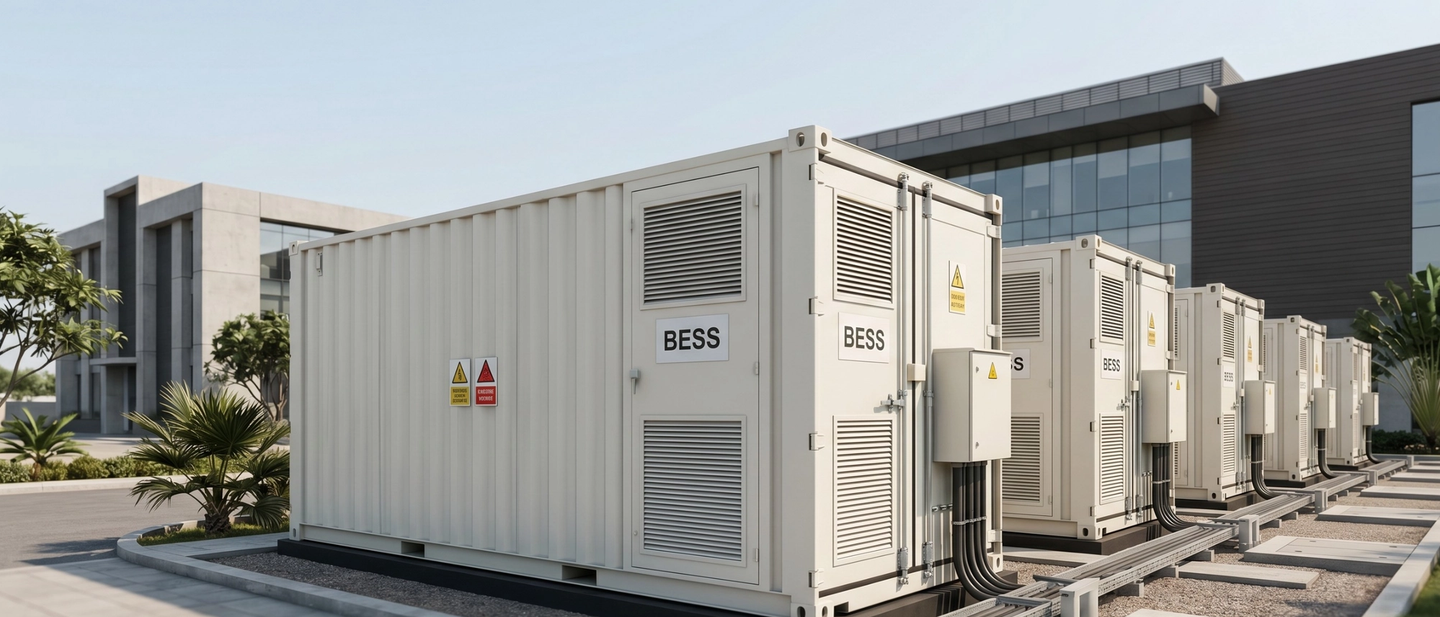
Maharashtra Now Requires Batteries With Commercial Solar
The Rule, in Plain Terms
Maharashtra became the first Indian state to make energy storage a core requirement for new renewable energy projects when it notified its RE and Storage Policy on March 18, 2026. The policy covers a range of project types, but the part that is most immediately relevant for commercial solar EPCs is the rooftop storage mandate.
From April 1, 2026, any new rooftop solar project above 100 kW that applies for grid connectivity must include a battery storage system. The required storage must be:
- At least 50% of the solar capacity — so a 200 kW solar array requires a minimum 100 kW battery system
- Capable of providing at least 2 hours of storage — meaning the 100 kW system must have at least 200 kWh of energy capacity
- Reviewed and potentially increased every two years — the 2-hour requirement will rise to 4 hours for projects commissioned after FY2030
The same rule applies to new open access and captive solar projects above 100 kW. Projects below 100 kW are not currently covered, though the policy encourages smaller systems to add storage voluntarily.
Why Maharashtra Did This
Maharashtra is India's largest industrial state and one of its biggest electricity consumers. Its grid carries heavy load from manufacturing clusters in Pune, Nashik, Aurangabad, and the Mumbai metropolitan area. As solar penetration increased, the grid started facing the same challenge seen in Gujarat and Rajasthan: too much solar power during the day and too little in the evening when factories and households need power most.
By requiring storage alongside new solar installations, Maharashtra is solving two problems at once. It gives consumers a way to use their own solar power in the evening rather than exporting it to a grid that may not need it. And it reduces the pressure on MSEDCL to manage a large solar surplus during the day followed by a sharp demand spike in the evening. Maharashtra has set a target of 100 GW renewable capacity and 100 GWh of daily storage by FY2036 — this mandate is how it gets there.
Two Related Mechanisms EPCs Should Know About
DISCOMs have their own, separate storage obligation. Maharashtra's distribution companies, MSEDCL, BEST, Tata Power-D, and Adani Electricity, must procure storage capacity equal to at least 10% of demand by FY2035-36, with at least 85% of that stored energy required to come from renewable sources. MERC has set a nearer-term checkpoint too: by 2030, MSEDCL's own Renewable Purchase Obligation and Energy Storage Obligation are stipulated at roughly 43.3% and 4% of total power demand respectively. This doesn't change what an individual commercial client must install, it's a utility-side obligation, but it signals sustained, structural demand for storage capacity in the state well beyond this one mandate, useful context when a client asks whether this is a passing rule or a longer trend.
BESS gets a materially stronger REC multiplier, with a real qualifier. Under CERC's First Amendment to the 2022 REC Regulations, notified March 24, 2026, Battery Energy Storage Systems earn a Renewable Energy Certificate multiplier of 3.0, against 1.0 for standalone solar or wind. Two things worth being precise about: this multiplier applies specifically to BESS charged by renewable energy sources only, and it applies to projects commissioned after the March 24, 2026 amendment under the new scoring system, not retroactively to earlier installations. For commercial clients with ESG reporting or Renewable Purchase Obligation exposure, this is a real, additional financial argument for storage beyond time-of-day arbitrage.
There's also a financial incentive worth mentioning: captive open-access projects that integrate storage qualify for a 10-year electricity duty exemption under the same policy, on top of the ToD savings and REC value above.
What Changes for EPCs in Maharashtra
Every commercial proposal above 100 kW now needs a storage component. This is not optional for new grid connectivity applications. An EPC quoting a 150 kW commercial rooftop in Pune must include at least a 75 kW / 150 kWh battery system in the design and the price.
Project costs will increase significantly. Battery storage at the required scale adds approximately Rs 3 to 5 lakh per 100 kWh of capacity at current 2026 prices. For a 200 kW solar project requiring 200 kWh of storage, this adds Rs 6 to 10 lakh to the project cost before installation. EPCs must build this into proposals clearly and explain the regulatory reason for it, so clients do not treat it as an optional upsell.
The pitch changes too. Storage is not just a regulatory cost — it is a genuine business benefit for commercial clients. Facilities with storage can shift their solar generation to evening peak hours, reducing grid purchases at the highest Time of Day tariff rates. In Maharashtra's industrial clusters, where ToD tariffs can vary by Rs 2 to 3 per unit between peak and off peak, the battery system can pay for itself faster than the solar array alone. EPCs who learn to present the storage ROI correctly will find clients more receptive than those who present it as a mandatory add on.
Battery Leasing: A Way Around the Upfront Cost
The capex increase above isn't the only path to compliance. A growing operating-lease model lets a client add mandate-compliant storage with zero upfront capital: a third-party BESS provider owns, installs, and maintains the battery, and the client pays a fixed periodic lease fee instead of buying the hardware outright. This directly answers the client's most common objection to this mandate, without EPCs needing to discount their own solar quote to compensate.
Worth knowing about specifically: Maharashtra's policy includes a state-backed bulk procurement push for smaller BESS systems (10-100 kW) aimed at MSMEs, with potential financial support through the state's Harit Urja Nidhi fund, alongside the private commercial leasing market. For EPCs, presenting a leasing option alongside an outright-purchase price keeps a hesitant client's deal moving rather than losing it over the battery line item specifically. Confirm current lease terms, tenor, and REES-compliance documentation directly with a specific provider before presenting numbers to a client, this is a fast-moving, competitive space.
One operational point worth verifying directly with your local DISCOM rather than assuming: some reporting suggests DISCOMs may not approve net metering for new C&I solar above 100 kW that doesn't include the mandated storage, which would make compliance a practical prerequisite for grid export, not just a paper requirement. This specific claim needs direct DISCOM confirmation before you present it to a client as settled.
Who this affects most: Commercial EPCs working with factories, warehouses, IT parks, hospitals, and educational institutions in Maharashtra. Any system you have quoted above 100 kW that has not yet received grid connectivity approval should be reviewed immediately. If the connectivity application has not been submitted, the new rule applies and the design must include storage.
Frequently Asked Questions
Q1. Does this rule apply to existing commercial solar installations?
No. The storage mandate applies only to new applications for grid connectivity from April 1, 2026 onwards. Existing systems that already have grid connectivity approved are not required to add storage — though the policy actively encourages them to do so and offers incentives such as priority grid connectivity for storage-integrated systems. If your project received connectivity approval before April 1, you are not affected.
Q2. How much does the required battery storage add to project cost?
At current 2026 prices, lithium iron phosphate (LFP) battery systems in the commercial scale range cost approximately Rs 3 to 5 lakh per 100 kWh including installation. For a 200 kW solar project requiring 200 kWh of battery capacity, this adds roughly Rs 6 to 10 lakh to the total project cost. This is significant but should be presented to clients alongside the ToD tariff savings that storage enables — which in many Maharashtra industrial locations can shorten the storage payback period to 3 to 5 years independently of the solar system's economics.
Q3. Will other states follow Maharashtra's lead?
Very likely. Maharashtra's policy is being watched closely by other industrial states. The CERC has already brought energy storage systems under the tariff framework at the central level. Rajasthan, Gujarat, and Tamil Nadu have all been experimenting with storage linked solar tenders for utility scale projects. A broader national push toward storage mandates for commercial solar is widely expected - Maharashtra is simply the first to formalise it for rooftop projects. EPCs in other states should start developing solar plus storage proposal capabilities now, before their state mandates it.
Q4. Can a client lease the required battery instead of buying it?
Yes, and it's an active, growing option. Several providers offer zero-capex operating leases, they own, install, and maintain the system, and the client pays a fixed periodic fee instead of a large upfront purchase. Present this alongside an outright-purchase quote for clients hesitant about the storage capex specifically. Confirm current terms and REES-compliance documentation directly with a provider, since this market is moving quickly.
Q5. Does adding storage help with anything beyond the mandate itself?
Yes, two ways worth mentioning to clients with sustainability commitments. BESS charged by renewable sources earns a Renewable Energy Certificate multiplier of 3.0 under a March 2026 CERC amendment, versus 1.0 for standalone solar, relevant for ESG reporting or RPO compliance. Captive open-access projects with storage also qualify for a 10-year electricity duty exemption under Maharashtra's policy.
Sources
- EQ Magazine — eqmagpro.com — Maharashtra RE and Storage Policy 2025-26 to 2035-36 — storage mandates, April 2026 rooftop rule
- Saur Energy — saurenergy.com — "Maharashtra Mandates 100 GWh Storage as Core of New Renewable Energy Policy" (March 2026)
- Power Peak Digest — powerpeakdigest.com — Maharashtra notifies RE and storage policy with 65% target by FY36 (March 2026)
- GoodEnough Energy — goodenough.energy — Maharashtra RE Policy 2026: BESS mandate explained for commercial EPCs
- CERC (Primary) — cercind.gov.in — First Amendment to the 2022 REC Regulations, notified March 24, 2026: BESS Renewable Energy Certificate multiplier of 3.0 (RE-charged only, new projects post-amendment).
- Lexology / Saur Energy / Energetica India / The Hitavada — Maharashtra RE and Storage Policy 2025-26 to 2035-36 — DISCOM Energy Storage Obligation (10% of demand by FY2035-36, 85% RE-sourced), MERC's 2030 checkpoint for MSEDCL (~43.3% RPO, ~4% ESO), 10-year electricity duty exemption for storage-integrated captive OA projects.
Related Articles
US Commercial Solar + Battery Storage in 2026
Model US commercial solar and battery payback using demand charges, TOU rates, load data, export rules and 2026 EPC cost drivers.
Commercial Solar + Battery India: Cost, Payback & Rules
Commercial solar + battery costs, payback, sizing and 2027 compliance guidance for Indian EPCs.
How to Add Battery Storage to an Existing Solar Project
Adding battery storage to an existing solar installation is different from fresh solar plus storage install. Here's how to assess retrofit, choose the right coupling method for Indian clients in 2026.