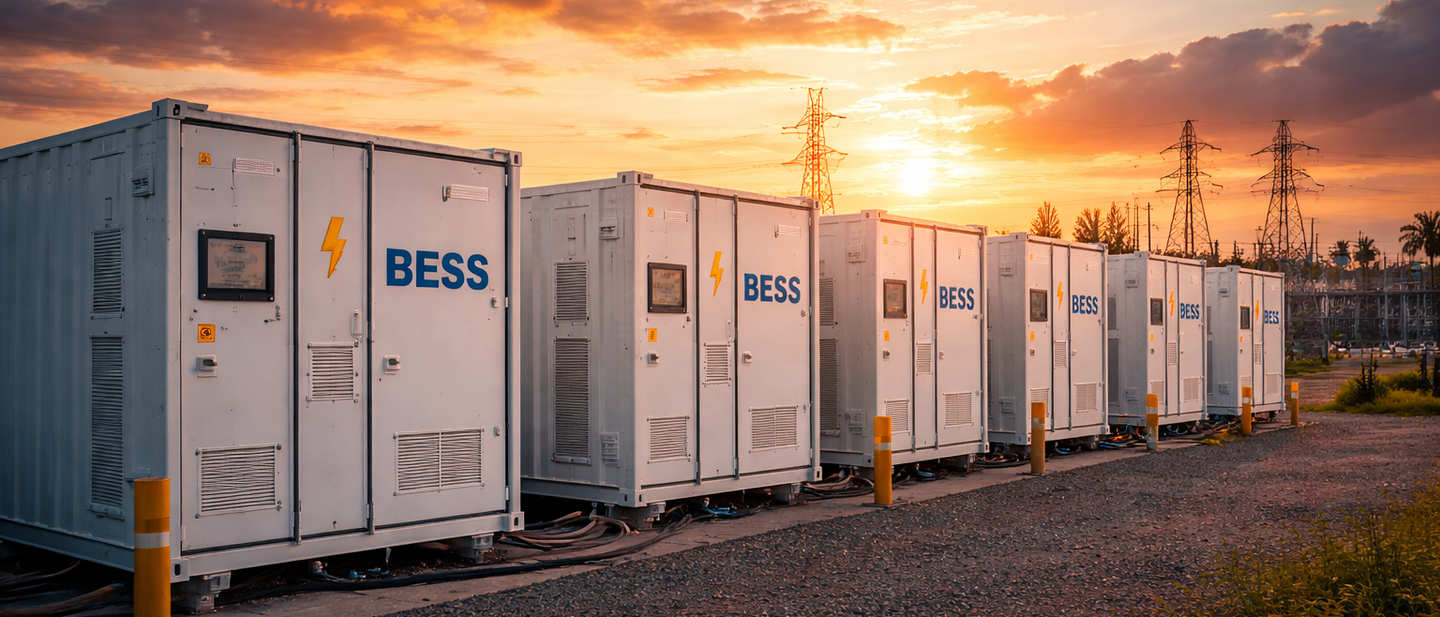
State-Level BESS Tenders Are Now the Fastest-Growing Segment in Indian Solar
Three Tenders in One Week — A Signal Worth Reading
In the first week of April 2026, India's battery energy storage pipeline moved in three directions at once. West Bengal's Department of Power invited bids to set up 500 MW/2,000 MWh of standalone battery storage systems — the bid deadline is April 24, with opening on May 7. Coal India and Sarus won a 375 MW/1,500 MWh BESS auction for Telangana grid stability, commissioned through TGGENCO. And NTPC completed its 2,334 MWh BESS auction across multiple thermal power stations in Karnataka, Maharashtra, Bihar, Andhra Pradesh, and Telangana simultaneously.
These are not related tenders. They are three independent state-level and central procurement processes happening in the same week, across different geographies, at different scales, from different tendering bodies. That simultaneous activity reflects something that is now structural rather than episodic in India's energy market: state distribution companies, central public sector units, and grid operators have all reached the same conclusion at roughly the same time — that storage is no longer optional for grid management.
Why States Are Moving Now
India's grid is experiencing what the GRID India CMD described as "unprecedented ramping and flexibility requirements" with demand swings reaching up to 90 GW. When solar generation accounts for 88% of new capacity additions but delivers power only during daylight hours, the gap between peak solar generation and peak demand — which in most Indian states occurs in the evening — creates a daily volatility problem that storage is specifically designed to solve.
Each state distribution company (DISCOM) is dealing with this problem independently. West Bengal, whose power mix has been shifting toward renewables, is adding storage to manage evening peak loads. Telangana, which has significant industrial load and a growing renewable capacity, needs grid stability support. NTPC's multi-state storage deployment is addressing the same flexibility requirement across its national footprint. The drivers are different in scale and context, but the conclusion is identical: store the solar, release it when needed.
The Opportunity for EPCs — and the Compliance Entry Bar
State-level BESS tenders represent a different market than rooftop solar or C&I open access. They are large-scale, technically complex, and involve long tendering and approval processes. The West Bengal 500 MW/2,000 MWh tender, for example, is a utility-scale project that requires substantial experience, financial capacity, and technical credentials to bid on directly. Most mid-sized EPCs will not win this tender outright.
But every large BESS project requires EPC execution. The contractors who win these tenders — whether BHEL, L&T, Adani, or specialist storage developers — will subcontract civil works, electrical installation, BMS commissioning support, and ongoing operations and maintenance to regional partners. The EPC who has demonstrated experience with any BESS installation — even a 200 kWh commercial system — is building the credential that opens the door to subcontracting relationships on larger projects.
The CEA's newly gazetted BESS safety regulations (Chapter XA, effective April 2027) set the compliance floor for all installations above 650V. EPCs who understand two-fault tolerance design, multi-level fire protection, and mandatory third-party audit requirements are the ones that large project developers will seek out for execution partnerships. Technical competency in the new regulatory framework is the differentiator that separates EPCs who get subcontracting calls from those who don't.

The BESS O&M Revenue Model — Recurring Income for Life
BESS projects have a fundamentally different maintenance profile from solar-only installations. Battery systems require ongoing state-of-health monitoring, cycle analysis, thermal management inspection, and BMS software updates. The CEA regulations mandate continuous BMS monitoring with automated alerts and shutdowns — which means every BESS installation generates an ongoing monitoring and maintenance requirement that solar-only systems do not.
For EPCs, this creates a recurring revenue model that solar-only installations rarely generate. An O&M contract on a 500 kWh commercial BESS system — covering monitoring, preventive maintenance, and emergency response — might generate ₹3–5 lakh per year. Across 20 such installations, that's ₹60–100 lakh in annual recurring revenue from projects already executed. This is the economics that makes BESS competency worth building now, even before utility-scale subcontracting opportunities materialize.
Source: Mercom India — West Bengal BESS tender, NTPC 4.7 GWh approval, NTPC auction results (April 2026). Power Peak Digest — Coal India/Sarus Telangana win (April 1, 2026) · SolarQuarter — NTPC 2,334 MWh auction completion (April 1, 2026). IESA/CES SESI 2026 whitepaper — 92 GWh pipeline, 5 GWh 2026 commissioning target
Related Articles
India’s Solar Grid Is Sending 35 GW of Power Nowhere
Crisil Ratings warns that over 35 GW of India's renewable capacity faces grid curtailment risk in FY27. Rajasthan and Gujarat are worst hit. Here is what it means for EPCs.
India Hits 143 GW Solar Milestone — What this Really Means for EPCs
India's solar capacity has crossed 143 GW with 88% of new RE additions coming from solar. Here's what this record-breaking pace means for EPC opportunity, workload, and strategy in 2026.
PM Surya Ghar Has Installed 25 Lakh Systems. The Target Is 1 Crore. The 75-Lakh Gap Is the Biggest EPC Opportunity in India Right Now.
25 lakh installed, 1 crore targeted. Parliamentary committee flags slow progress, FY27 deadline looming. Here's why India needs 2,300 rooftop installations per day — and what that means for EPCs.