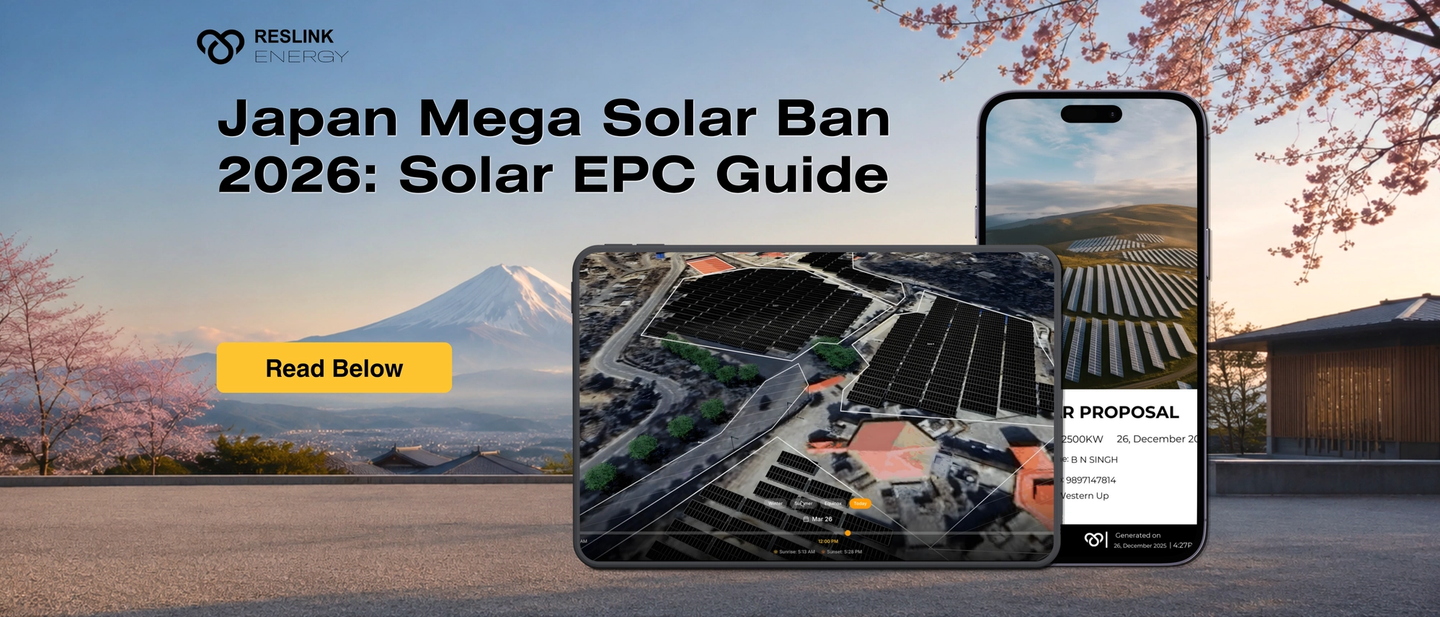
Japan Closed Mega Solar: Rooftop FIT at JPY 19 Per kWh Is Now the Only Path
How the Mega Solar Countermeasure Package Closed Ground Mount
The Mega Solar Countermeasure Package was not a single announcement. It was a series of policy tightenings accumulating into a definitive end of ground-mount solar support. The December 2025 initial package addressed large-scale installations in environmentally sensitive areas. The Forest Act amendments effective April 2026 tightened development restrictions in forest zone categories previously accessible through deforestation permits. The result: from FY2027, ground-mount solar in the 10 to 50 kW range is excluded from both FIT and FIP. Larger ground-mount above 250 kW already faces the FIP auction end date of September 30 2026.
The policy logic is clear. Japan had significant community and environmental opposition to large-scale solar farm development on agricultural and forest land. The visible spread of solar farms on hillsides, in watersheds, and on former forest land generated political pressure that the government addressed by restricting development at the policy level. The result is a policy environment that actively discourages new ground-mount while actively encouraging rooftop and built-environment solar.
The Rooftop FIT Structure in Detail
The current rooftop FIT structure, confirmed in the March 19 2026 METI announcement, applies to non-residential rooftop solar above 10 kW that is not on forest land. The rate is JPY 19 per kWh for years 1 to 5 and JPY 8.3 per kWh for years 6 to 20. This two-tier structure front-loads revenue in the early years when financing costs are highest and tapers to a lower base rate for the back half of the project life.
The self-consumption bonus of JPY 1 per kWh is available when the installation achieves a self-consumption ratio of 30 percent or more: at least 30 percent of solar generation is consumed on site rather than exported to the grid. For commercial buildings with significant daytime electricity consumption, including offices, factories, logistics centres, and retail facilities, achieving a 30 percent self-consumption ratio is typically achievable with a well-sized system.
Japanese commercial and industrial electricity prices typically run JPY 20 to 30 per kWh. Against this import price, the combination of self-consumed solar at avoided import cost and FIT-credited exported generation creates a compelling financial case for commercial rooftop installations. The payback calculation at current electricity prices and the current FIT structure is strong in most locations.
The Rooftop Opportunity the Data Supports
Japan's estimated available rooftop capacity of 100 to 180 GW against approximately 30 GW currently installed is a striking statistic. Less than 20 to 30 percent of Japan's technically available rooftop solar capacity has been installed. The gap is larger than in almost any other mature solar market, driven by slow uptake of commercial and industrial rooftop relative to residential and utility-scale segments.
The reason for the gap is institutional and cultural: building owners in Japan have historically been more conservative about structural modification and longer-term energy contracts. The Mega Solar Countermeasure Package, paradoxically, addresses this by concentrating all available government support on the rooftop segment, making the financial case for rooftop solar more compelling than at any prior point in Japan's solar market history.
For EPCs making the transition from ground-mount to rooftop, the two most important capability investments are: first, a design process that handles rooftop structural analysis, panel layout optimisation on complex roof shapes, and shading analysis efficiently; and second, a client proposal process that presents the FIT financial case to building owners who may have limited prior experience with solar revenue streams.

Forest Act Amendments: What They Change in Practice
The Forest Act amendments effective April 2026 added specific documentation and assessment requirements for solar development on or adjacent to forest land. Projects in designated forest zones now require enhanced environmental assessments and in some categories face outright prohibition. White and Case's analysis confirms these amendments as a significant constraint on the development pipeline for ground-mount projects that relied on forest zone land access.
Any project in development that involves forest zone land should be assessed immediately against the April 2026 amendments. Projects that relied on a deforestation permit pathway that is no longer available need to be paused pending legal review. The cost of discovering this constraint after significant development expenditure is substantially higher than addressing it now.
Action this week: Review your ground-mount development pipeline specifically for projects on or adjacent to forest zone land. The April 2026 Forest Act amendments may have changed the permitting pathway for these projects. Separately, identify which clients in your installed or prospect base own or occupy commercial buildings in Japan. These are your rooftop FIT opportunities, and they qualify for a supported structure that ground-mount no longer has.
How to Transition Your Ground-Mount Pipeline to Rooftop
The transition is not a complete restart. Much of what EPCs know from ground-mount project development transfers directly to commercial rooftop: site assessment, irradiance analysis, yield estimation, financial modelling, grid connection, and client relationship management. The differences are: rooftop structural analysis replaces civil foundation design, roof-mounted panel layout replaces field layout, and the FIT sales conversation replaces the auction bid process.
For EPCs with a commercial and industrial client base, the transition to rooftop commercial solar is the natural evolution of existing relationships. Companies that host ground-mount solar projects often have rooftop area on their own facilities. The conversation is an extension of an existing relationship rather than a new market entry.
Reslink helps EPCs scope, design, and propose Japanese commercial rooftop projects using satellite imagery for roof analysis and FIT-based financial models built into the proposal from the first client conversation. The tool that helped size a ground-mount project accurately now does the same work for a commercial rooftop.
Frequently Asked Questions
Q1. Does the two-tier FIT rate apply to all non-residential rooftop solar?
The JPY 19 per kWh for years 1 to 5 and JPY 8.3 per kWh for years 6 to 20 rates apply to non-residential rooftop solar above 10 kW that is not on forest land and meets current METI certification requirements. Residential solar has a different rate structure. Solar on agricultural land and forest land is subject to additional restrictions under the Mega Solar Countermeasure Package. The two-tier structure is specifically for the commercial and industrial rooftop category that the government is actively supporting as the primary growth segment from FY2027. Confirm the applicable rate for any specific project against the current METI FIT schedule at the time of certification, as rates can be revised annually at the start of each fiscal year.
Q2. What exactly triggers the JPY 1 per kWh self-consumption bonus?
The self-consumption bonus of JPY 1 per kWh is triggered when the installation achieves a self-consumption ratio of 30 percent or more: at least 30 percent of total solar generation is consumed on site rather than exported to the grid. The bonus applies to all generation in the qualifying period, not just the self-consumed portion. Achieving 30 percent self-consumption on a commercial building requires a well-matched system size relative to daytime electricity demand. A building with significant daytime consumption, such as a factory, logistics centre, or office operating during business hours, will typically achieve this threshold without any storage addition. Adding battery storage significantly increases the ratio and extends hours during which generation is consumed rather than exported, making the bonus more consistently achievable.
Q3. Are ground-mount solar projects below 10 kW still eligible for FIT?
Yes. The Mega Solar Countermeasure Package specifically targets larger ground-mount installations. Ground-mount solar below 10 kW is not affected by the exclusion that applies to the 10 to 50 kW ground-mount category from FY2027. In practice, ground-mount solar below 10 kW is uncommon in commercial and utility contexts. For EPCs whose business is commercial or utility-scale, the meaningful thresholds are the 10 to 50 kW ground-mount exclusion and the FIP auction end for larger projects. The sub-10 kW edge case is not a meaningful commercial pathway for most EPCs.
Q4. How do Forest Act amendments affect projects currently in development?
Projects in development that involve forest zone land should be assessed immediately against the April 2026 amendments. White and Case's March 2026 update confirms the amendments tightened requirements for solar development in designated forest zones, with some categories facing prohibition and others facing substantially enhanced environmental assessment and documentation requirements. Projects that relied on a previously available deforestation permit pathway may find that pathway no longer open or significantly more difficult. Legal review of each project's specific land classification and the applicable post-April 2026 requirements is essential before continuing development expenditure. The cost of discovering this constraint after committing further resources is substantially higher than addressing it now.
Q5. What is the financial case for a 200 kW commercial rooftop installation in Japan?
A 200 kW rooftop installation on a commercial or industrial building in a central Japanese location will generate approximately 200,000 to 240,000 kWh annually. At the JPY 19 per kWh FIT rate for years 1 to 5, gross FIT income on fully exported generation would be JPY 3.8 to 4.6 million per year in early years. Where 30 percent or more is self-consumed, the JPY 1 bonus adds JPY 200,000 to 240,000 per year. The combination of avoided import savings at JPY 20 to 30 per kWh on self-consumed generation plus FIT income on exported generation typically produces a project payback period of 9 to 13 years for a well-designed installation. This range is commercially viable for a building owner with a long-term property interest, particularly given the 20-year FIT contract term extending well beyond payback.
Q6. What types of Japanese buildings offer the best rooftop solar opportunity?
The strongest commercial rooftop targets in Japan combine large flat or low-pitch roof areas, high daytime electricity consumption, and long-term building occupancy certainty. Distribution and logistics centres in the greater Tokyo, Osaka, and Nagoya corridors are particularly well-suited: large flat roof areas, operations with significant electricity demand, and operators with corporate sustainability commitments under supply chain pressure from international clients. Manufacturing facilities in industrial zones have similar characteristics. Cold storage and food processing facilities have very high electricity intensity and can achieve excellent self-consumption ratios. For EPCs building a rooftop pipeline in Japan, logistics and manufacturing are the two highest-priority client segments.
Sources
- PV Magazine , pv-magazine.com , Japan FIT terms for rooftop solar, JPY 19/kWh years 1 to 5, JPY 8.3/kWh years 6 to 20 (March 19 2026)
- White and Case , whitecase.com , Japan renewable energy, Mega Solar Countermeasure Package, Forest Act amendments April 2026
- Shulman Advisory , shulman-advisory.com , Japan shifts FIT/FIP support away from new ground mounted solar
Related Articles
Solar & Storage Live UK 2026: EPC Guide
NEC Birmingham, September 22-24. Confirmed speakers, six conference tracks, and the live grid-connection fight EPCs should actually watch.

Solar Design Software for EPCs in Botswana
Botswana's Rooftop Solar Programme runs through BPC. What EPCs need for compliance, and how Reslink fits a market just getting started.
US Energy Storage Hits Record 20.2 GWh in Q2 2026
US energy storage hit a record 20.2 GWh in Q2 2026, 44% paired with solar. What the SEIA/Benchmark data signals for solar EPCs globally.