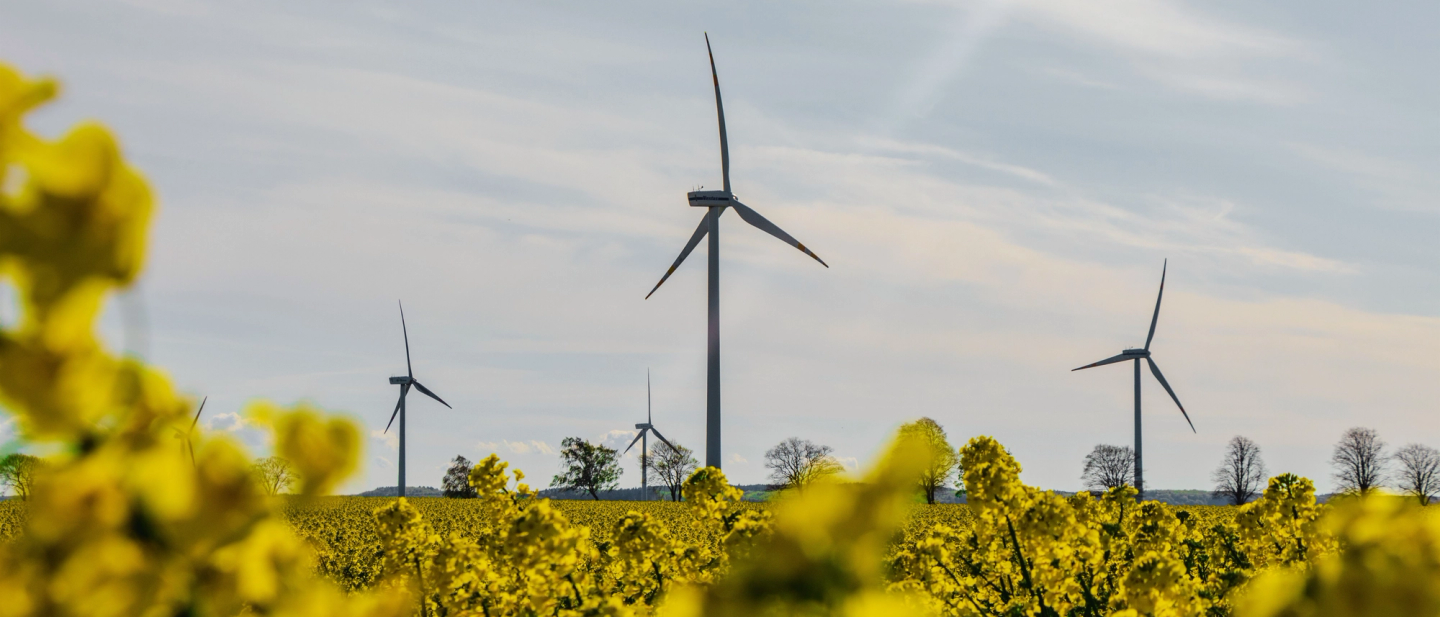
How to Survey and Design a Wind Solar Hybrid Site
How a Hybrid Site Differs from a Pure Solar Site
On a pure solar site, you design the solar array to maximise generation within the available land. On a hybrid site, the wind turbines are already specified or co designed, and you need to design the solar array around them. Three factors from the wind turbines affect your solar design:
1. Shadow zones from turbine towers and blades
A wind turbine's rotating blades cast moving shadows that can affect solar panels placed within a certain radius of the turbine. The shadow's reach depends on the turbine height (typical tower heights in India: 80 to 140 metres), the blade length, and the time of day and year. As a rule of thumb, avoid placing solar panels within 2 to 3 times the rotor diameter of any turbine in the northward shadow direction. Your shading simulation tool must model this moving shadow as an additional obstruction on top of terrain and fixed structures.
2. Wake zones affecting land use patterns
Wind turbines are typically spaced 5 to 7 rotor diameters apart in the prevailing wind direction and 3 to 5 diameters in the cross wind direction. The areas between turbines, outside the wake and shadow zones, are where the solar array can be most efficiently placed. In practice, this means solar panels in the rows between turbine clusters, with clearance zones around each turbine.
3. Access roads and crane pads
Each turbine requires a crane pad for installation and periodic maintenance, and an access road wide enough for heavy transport vehicles. These infrastructure elements take up land that cannot be used for solar. Your layout must account for these permanent land reservations.
The Site Survey for a Hybrid Project
Your survey as the solar EPC on a hybrid project covers all the standard solar assessment elements, plus a few hybrid specific ones.
Standard solar elements: Irradiance data from satellite based tools such as NASA POWER, PVGIS, or Meteonorm for the specific location. Topographic survey to identify slope, drainage, and ground conditions. Geotechnical data for mounting structure foundations, which on a hybrid site may be shared with or need to integrate around wind turbine civil works.
Hybrid specific elements: Turbine placement plan from the wind developer (if final) or indicative turbine coordinates. Shadow study showing the turbine shadow reach at different times of year. Access road and crane pad locations. Substation capacity already allocated to the wind component, and the available balance capacity for the solar injection. Understanding the latter is critical because the shared substation's transformer rating determines the maximum solar capacity the site can absorb into the grid connection.
Designing the Solar Array Layout
Once you have the turbine coordinates and the shadow study, your solar layout follows the same principles as any ground mounted system, with the turbine exclusion zones applied as additional constraints. A few practical approaches that work in Indian hybrid project contexts:
1. Row orientation perpendicular to turbine rows
Most Indian wind farms are laid out with turbines aligned roughly with the prevailing wind. Solar rows oriented perpendicular to the turbine line of sight minimise the time panels spend in a turbine's shadow while maximising packing density in the inter turbine spaces.
2. Use single axis trackers selectively
Single axis trackers increase generation by 15 to 20% by following the sun but require more land per MW than fixed tilt structures. On a hybrid site, the inter turbine land is typically available and trackers can often be used in the open spaces between turbine rows. In the tighter zones near turbines, fixed tilt at 25 degrees south is often more practical.
3. Size the solar to the available substation headroom
This is the most common design error on hybrid projects. If the wind component has contracted 150 MW of grid capacity from a 200 MW transformer, only 50 MW of solar can be connected without additional transformer capacity. Always confirm the total contracted capacity and the balance available for solar before committing to a solar size in your proposal.
Electrical Integration at the Shared Substation
On a hybrid project, your solar inverter output connects to the same AC bus as the wind turbine output at the shared substation. The electrical design must account for power flow from both sources simultaneously and ensure that the protection systems on both the solar and wind sides are coordinated to trip correctly under fault conditions. This design is typically done in conjunction with the electrical consultant for the overall project. As the solar EPC, your deliverable is the solar system up to the point of interconnection at the substation. What happens beyond that point is typically the developer's or a separate consultant's responsibility, but you need to understand it to design your system correctly.
The MNRE technical standards for wind solar hybrid systems, combined with the CEA's grid connectivity requirements, define the protection relay settings, reactive power compensation requirements, and monitoring systems you must provide. Read these before your first hybrid project bid to understand what documentation you will be expected to submit at commissioning.
Action this week: Download the latest MNRE Wind Solar Hybrid Policy document from mnre.gov.in and the SECI technical specifications for a recent hybrid tender. Read the sections on solar component requirements. You are looking for the answer to two questions: what minimum solar to wind capacity ratio does the policy require, and what substation and grid connectivity documentation is expected from the solar EPC. Having these answers ready before your first developer conversation makes you a credible partner rather than a newcomer learning on the job.
Frequently Asked Questions
Does a solar EPC need any wind specific certifications to work on a hybrid project?
No. The solar component of a hybrid project is installed and commissioned by a solar EPC using the same licences and certifications as any other solar project. The wind turbines are installed separately by the turbine OEM's service team or a wind specialised EPC. You do not need wind installation certifications, crane operator licences, or turbine specific training to execute the solar work. What you do need is an understanding of the wind component's layout (turbine coordinates, shadow zones, access roads, crane pads) so your solar design accommodates rather than conflicts with the wind infrastructure. This is a design and coordination requirement, not a certification requirement.
How is performance monitoring structured on a hybrid project?
On most hybrid projects, the developer has a single SCADA (Supervisory Control and Data Acquisition) platform that monitors both wind and solar generation together. As the solar EPC, you are required to integrate your solar monitoring system into this central SCADA. This typically means providing a data logger with a specified communication protocol (usually Modbus TCP or DNP3) that sends inverter data, string data, and system health metrics to the developer's SCADA at a defined time interval (typically 5 to 15 minutes). Confirm the SCADA protocol requirements with the developer before selecting your solar monitoring hardware, as compatibility is required and retrofitting communication protocols after commissioning is expensive.
Sources
- MNRE — mnre.gov.in — National Wind Solar Hybrid Policy — layout requirements, capacity ratio guidelines, grid connectivity standards
- SECI — seci.co.in — Wind solar hybrid tender technical specifications — solar EPC scope of work, substation integration
- CEA — cea.nic.in — Grid connectivity and protection relay standards for hybrid projects
Related Articles

EU Hybrid Solar‑Wind Projects: An EPC‑Focused Guide
EU hybrid solar-wind EPC guide using Spain and Germany cases: shared grid connections, Frontones, Vattenfall, permits and guarantee rules.

India Is Targeting 100 GW of Wind by 2030
India targets 100 GW wind by 2030, up from 56 GW today, 44 GW in four years. Solar EPCs partnering into wind projects can access this pipeline.

India Wind Renewable Consumption Obligation 2026
India's new Wind RCO sits alongside solar RPO. With 6.05 GW of wind added in FY2026, here's why solar EPCs should pay attention.