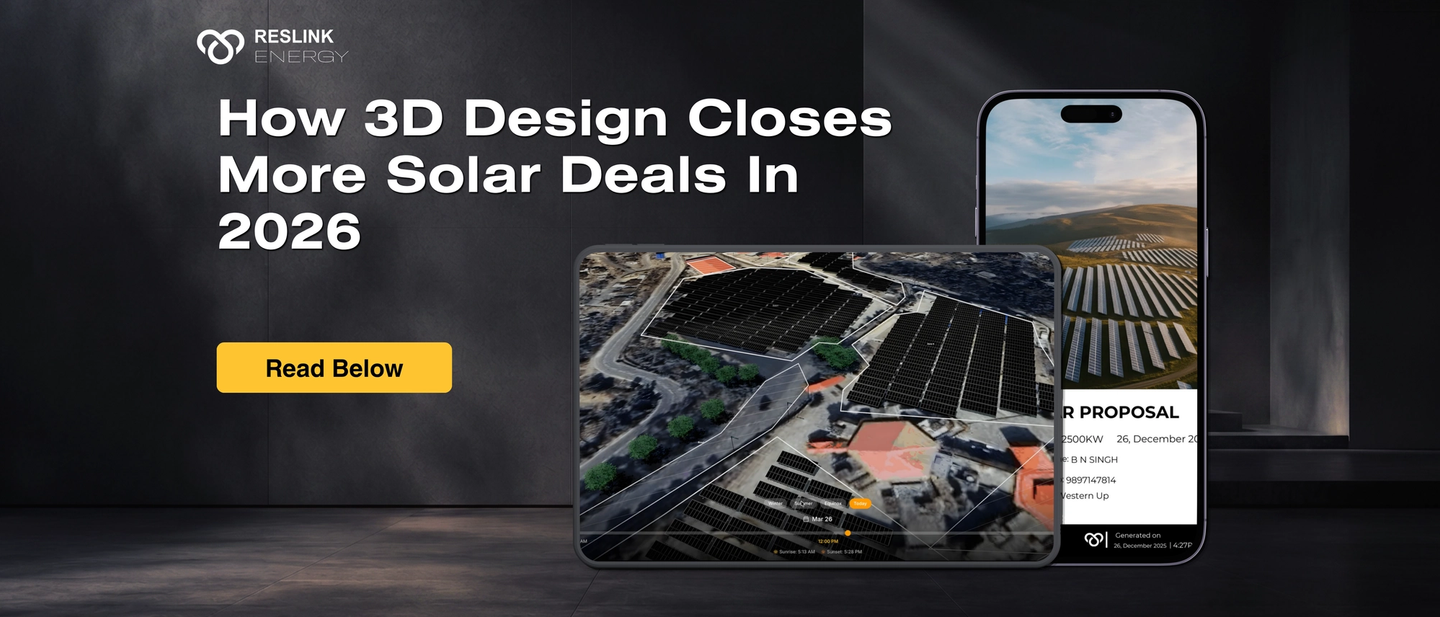
How 3D Design Closes More Solar Deals: Indian EPC Guide
Quick Answer
Question | Answer |
|---|---|
Does a 3D proposal actually close more deals, or is that just a design preference? | Reslink's own customer data shows a 25 to 35% close rate improvement with 3D visual proposals over flat quotes, not just a stylistic difference. |
Why does seeing the design change the client's decision speed? | It replaces an abstract purchase with a specific, visible one, the client isn't imagining a generic system, they're looking at their own roof. |
Who does this apply to? | Residential and commercial solar EPCs competing on projects where multiple bids look similar on paper. |
What's the single biggest fact? | The advantage isn't aesthetic, it's that visual evidence answers objections a flat document can't, before the client has to ask. |
What should EPCs do now? | Check whether the last few lost deals were lost on price, or lost because a competitor's proposal was easier to evaluate. |
The Proposal Gap Most EPCs Do Not See
When three solar EPCs compete for the same commercial rooftop, all three typically have similar panel brands, similar pricing, and similar payback periods. The client cannot verify which technical claim is more accurate. What they can evaluate is how clearly each EPC communicates what they are proposing to build.
Reslink's own data across its customer base shows EPCs delivering a 3D visual proposal, with shadow analysis, generation data, and panel placement shown on the actual roof, see a 25 to 35% improvement in close rate compared to flat, text-based quotes. The underlying mechanism is well documented outside solar too: visual, specific communication is consistently shown in sales and consumer-behaviour research to build buyer confidence and speed decisions more than text alone. 3D design removes the mental work the client has to do. Instead of reading about a solar system and trying to imagine it, the client sees it.
Why Clients Decide Faster With 3D
A solar purchase involves committing a meaningful sum of money to something the client has never seen before. A flat proposal requires the client to trust numbers they cannot verify for a system they cannot visualise. A 3D proposal reduces both problems simultaneously.
When clients see a 3D layout of their roof with panels placed in the exact positions where they will be installed, three things happen:
- The installation becomes real and specific rather than generic
- The shading analysis demonstrates that the EPC has studied this particular roof rather than applying a standard template
- The generation forecast attached to a specific layout feels more credible than a number in a spreadsheet, because the client can see the physical basis for the estimate
Clients who understand what they are buying decide faster. Speed of decision also benefits the EPC, a client who decides quickly doesn't have time to collect three more competing proposals in the meantime.
Five Moments Where 3D Changes the Outcome
The first conversation
With 3D design tools that generate a roof model from a satellite address, the salesperson can arrive at the site visit with a preliminary layout already prepared. Showing a client their roof with panels placed on it in the first conversation, even before other EPCs have submitted quotes, creates an immediate impression of competence that is very difficult to reverse.
The proposal delivery
A 3D layout sent alongside the financial proposal answers the client's most immediate question, where exactly will the panels go, before they have to ask it. The layout contains embedded technical data: panel count, string configuration, inverter location, and shading analysis. A competitor sending a price list cannot compete with this level of specificity.
The objection phase
When a client says the panels will look bad on their roof, or raises concerns about shadow from a nearby structure, a 3D layout with shading simulation answers the question in one image. Visual evidence resolves objections that words alone tend to leave unresolved. A salesperson who can pull up the 3D model on a phone and point to exactly how the shading was accounted for is in a different category from one who says not to worry, it's been accounted for.
The competitor comparison
When a client is comparing proposals from multiple EPCs, the comparison is easier when one proposal is visual and the others are not. A client who receives one clearly designed 3D proposal alongside two plain documents will often attribute the quality of the proposal to the quality of the installation itself, even when that inference isn't strictly logical. Perceived technical competence is built through what the client can see.
The referral conversation
When a satisfied client recommends the EPC to a neighbour or colleague, they typically describe what they experienced. Being able to say "they showed me exactly what my roof would look like before they started" is a more specific, memorable referral story than a generic endorsement. The 3D design becomes part of the word-of-mouth narrative that drives the referral pipeline.
Where This Connects Beyond the Proposal Itself
A proposal that wins the deal is only the first half. Reslink's CRM keeps the same lead and its full design history visible from that first conversation through to signature, so a client who takes a week to decide across two or three follow-ups doesn't turn into a re-explained conversation each time, or a lead that quietly goes cold because nobody had the original design in front of them on the next call.
What Indian EPCs Say After Switching
Reslink Energy customers, specifically the Indian EPCs, consistently report the same two outcomes: clients are visually impressed during the sales presentation, and the shading analysis resolves technical objections before they escalate. One EPC testimonial cited: "The 3D link and shadow analysis help us close more clients. The 3D simulation is the best we have seen compared to any other platform."
Other EPC in Pune reduced its average project completion time by 50% after switching from manual CAD drawings to AI based 3D design, and shading accuracy improved simultaneously. The business impact was both operational (faster delivery) and commercial (higher close rate). Speed and quality are not a trade off when the design process is built around the right tools.
The competition reality worth keeping in mind: an EPC presenting a 3D layout with shading analysis is no longer competing on price alone. They're competing on visible evidence of technical skill, and that's a competition they can win even against a lower-priced bid.
Common Mistakes EPCs Make With Visual Proposals
- Treating the 3D layout as a nice-to-have add-on rather than the core of the proposal. A polished PDF wrapped around a generic spec sheet doesn't get the persuasion effect, the layout has to be built from the client's actual roof, not a template.
- Not addressing accuracy expectations upfront. A 3D design built from satellite imagery is a pre-installation model, not a construction drawing. Clients who aren't told this upfront sometimes expect millimetre-level precision the model was never meant to provide.
- Showing the design without the shading analysis attached. The layout alone answers "where will the panels go." It's the shading analysis specifically that resolves the objections about performance and placement, skipping it leaves the strongest part of the pitch unused.
What EPCs Should Do Now
- Check whether recent lost deals were actually lost on price, or lost because a competitor's proposal was simply easier for the client to evaluate.
- Compare how long it currently takes to produce a 3D visual proposal against how long a flat, text-based one takes, most of the objection-handling value comes from having it ready in the first conversation, not after.
- Book a demo to see a full 3D proposal, shading analysis included, built live.
How This Fits Into a Reslink Workflow
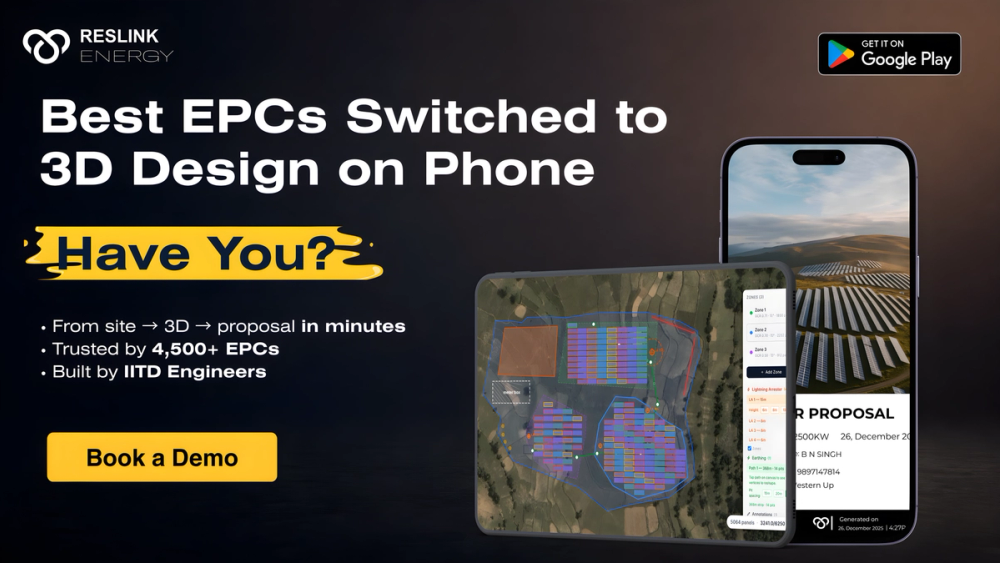
The 3D layout, the shading analysis, and the proposal all come from the same design, generated on-site, on a phone, before the salesperson leaves the roof. That's what makes the objection-handling moments above possible in the first conversation rather than a follow-up call, there's no separate design step happening back at an office between the site visit and the proposal reaching the client.
See a full 3D proposal built live, on a real site → Book a demo
Frequently Asked Questions
Q1. Does a 3D proposal work for residential clients, or only commercial?
It works for both, but the conversion impact tends to be stronger for residential clients. A homeowner investing their own money in their personal property has a strong emotional stake in what the installation will look like. A 3D view of their specific home with panels placed on it is far more persuasive than a generic system specification. For commercial clients, the 3D layout plus shading analysis matters more than visual appeal alone, facility managers respond to technical rigour, which the layout demonstrates concretely.
Q2. How much does 3D solar design software cost for an Indian EPC?
Costs vary by platform and scale. The right comparison isn't the software cost in isolation, it's the cost per proposal against the revenue per closed project. EPCs who switch to Reslink typically see up to a 30% improvement in lead conversion within the first month itself, which for most teams more than covers the software cost from the additional closed deals alone.
Q3. What if the 3D design does not match the actual roof exactly?
The 3D design is a pre-installation model, not a construction drawing. Most clients understand this distinction when it's explained clearly upfront. The proposal should note that the layout is based on satellite imagery and subject to minor adjustment during the site verification visit. The value of the 3D model isn't millimetre-level accuracy, it's demonstrating how the system will be placed, where shading occurs, and what the result will look like. Clients who see a 3D model don't expect a blueprint, they appreciate the level of preparation it represents.
You May Also Like
- Solar Design Software for Indian EPCs
- 3D Solar PV Design Software: Design First, Visit Once
- How Reslink's 3D Solar Design Works: Site to Bankable Output
Sources
- General sales and consumer-behaviour research on visual communication and buyer decision speed, cited for the underlying mechanism, not for a specific percentage
- Reslink internal customer data, cited for the 25 to 35% close rate improvement and the 30% first-month conversion figure
Related Articles
Best Solar Design Software India: The Full Scorecard
6 platforms scored on nine criteria, methodology shown, India regulatory depth included. The most complete, most transparently scored comparison published.
Best Solar Software in India: By Type, Then by Use Case
Which type of solar software you actually need, then the right pick by project type: residential, C&I, utility-scale, and multi-state Indian EPCs.
Solar Design Software Stack India: Break-Even Math (2026)
No single tool covers the Indian solar stack. The real break-even formula for licensing PVsyst and AutoCAD in-house versus outsourcing them.