Germany Commercial Solar Incentives 2026: Full Stack
Why Germany's C&I Solar Market Has a Knowledge Gap
Germany's commercial solar incentive framework is deliberately layered. No single instrument covers the full project cost. The design is intentional: the government wants projects to combine multiple instruments, each serving a different policy goal. A business that uses only the EEG feed-in tariff is leaving significant available support unclaimed. A business that combines KfW 270 financing, Marktprämie revenue, §7g depreciation, VAT recovery, and applicable state grants achieves project economics that are structurally different from a competitor relying on a single channel.
The knowledge gap exists because the stack is complex and the sequencing rules are strict. Both KfW and state grant programmes require applications to be submitted and approved before any delivery contracts are signed. Retroactive applications are voided without exception. An EPC advising a commercial client on incentives after the installation contract is signed has already disqualified a significant portion of the available funding. The advice has to come first.
The Intersolar Europe 2026 focus theme, "A Smart Combination for Industry and Commerce," has put this market in focus for the week of June 23. The commercial solar conversation in Munich this year centres on how German businesses can build the strongest possible financial case for their solar investment. This guide is the EPC side of that conversation.
The Six Instruments and How They Stack
1. KfW 270: the financing foundation
The KfW 270 Renewable Energies Standard loan covers the full cost chain of a commercial solar installation, including modules, inverters, mounting systems, and balance of system components. Loans cover up to 100% of eligible project costs, up to €150 million per project, at subsidised interest rates. Terms run from 5 to 30 years with up to 5 repayment-free years. The programme has no minimum loan amount. Applications go through a certified KfW Hausbank, not directly through KfW. The critical sequencing rule: the Hausbank application must be submitted and approved before any delivery contracts or purchase orders are placed. Placing an order before approval does not void the KfW loan application in all cases, but it can complicate the disbursement. Confirm with the Hausbank before issuing any purchase order.
KfW 270 is a loan, not a grant. It does not reduce the total amount repaid; it reduces the interest cost over the loan term. On a €400,000 project financed at KfW's subsidised rate versus a standard commercial loan, the interest saving over 15 years is materially significant. It also does not compete with grant programs: KfW 270 can be combined with state grants and tax benefits simultaneously.
2. State-level grants: Bayern Mittelstand PV and progres.nrw
State programs such as Bayern Mittelstand PV and progres.nrw offer grants for qualifying commercial solar projects in their respective states. Grant amounts, eligibility criteria, and programme budgets vary by cycle. Confirm current availability directly with the Bayerisches Staatsministerium für Wirtschaft and MWIDE NRW before including any state grant in a client financial model. Apply before signing any delivery or installation contracts; late applications are rejected without exception.
3. Marktprämie: the 20-year revenue foundation for larger systems
Systems above 100 kWp must enter Direktvermarktung (direct marketing) under EEG 2023 §22 Abs. 3 and receive the Marktprämie, a premium above the wholesale electricity price, instead of the fixed feed-in tariff. For rooftop systems between 100 kWp and 750 kWp, the anzulegender Wert (reference value for the Marktprämie calculation) is legally fixed under EEG §48: no Bundesnetzagentur tender is required. For rooftop systems above 750 kWp (since Solarpaket I, May 2025) and for ground-mount systems, the anzulegender Wert must be obtained through a quarterly Bundesnetzagentur tender, where projects bid the minimum premium they require and the lowest bids receive 20-year contracts. The Bundesnetzagentur's March 2026 auction recorded an average award price of 4.94 ct/kWh for ground-mount, with bids ranging from 3.99 to 5.10 ct/kWh. Solarpaket I (in force May 2024) expanded annual EEG tender volumes for rooftop solar, creating more available capacity per auction round. For commercial EPCs, this means the bidding environment for rooftop systems is more competitive than ground-mount but the available MW in each round is larger.
4. §7g accelerated depreciation: 20% in year one
Under Section 7g of the German Income Tax Act (EStG), businesses can claim accelerated depreciation on newly acquired assets including solar installations. In the year of commissioning, 20% of the acquisition cost can be deducted from taxable income immediately, rather than depreciating over the standard 20-year asset life. For a €400,000 commercial solar installation, this is an €80,000 deduction in year one. For profitable businesses with a 30% effective tax rate, the immediate tax saving is €24,000. This instrument does not require a separate application. It is claimed in the annual tax return for the year of commissioning. An EPC who presents this to a commercial client alongside the project investment case is providing information the client's tax advisor will confirm and that directly improves the year-one cash position.
5. Zero VAT on hardware and installation
Since January 1, 2023, a 0% VAT rate applies to the supply and installation of solar panels and associated components for systems on or adjacent to residential and public buildings. For commercial buildings, VAT is charged at the standard 19% rate but is fully recoverable by VAT-registered businesses as input tax. A commercial business that pays VAT on installation in January and recovers it in the next quarterly VAT return has effectively received a short-term financing benefit of up to 19% of the project cost for 3 months, with full recovery guaranteed. The cash flow implication is worth modelling explicitly in the EPC's proposal to the client.
6. State programs: apply before the budget runs out
Bayern Mittelstand PV and progres.nrw are the two largest state-level commercial solar programs active in 2026. Both stack with KfW 270 and have separate application portals through their respective state energy ministries. Both have annual budget caps. Apply before signing any delivery contract and confirm current availability with the relevant state ministry before including state grants in a client financial model. The state program application should be the first step before KfW.
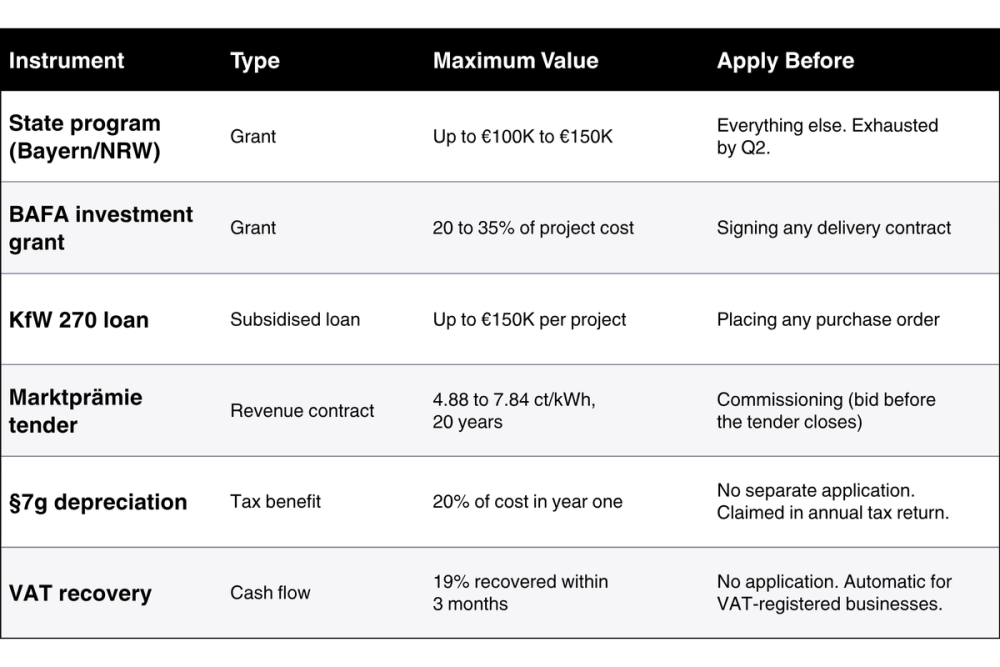
The rule that eliminates most missed incentives: Every state grant program requires approval before you sign any delivery or installation contract. An EPC who presents the incentive stack to a client and then immediately issues a purchase order before state grant approval has disqualified that grant. The sequencing is: state program application first, KfW Hausbank application second, then purchase orders and contracts, then commissioning, then Marktprämie tender for systems that require it.
The Bavaria Example: How the Full Stack Changes the Numbers
A 500 kWp commercial rooftop installation in Bavaria, typically on a logistics facility or food production plant, illustrates how the stack changes the economics. Gross installation cost at current German commercial pricing: approximately €400,000 to €500,000. Applied correctly, the full stack delivers:
- Bayern Mittelstand PV: up to €100,000 additional reduction
- §7g depreciation at 20%: €80,000 to €100,000 tax deduction in year one, saving approximately €24,000 to €30,000 in immediate tax at a 30% rate
- KfW 270 interest saving: approximately €15,000 to €25,000 over the loan term versus a standard commercial rate
- Marktprämie revenue: 20-year income stream on top of self-consumption savings
The combined effect of grants, tax benefit, and financing saving on a well-structured Bavaria project is substantial. An EPC who presents only the EEG self-consumption case to a Bavarian commercial client is presenting a fraction of the actual financial argument available.
How to Present This to a Commercial Client
The commercial client's decision is not about whether solar makes sense. In Germany in 2026, with retail electricity at 28 to 32 cents per kWh and a full incentive stack available, the question is whether the timing and sequencing of the application process fits their business planning calendar. The EPC who can answer that question precisely, with a clear timeline from first application to commissioning, is the EPC who closes the commercial project.
A complete commercial proposal should include: system design with generation and self-consumption estimates; full incentive stack available for this client's location, size, and business type; application sequence with realistic timelines for each approval; 20-year financial model incorporating Marktprämie revenue and self-consumption savings net of all financing costs; and a clear action timeline showing when each application must be submitted to hit the target commissioning date. Producing this proposal manually for each commercial client is time-intensive and error-prone. Tools like Reslink generate the design, generation model, and financial output from a single workflow, reducing the time from site visit to commercial proposal from days to hours.
Frequently Asked Questions
Q1. Can KfW 270 and BAFA grants be combined on the same project?
Yes. KfW 270 is a subsidised loan and state programs such as Bayern Mittelstand PV and NRW Progress.NRW are direct capital grants. They serve different purposes and can be combined. KfW 270 reduces the interest cost on the borrowed portion; the state grant reduces the capital amount. The application sequence matters: apply for the state grant and receive approval before placing any purchase orders or signing any delivery contracts. The KfW Hausbank application should also be submitted before purchase orders are placed. Both require pre-commitment approval to remain valid.
Q2. What is the Marktprämie and when does it apply?
The Marktprämie is a top-up payment above wholesale electricity prices for solar systems that enter Direktvermarktung. It applies instead of the fixed EEG feed-in tariff, which is generally available only for systems up to 100 kWp. Systems above 100 kWp must enter Direktvermarktung under EEG §22 Abs. 3. For rooftop systems between 100 kWp and 750 kWp, the anzulegender Wert used for the Marktprämie calculation is legally fixed under EEG §48, so no tender is required. Only rooftop systems above 750 kWp and ground-mount systems must participate in Bundesnetzagentur tenders to establish their anzulegender Wert. EPCs delivering systems above 100 kWp should arrange a Direktvermarktung aggregator agreement before commissioning.
Q3. What happens if my client applies for BAFA after signing the installation contract?
The application will be rejected. German state grant programmes require that no delivery contracts, purchase orders, or installation agreements have been signed before the grant application is submitted and approved. The rationale is that the grant must demonstrably be an incentive to invest, not a windfall on an already-committed decision. If the investment has already been committed before approval, the programme administrator concludes the grant is not influencing the decision. There are no exceptions and no appeal pathway once a contract is signed. This is the most common and most expensive mistake in German commercial solar incentive applications. The EPC's role is to flag this before the client commits to anything in writing.
Q4. Does §7g accelerated depreciation require a separate application?
No. Section 7g of the German Income Tax Act is a statutory tax provision that applies automatically to qualifying business assets. It does not require a separate application to any government body. It is claimed in the annual income tax return for the year of commissioning by the business's tax advisor. The EPC's role is to make the client aware of this provision before finalising the investment decision, so the client can factor the year-one tax saving into their cash flow planning. The 20% deduction in year one significantly improves the immediate return on a commercial solar investment. For a profitable business in a 30% tax bracket, a €400,000 installation generates an immediate year-one tax saving of approximately €24,000 through this provision alone.
Q5. Do state programs like Bayern Mittelstand PV stack with BAFA?
Yes. State programs such as Bayern Mittelstand PV and NRW Progress.NRW stack with KfW 270 financing. They are administered by the relevant state energy ministry with separate application portals and approval processes. Both types of support can apply to the same project. The critical constraint: both state programs have annual budget caps and require pre-approval before any contracts are signed. Apply as early in the calendar year as possible and confirm current availability directly with the relevant state ministry before including state grants in a client financial model, as programme terms and budget availability change annually.
Q6. What is the correct sequencing for a German commercial solar incentive application?
The correct sequence is: (1) Apply for state program first (Bayern Mittelstand PV or NRW Progress.NRW if applicable) before signing any contracts; (2) Apply through a KfW Hausbank for KfW 270 financing before placing any purchase orders; (3) Once all approvals are received, issue purchase orders and sign installation contracts; (4) Arrange a Direktvermarktung aggregator agreement before commissioning if the system is above 100 kWp; (5) For rooftop systems above 750 kWp or ground-mount, submit a Bundesnetzagentur tender bid before commissioning; (6) Commission the system and register in MaStR within one month of commissioning; (7) Claim §7g depreciation in the year-end tax return. Missing the sequence at steps 1 or 2 voids the corresponding grant entirely.
You May Also Like
- Germany Solar Feed-In Tariff 2026: Last Year to Lock In
- Intersolar Europe 2026: What German Solar EPCs Should Look For in Munich
- Germany Agri-PV 2026: What Solar EPCs Need to Know
Sources
- Bundesnetzagentur, February 13, 2026 — bundesnetzagentur.de — December 2025 ground-mount solar auction: average 5.00 ct/kWh, range 4.40 to 5.30 ct/kWh; special solar installations (including Agri-PV) awarded within first-segment auction
- Bundesnetzagentur, March 2026 — bundesnetzagentur.de — March 2026 ground-mount auction results: average 4.94 ct/kWh, range 3.99 to 5.10 ct/kWh
- KfW (Primary): kfw.de, official KfW 270 Erneuerbare Energien Standard Merkblatt, confirming up to €150 million per project and 5 to 30 year terms with up to 5 repayment-free years, application through certified Hausbank
- Bundesnetzagentur (Primary) — bundesnetzagentur.de — EEG Marktprämie quarterly tender results and upcoming tender volumes; 100 kW threshold for direct marketing obligation
Related Articles
Solar & Storage Live UK 2026: EPC Guide
NEC Birmingham, September 22-24. Confirmed speakers, six conference tracks, and the live grid-connection fight EPCs should actually watch.

Solar Design Software for EPCs in Botswana
Botswana's Rooftop Solar Programme runs through BPC. What EPCs need for compliance, and how Reslink fits a market just getting started.
US Energy Storage Hits Record 20.2 GWh in Q2 2026
US energy storage hit a record 20.2 GWh in Q2 2026, 44% paired with solar. What the SEIA/Benchmark data signals for solar EPCs globally.