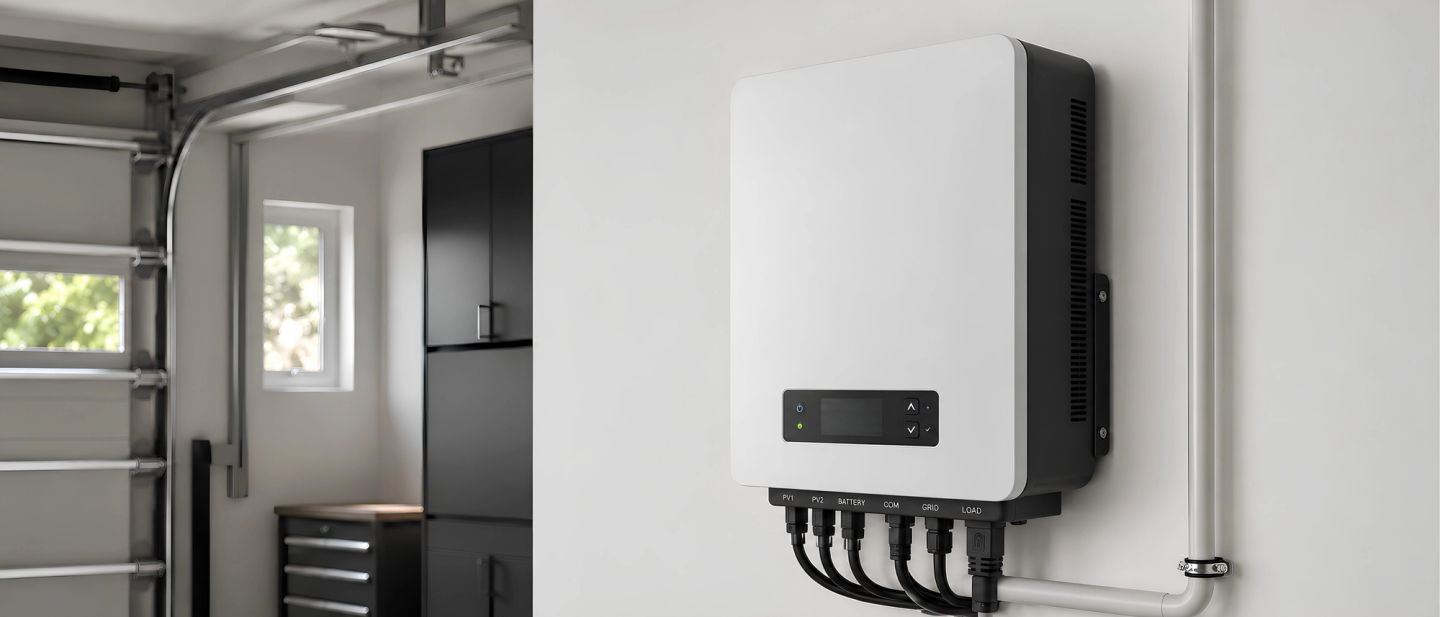
FCC Inverter Ban 2026: What's Actually Banned
Quick Answer
Question | Answer |
|---|---|
What did the FCC do? | On July 28, 2026, the FCC added foreign-produced connected power inverters to its Covered List, barring new models from receiving the equipment authorization required to import, market, or sell them in the US. |
Does this affect inverters already in use or already approved? | No. The action is forward-looking only. Previously authorized models can still be imported, sold, installed, and used without restriction. |
What counts as a "covered" inverter? | A device must do both: convert DC to AC (or AC to DC) power, and have remote communication capability, Wi-Fi, cellular, Bluetooth, or similar. Non-networked, air-gapped inverters aren't covered. |
Is this limited to residential or small-scale systems? | No. Unlike the FCC's earlier router listing, this covers all foreign-produced connected inverters regardless of project scale, including utility and commercial systems. |
Can a manufacturer get an exemption? | Yes, through a Conditional Approval application to the Department of War or Department of Homeland Security, but the FCC hasn't published criteria for what gets approved. |
Why This Matters for EPCs
If you're specifying inverters for a US project right now, the model you'd normally reach for might not be the model you can use going forward, but your existing bill of materials for projects already in the pipeline is very likely untouched. That distinction, new authorizations versus existing ones, is the entire story here, and it's also exactly where the initial wave of coverage got confused. pv magazine's own first report on this, published the day of the announcement, ran language broad enough to suggest a general ban on foreign inverters; an Editor's Note added the next day walked that back to the narrower, accurate scope. A meaningful share of what's still circulating in the industry right now is working off that first, overstated version.
This isn't an isolated action. It landed five weeks after the Section 232 polysilicon tariffs, which reshape module and cell costs starting December 4, 2026. Together, the two actions tighten sourcing on both sides of a solar system, panels and modules on one side, inverters on the other, within the same summer. See our full Section 232 guide for the module and cell cost basis changes, this piece covers the equipment authorization side.
What the FCC Actually Did
Date | Event |
|---|---|
December 2025 | FCC adds foreign-produced drones and drone components to the Covered List |
March 23, 2026 | FCC adds foreign-produced consumer routers to the Covered List |
July 27, 2026 | White House-convened interagency body delivers National Security Determinations on power inverters and advanced robotic devices to the FCC |
July 28, 2026 | FCC adds both categories to the Covered List, effective immediately |
January 1, 2029 | Software/firmware update waiver for pre-ban authorized inverter models expires unless extended |
The FCC's Covered List, established under the Secure and Trusted Communications Networks Act, lists equipment the government has determined poses an unacceptable national security risk. Equipment on the list can't receive FCC equipment authorization, and most electronics require that authorization before they can be legally imported, marketed, or sold in the US. Critically, the FCC itself doesn't decide what goes on the list. It's required to add whatever national security agencies determine, which is exactly what happened here: an interagency body delivered its determination on July 27, and the FCC acted on it the very next day.
The stated rationale, quoting the government's own National Security Determination directly: foreign-produced inverters create "a supply chain vulnerability that could disrupt U.S. economic security" and "a cybersecurity risk that threatens the security of critical infrastructure," specifically because remote connectivity could let a foreign actor disable inverters, exfiltrate data, or conduct surveillance through the grid.
The Two-Prong Test: What's Actually Covered
Requirement | Covered | Not Covered |
|---|---|---|
Power conversion | Converts DC to AC or AC to DC (microinverters, string inverters, central inverters, hybrid/battery inverters) | N/A, this alone doesn't trigger coverage |
Connectivity | Has remote communication, control, sensing, or monitoring via Wi-Fi, cellular, Bluetooth, or similar | Hardwired, air-gapped inverters with no remote connectivity |
Country of manufacture | Foreign-produced (doesn't meet the "domestic end product" standard under Buy American Act rules) | US-manufactured, meeting the domestic end product standard |
Both conditions have to be true for a device to be covered. This is worth stating plainly because a lot of secondary coverage treats it as a blanket ban on foreign inverters, and it isn't. A foreign-made inverter with zero remote connectivity, an increasingly unusual but not nonexistent product category, falls outside the rule entirely.
"Domestic end product" isn't just about where final assembly happens. Under the Buy American Act standard the rule incorporates, an inverter must be manufactured in the US and the cost of its US-made components must exceed 65% of the cost of all components, a threshold rising to 75% in 2029. A US-branded inverter assembled abroad is covered by the ban. A foreign-owned manufacturer's US-built unit may not be, if the domestic content math clears that bar. This cuts both ways, and it's worth checking the actual content breakdown, not just the country listed on the box, before assuming a model is or isn't affected.
The Real Cost of a Mid-Project Model Swap
The scope of this rule is narrow, new authorizations only, but the practical cost of getting caught by it isn't. Interconnection applications specify an exact inverter model. Swap that model after the application is filed, and utilities generally treat it as a Material Modification requiring a fresh engineering restudy, not a paperwork update. Industry analysts speaking to PV Tech and Energy-Storage.news both describe this as adding years, not weeks, to a project timeline, and sending the project back in the interconnection queue rather than holding its place.
One legal nuance worth being precise about, since initial coverage of this rule got it wrong in the same way it overstated the ban's general scope: the Covered List restricts equipment authorization, not interconnection or operating rights. A project already interconnected, or running on a model that already holds a valid FCC authorization, isn't at legal risk of losing the right to operate. The restudy cost only applies if a developer is forced to substitute a different, unauthorized model into an application already filed against a specific one.
Scenario | Consequence |
|---|---|
Project uses an inverter model already FCC-authorized before July 28, 2026 | No restudy, no change to interconnection status |
Project's specified model was never authorized, and now can't be | Likely forced substitution, treated as a Material Modification, restudy required |
Project already interconnected and operating | Not affected, authorization applies to new market entry, not existing operation |

Which Manufacturers Are Affected
No official list exists of which specific brands or models are covered, checking a model's own FCC authorization status directly is the only fully reliable method. But named examples from industry reporting give a useful directional picture.
Manufacturer | Status | Source |
|---|---|---|
Hoymiles (China) | Existing portfolio, including the HiFlow Pro and HMS series, authorized before July 28, 2026, unaffected | Manufacturer statement, July 10, 2026 |
APsystems (China) | Entire current product line confirmed authorized under Grantee Code 2AFGR | Manufacturer statement |
SMA (Germany), Power Electronics (Spain) | Non-Chinese foreign manufacturers industry analysts expect could pursue Conditional Approval waivers | Industry analyst, quoted by Canary Media |
GE Vernova | US-based, operates an inverter factory in Pittsburgh with potential for expanded domestic capacity | Industry reporting |
Nextpower (US) | Acquiring the inverter and power conversion business of Spain's Zigor, including its US subsidiary Apex Power | Industry reporting |
Two of these, Hoymiles and APsystems, are named specifically because their entire current portfolios are confirmed pre-authorized, useful if either is already in your supply chain. The rest illustrate the market response rather than confirm any specific compliance status, treat them as directional, not a substitute for checking an actual model's authorization directly.
What's Not Affected
- Previously authorized models: Any inverter model that received FCC equipment authorization before July 28, 2026 can continue to be imported, sold, installed, and used without restriction. This covers the large majority of equipment already specified in active projects.
- Devices already purchased or installed: The action has no effect on continued use of anything already in the field.
- Federal government purchases and use: The Covered List restrictions don't apply to devices sold to or used by federal agencies.
- Software and firmware updates on existing authorized models, under a blanket OET waiver, though this waiver doesn't cover hardware changes and is currently set to expire January 1, 2029 unless extended.
The Conditional Approval Path, and Its Real Uncertainty
Manufacturers can apply for a Conditional Approval that exempts a specific inverter or class of inverters from the prohibition, submitted to the FCC and reviewed by the Department of War or the Department of Homeland Security. This is a genuine path back into the market for a foreign manufacturer, but as of this writing, the FCC has not published criteria for what wins approval. That's not a gap in this piece's research, it's an actual, current gap in the public record. Any supplier who tells you they're "getting a Conditional Approval" is describing an application to a process with no published standard yet, not a guaranteed or even predictable outcome.
A Genuine Policy Tension Worth Knowing
The Department of Energy conducted its own security audit of 30 Chinese-made inverters in January 2026 and found zero evidence of malicious hardware. The FCC's action doesn't contest that finding, it reframes the risk entirely: not physical tampering, but the exploitable combination of remote firmware-update capability and network connectivity itself. Whether that's the right line to draw is a genuinely contested policy question, not a settled one, and it's worth understanding the distinction rather than assuming the ban followed from a security failure that was actually found.
The Domestic Supply Question
This is where the compliance story becomes a sourcing story. According to one industry analysis, US-based inverter manufacturing now covers roughly 40% of combined 2027 solar and battery storage demand, up from around 7% in 2020, and domestic annual inverter capacity is tracking toward roughly 40 GW by the end of 2026. The EIA separately forecasts 43.4 GW of utility-scale solar additions in 2026 alone. Read together, domestic capacity is closing the gap but hasn't closed it, worth flagging as a single-source estimate rather than a government figure, the scale of the gap is directionally real even if the exact percentages need a second look before quoting to a client.
One concrete example of how this plays out for a specific product line: Hoymiles confirmed on July 10, 2026, ahead of the ban taking effect, that its existing portfolio, including the HiFlow Pro, held FCC authorization prior to the cutoff and remains fully legal to sell and install. That's a single manufacturer's own statement, not independently verified here, but it's the kind of concrete "is my model still fine" answer worth knowing how to look for with any specific supplier.
Common Mistakes to Avoid
- Assuming this bans foreign inverters generally. It doesn't. It bars new authorizations for new models going forward; anything already authorized is untouched.
- Assuming a project already in the interconnection queue is affected. If the specified inverter model already holds FCC authorization, nothing about this action changes that project.
- Treating "Conditional Approval" as a known, predictable process. No criteria have been published yet. Don't commit a client timeline to an approval that doesn't have a defined path.
- Assuming this is residential-only. Unlike the router action, this explicitly covers commercial and utility-scale equipment too.
- Assuming a hardwired inverter with no app or remote monitoring is covered. It isn't, the two-prong test requires connectivity, not just power conversion.
How This Fits Into a Reslink Workflow
For any new US project, confirm the FCC authorization date of every inverter model in your standard BOM before quoting, if a model was authorized before July 28, 2026, nothing changes; if you're evaluating a newer or unreleased model from a foreign manufacturer, check its authorization status directly rather than assuming. If a supplier claims Conditional Approval status, ask for the actual approval documentation, not a stated intention to apply, given there's no published approval criteria yet, an in-progress application isn't the same as a resolved one.
See the full workflow generate a complete proposal in under 10 minutes → Book a demo
Frequently Asked Questions
Q1. Can I still buy and install inverters I've used on past projects?
Yes, as long as that specific model received FCC equipment authorization before July 28, 2026. The ban only blocks new authorizations, it doesn't revoke or affect existing ones.
Q2. Does this affect microinverters specifically, or just larger string and central inverters?
All of them. The FCC's definition explicitly includes microinverters, string inverters, central inverters, and hybrid battery-based inverters, as long as the connectivity condition is also met.
Q3. What happens to a project already in an interconnection study with a foreign inverter specified?
If that inverter model was authorized before the ban, nothing changes. If it wasn't, or if you're switching to a newer unreleased model, that substitution could count as a material change requiring interconnection restudy, worth checking with the interconnecting utility before assuming a swap is a minor change.
Q4. Is there a list of which specific inverter models are affected?
No. The Covered List operates by category and definition (foreign-produced, DC/AC conversion, remote connectivity), not by naming specific banned models. Checking a specific model's FCC authorization date and status is the only reliable way to confirm its status.
Q5. Does US-made equipment need to worry about this at all?
No. The rule only applies to foreign-produced inverters, meaning products that don't meet the "domestic end product" standard under Buy American Act rules. US-manufactured inverters are unaffected regardless of connectivity features.
Sources
- Federal Communications Commission (Primary): docs.fcc.gov, "FACT SHEET: FCC Updates Covered List to Include Foreign-Produced Advanced Robotic Devices and Power Inverters," July 28, 2026, confirms the action, legal basis, exemptions, and Conditional Approval pathway, includes verbatim National Security Determination language
- Wiley: wiley.law, confirms the two-prong conjunctive definition and the non-residential, non-consumer scope
- Stoel Rives LLP: stoel.com, confirms the January 1, 2029 software/firmware waiver expiration and its hardware-change limits
- Pillsbury Winthrop Shaw Pittman LLP: pillsburylaw.com, confirms the drone-router-inverter Covered List expansion timeline
- pv magazine USA: pv-magazine-usa.com, July 28-29, 2026, including the July 29 Editor's Note correcting the initial scope characterization
- mGrid: mgrid.org, domestic inverter manufacturing capacity estimates, flagged as single-sourced
- PluginSolarUS: pluginsolarus.com, the Hoymiles HiFlow Pro authorization example, flagged as single-sourced, manufacturer's own statement
Related Articles
Solar & Storage Live UK 2026: EPC Guide
NEC Birmingham, September 22-24. Confirmed speakers, six conference tracks, and the live grid-connection fight EPCs should actually watch.

Solar Design Software for EPCs in Botswana
Botswana's Rooftop Solar Programme runs through BPC. What EPCs need for compliance, and how Reslink fits a market just getting started.
US Energy Storage Hits Record 20.2 GWh in Q2 2026
US energy storage hit a record 20.2 GWh in Q2 2026, 44% paired with solar. What the SEIA/Benchmark data signals for solar EPCs globally.