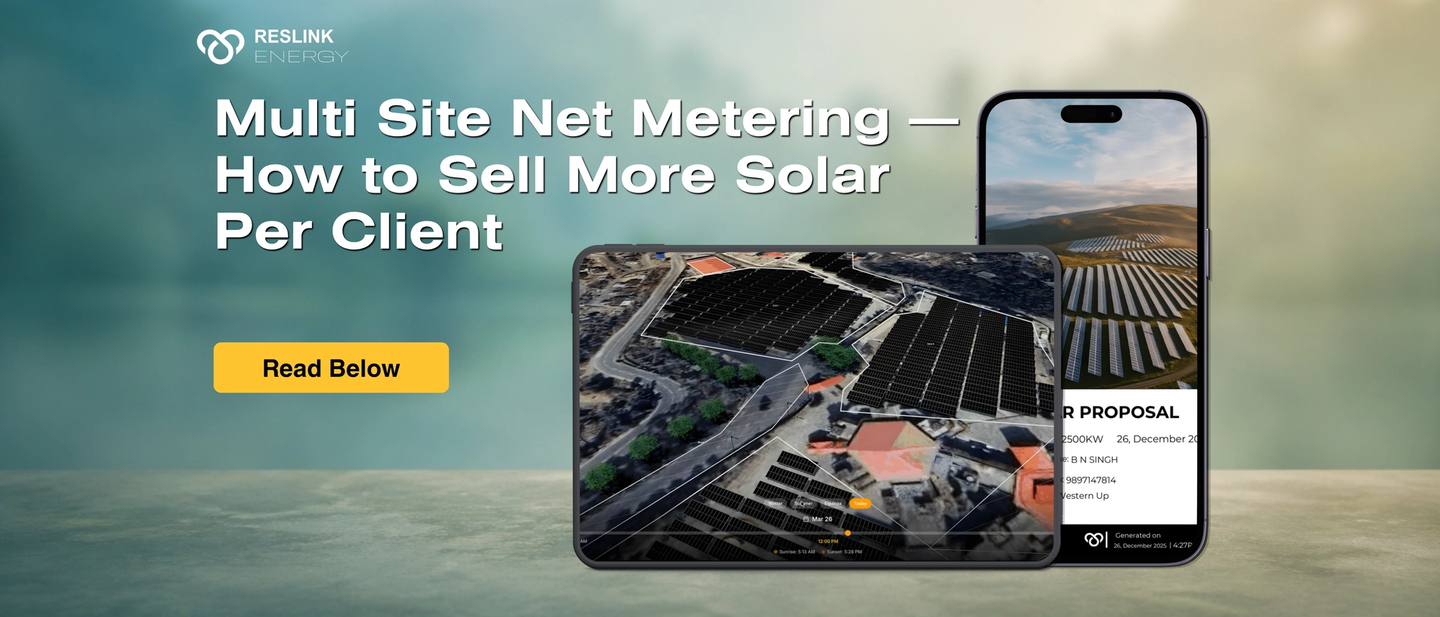
Multi Site Net Metering Is Here. How to Sell More Solar Per Client.
What Multi Site Net Metering Means
Standard net metering in the Philippines works at the account level. Your solar system generates power. Excess power goes to the grid. You earn bill credits on that specific electricity account at that specific address. The credit cannot move to a different property or a different account.
Multi site and aggregate net metering, introduced in the February 2026 DOE reform, changes this. Consumers can now share energy credits across multiple electricity accounts within the same distribution utility area. A business owner who installs solar on their factory can use the excess credits to offset electricity bills on their warehouse two kilometers away, their office building in the same city, or their retail outlets within the Meralco service area.
This is a significant commercial change. For clients with multiple properties, it means a single large solar installation can benefit multiple locations. For EPCs, it means more systems per client, larger average project size, and a new conversation to have with every commercial client who owns more than one property.
Who Benefits Most
- Commercial and industrial property owners with multiple buildings in the same utility service area. A manufacturer with a factory and a warehouse, a developer with multiple commercial units, a school or hospital group with multiple campuses.
- Retail chains and franchise businesses with multiple outlets in the same city. If one outlet has a large roof with strong solar potential but the others do not, multi site metering lets the one strong installation serve the whole portfolio.
- Residential property owners with multiple houses in the same Meralco or VECO area. Someone who owns their home and two rental properties can install solar on the property with the best roof orientation and share credits across all three accounts.
The New Revenue Stream: RECs
The February 2026 reform also introduced a new benefit: prosumers now retain ownership of Renewable Energy Certificates (RECs) for the electricity they consume from their own solar installation. These certificates can be sold or traded through the Philippine Renewable Energy Market.
This is an additional revenue stream that most Philippine solar clients do not yet know exists. RECs represent the renewable attribute of each unit of electricity generated. Corporations with sustainability commitments, ESG reporting requirements, or RE100 pledges are active buyers of RECs. A household or business that generates renewable energy and retains its RECs can sell these certificates to buyers who want to claim renewable energy consumption without generating it themselves.
For EPCs, this is a conversation that positions solar as a business asset rather than just a cost saving tool. A medium sized manufacturer in Laguna who installs 500 kW of rooftop solar is not just reducing their electricity bill. They are generating a stream of RECs that can be sold to export focused clients who need renewable energy documentation for their global supply chain compliance.
How EPCs Should Update Their Pitch
For any commercial client who owns or operates more than one property, add one question to your first meeting: "How many electricity accounts do you have within the Meralco or VECO service area?" The answer tells you whether multi site net metering applies and opens a conversation about covering the whole portfolio rather than a single location.
For clients with good rooftops on one property and high bills on another, the pitch becomes: "We can install solar on your factory, which has the best roof, and use the excess credits to offset your office and warehouse bills as well. One installation, multiple savings."
For businesses with sustainability reporting requirements, add the REC angle: "Your solar installation generates Renewable Energy Certificates that you can either use for your own ESG reporting or sell to other companies that need to document renewable energy use. Either way, the installation generates value beyond the electricity savings."
Frequently Asked Questions
Q1. Does multi site net metering work across different distribution utilities?
No. Multi site and aggregate net metering only applies within the same distribution utility area. A client who has a factory in Meralco territory and a warehouse in VECO territory cannot share credits between them. The two accounts are in different utility service areas with separate billing and metering systems. Within a single utility's service area, however, multiple accounts can be linked. This means multi site net metering is most applicable in Metro Manila (entirely Meralco), Metro Cebu (VECO), and Metro Davao (Davao Light), where property portfolios are concentrated within one utility's jurisdiction.
Q2. What are RECs and who buys them in the Philippines?
Renewable Energy Certificates are market instruments that represent the environmental and renewable attribute of one megawatt hour of electricity generated from a renewable source. In the Philippines, the Renewable Energy Market is managed by the DOE and allows accredited participants to trade RECs. Buyers are typically large corporations that need to demonstrate renewable energy sourcing for their sustainability reports, export supply chain compliance requirements, or RE100 commitments. Philippine manufacturers supplying to Japanese, European, or North American brands with scope 2 emissions requirements are active REC buyers. For a solar EPC's clients, RECs are an additional revenue stream on top of the electricity savings.
Sources
- Philippine Information Agency — pia.gov.ph — PH accelerates solar net metering with faster permits and new perks — multi site metering, REC retention (February 2026)
- PV Magazine — pv-magazine.com — Philippines accelerates permits for solar net metering — multi site and aggregate metering details (February 4, 2026)
- Kingfit Energy — kingfitenergy.com — Top solar storage battery incentives Philippines 2026 — GEOP, RECs, net metering stacking guide
Related Articles

Solar Design Software for EPCs in Botswana
Botswana's Rooftop Solar Programme runs through BPC. What EPCs need for compliance, and how Reslink fits a market just getting started.
US Energy Storage Hits Record 20.2 GWh in Q2 2026
US energy storage hit a record 20.2 GWh in Q2 2026, 44% paired with solar. What the SEIA/Benchmark data signals for solar EPCs globally.
India, Indonesia, Laos Solar Tariffs 2026
Commerce set preliminary duties up to 143% on solar cells from India, Indonesia, and Laos. What's confirmed, what's still pending, and who's affected.