
How to Hire and Train a Solar Field Sales Team
Quick Answer
Question | Answer |
|---|---|
What skills actually matter when hiring a solar field sales rep? | Comfort with in-person selling and building trust on-site matter more than prior solar or technical knowledge, which training can cover in days, not months. |
Do I need to hire someone with an electrical or solar background? | No. Product and technical knowledge is the easiest gap to close with training; sales instinct and comfort closing in person are much harder to teach. |
Who is this guide for? | EPCs hiring their first one to three field sales reps, especially founders who've been running every site visit themselves so far. |
What's the single biggest fact? | A trained rep using a mobile 3D design workflow can go from hire to a real, customer-ready proposal in 1 to 2 days, not weeks. |
What should I do now? | Hire for sales aptitude first, run a structured first-week shadow-and-practice program, and track each rep's site-visit-to-proposal conversion from day one. |
Why This Matters for EPCs
Most new and growing EPCs hit the same wall: the founder is the only person who can close a deal on-site, because closing has always required product knowledge, design ability, and sales instinct all at once, and that combination feels too risky to hand off. That bottleneck caps growth directly, deal volume is limited by how many site visits one person can physically make in a week. If your lead volume has already outgrown what one person can visit, per the lead-generation guide covered here, hiring your first field sales rep is usually the next real constraint. Building a real team removes the ceiling, but only if training actually closes the gap between knowing the product and being able to close in person, not just one of the two.
What Actually Matters in a Field Sales Hire
The two things people hire for, technical/solar knowledge and sales ability, aren't equally trainable. Product knowledge, panel types, financing structures, what a shadow analysis means, is straightforward to teach on the job, most reps pick up the essentials within days of running the real workflow. Sales aptitude, reading a customer, handling price objections, closing without sounding pushy, is not something a week of shadowing reliably fixes if it isn't there to begin with.
This is a different hire from the electrical contractor licence covered when starting the business itself, technical certification and sales aptitude are two separate skill sets, and conflating them is a common early hiring mistake. The licence holder doesn't need to be your closer, and your closer doesn't need the licence.
Hiring: What to Screen For, and What Not To
Screen for prior face-to-face sales experience, even outside solar, insurance, real estate, and appliance sales all involve the same core skill of closing in person under real objections. Screen for how a candidate handles a mock price pushback in the interview itself, not just their resume. Screen for comfort explaining a technical concept in plain language, since every proposal conversation involves translating a shadow analysis or a payback period into something a homeowner or a facility manager actually understands.
Don't screen for an engineering degree or electrical certification, that's a different role entirely. Don't over-index on solar industry experience specifically, a strong closer from an unrelated field, trained properly, usually outperforms a technically fluent hire with no sales instinct.
A few concrete signals worth checking beyond the mock-pushback exercise. Ask a candidate to walk through their last five actual deals they personally closed, not leads they generated, vague or evasive answers here are a stronger warning sign than a thin resume. Ask how they've handled a customer who went silent mid-decision, a real closer usually has a specific follow-up habit, not a shrug. And watch for candidates who talk exclusively about product features when asked why a customer should buy, that's often technical comfort substituting for actual persuasion skill, and it tends to resurface once they're in the field.
How to Structure Compensation for a Field Sales Rep
Most solar EPCs land on one of three structures: a base salary with no commission, commission-only, or a hybrid of the two. Pure salary is the easiest to manage but gives a new rep little incentive to push through the longer sales cycles a C&I deal usually involves, and it puts full downside risk on the business during a rep's ramp period. Commission-only shifts that risk to the rep and can work for an experienced closer, but it's a difficult structure to ask a brand-new hire to accept before they've proven they can convert at all, and it tends to filter out otherwise strong candidates who can't absorb zero income during training.
A hybrid structure, a modest base plus commission on closed deals, is the most common starting point for a first or second sales hire specifically because it covers that ramp period without removing the incentive to close. The base should be enough to cover a realistic training-to-first-close timeline, the 1 to 2 week ramp above plus your typical sales cycle length after that, not just the first week of onboarding. Commission structure itself, a flat rate per kW, tiers by deal size, or a percentage of margin, is a business decision specific to your own unit economics and shouldn't be copied from a competitor without checking whether their margins actually match yours.
The Training Timeline: From Hire to First Real Proposal
Stage | What Happens |
|---|---|
Day 1 | Product and platform orientation; shadow a senior rep or founder on one to two real site visits |
Day 2 | First supervised site visit, the new rep runs the design and proposal themselves, reviewed before it reaches the customer |
Day 3 to 5 | Solo site visits continue, proposals still reviewed before customer delivery |
Week 2 onward | Independent operation, performance tracked from here |
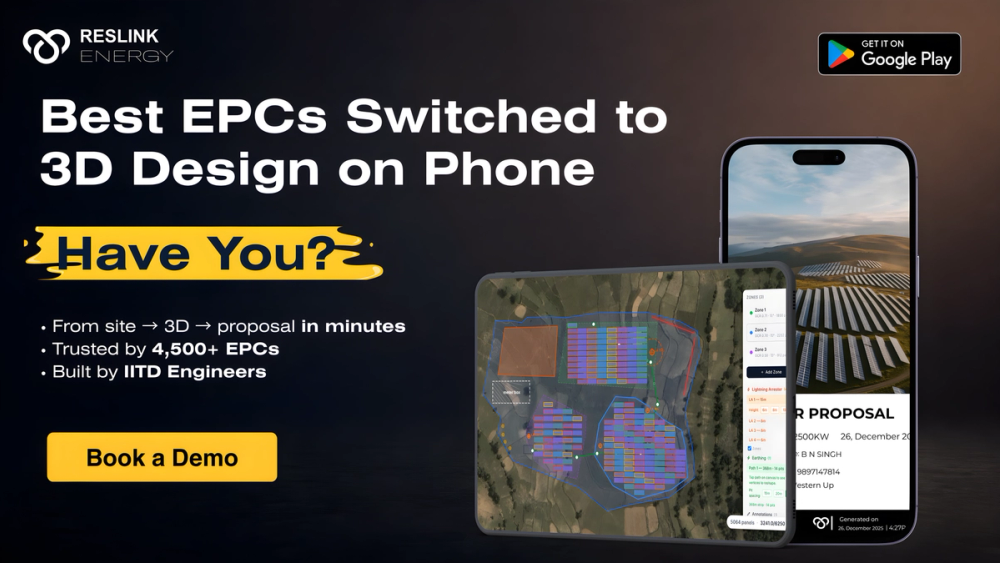
The 3D design step benefits from shadow analysis that runs automatically, modeling structures like parapets, water tanks, AC units, and adjacent buildings as part of the simulation. A trained rep also marks visible ground-level obstructions, trees, poles, vents, on the satellite image during the walk itself. It isn't a fully hands-off process, and it isn't a manual design exercise requiring an engineer either, it sits in between: the platform doing the heavy simulation work, with a short, teachable marking step a rep picks up within their first day or two on the job, not a skill that takes months to build.
Why This Timeline Works
Traditionally, closing on-site required a rep who could sell and perform accurate technical design work in the same visit, sizing a system, running a shadow analysis, formatting a professional proposal, which meant either hiring someone with both rare skill sets, or running a slower two-visit process, design at the office, a follow-up visit to close. A mobile 3D design workflow moves the technical half of that requirement onto the platform, which is exactly what lets hiring focus on the harder-to-train half, sales aptitude, instead of splitting attention across both.
What EPCs Should Do Now
Step | Action | Why it matters |
|---|---|---|
Define the hire | Screen for face-to-face sales experience and comfort with objections, not a technical background | Sales instinct is the harder gap to train; product knowledge is the easier one |
Structure week one | Day 1-2 shadowing and supervised visits, day 3-5 solo visits with review before customer delivery | A defined ramp catches mistakes before they reach a customer without slowing the rep down for weeks |
Delegate the technical step | Use a mobile 3D design workflow so the rep isn't required to do manual sizing or CAD work | This is what makes a 1 to 2 day onboarding realistic in the first place |
Track conversion, not activity | Monitor site-visit-to-proposal and proposal-to-close rate per rep from day one | Surfaces which reps are actually converting, not just staying busy |
Reading the Conversion Numbers
Tracking the numbers only helps if you know what they're telling you. A rep with high site visits but few proposals usually points to the on-site workflow itself being the bottleneck, not the rep's effort, worth checking before assuming a performance problem. A rep sending proposals that rarely convert to closed deals usually points to weak follow-up or objection handling, which is a coaching fix, not a lead-volume problem. And low site visits overall, before proposals even enter the picture, is often a lead-routing or scheduling issue upstream of the rep entirely. Diagnosing which of the three you're looking at matters more than the raw numbers on their own.
Common Mistakes EPCs Make Hiring and Training a Sales Team
- Hiring for technical background over sales aptitude, then being surprised the rep can't close.
- Skipping structured shadowing and putting a new hire on solo site visits before they've seen the process run correctly even once.
- Not reviewing early proposals before they reach the customer, letting mistakes reach the client instead of getting caught in training.
- Measuring activity instead of conversion, tracking how many visits a rep makes rather than how many actually turn into proposals and closes.
- Assuming a two-visit process is unavoidable, design at the office, then a second visit to close, when the actual bottleneck is usually the tooling, not the workflow itself.
Where Reslink Fits in Hiring and Training a Field Sales Team
New sales hires are traditionally slow to become productive because closing on-site requires selling and technical design ability at the same time, and technical design is normally the part that takes months to learn, sizing systems accurately, running shadow analysis by hand or in desktop software, formatting a professional proposal. That's the actual bottleneck this guide keeps circling back to.
Reslink's mobile 3D design workflow moves the technical half of that requirement onto the platform rather than the rep. Shadow analysis runs automatically from an 8,760-hour simulation modeling structures like parapets, water tanks, and AC units, and a rep marks any visible ground-level obstructions on the satellite image as part of the same walk, a quick, teachable step rather than a design skill. The proposal itself, generated from that same design and delivered over WhatsApp before the visit ends, means a trained rep isn't waiting on a design team or a follow-up visit to give a customer something real to consider.
That combination is what makes a 1 to 2 day onboarding timeline realistic rather than aspirational, the rep is being trained to sell and run a guided workflow, not to become a solar design engineer. And because every design and proposal a rep generates lives in the CRM, a manager training multiple new hires at once can see exactly where each rep's site-visit-to-proposal conversion actually stands, not guess at it from memory.
See the full mobile design-to-proposal workflow a new rep would actually run → Book a demo
Frequently Asked Questions
Q1. Do I need to hire someone with solar or electrical experience?
No. Technical and product knowledge is the easiest gap to close through training, usually within the first few days on a real workflow. Sales aptitude, comfort with in-person selling, handling objections, closing without pressure, is harder to teach and should be the primary hiring filter.
Q2. How long does it realistically take to train a new field sales rep?
With a structured shadow-and-practice ramp, most reps can run supervised site visits by day 2 and solo visits with proposal review by the end of week one. Full independent operation typically follows in the second week, though this depends on deal complexity and how much day-to-day mentorship a manager can give.
Q3. What's the biggest mistake EPCs make building a sales team?
Hiring for technical background over sales aptitude, then being surprised the rep can't close. A close second is skipping structured shadowing and putting a new hire on solo site visits before they've seen the process run correctly even once.
Q4. Can a non-technical hire really do accurate 3D solar design on-site?
For the parts that matter to a proposal, yes, with the right platform. Shadow analysis and system sizing run automatically from the design; the rep's job is marking obstructions and walking the customer through the output, not performing engineering calculations by hand.
Q5. How do I know if a new rep is actually working out?
Track site-visit-to-proposal conversion and proposal-to-close rate per rep, not just how many visits they're logging. A rep who visits often but rarely converts is a coaching problem; a rep who converts consistently on fewer visits may just need more leads.
You May Also Like
Related Articles
NFCC BESS Guidance 2026: What's Confirmed, What's Open for UK EPCs
NFCC's updated BESS guidance cut spacing to 3 feet with UL 9540A testing. What's confirmed, what's still unresolved, and what to bring to planning.
MCS 2027 Deadline: What's Actually Changing for Solar and Battery EPCs
Every MCS-certified installer must move to the redeveloped Scheme by 31 March 2027. What's actually changed, why the date matters twice, and what to do now.

Solar BOM Automation: What It Actually Fixes
A quantity error on DC cable alone can erode 6-9% of project margin. See what BOM automation actually solves, and what still needs a manual check.