Your First C&I Open Access Project: A Step-by-Step Entry Guide
The Segment That Most Rooftop EPCs Are Missing
India's commercial and industrial renewable energy capacity is heading to 40 GW by the end of FY26 and 57 GW by FY28. A large share of C&I renewable procurement now happens through open access rather than rooftop alone, which is why EPCs focused only on on-site systems can miss a major opportunity pool. Yet the majority of India's solar EPCs operate primarily in the residential rooftop or small commercial segment and have never executed a standalone open access project.
The reason is not capability. Indian EPCs are perfectly capable of designing and building 1–5 MW ground-mount or elevated-rooftop systems. The reason is process knowledge. Open access projects involve a multi-step regulatory workflow that is unfamiliar to EPCs who've never navigated it. This guide walks through every step, in sequence, so that an EPC with rooftop experience and ambition can understand exactly what executing their first open access project requires.
Step 1: Identify the Right Client
The ideal first open access client is an industrial or commercial consumer with high electricity costs, available land or large rooftop space (typically 4–10 acres for 1 MW ground-mount), a willingness to commit to a long-term arrangement (12–15 years), and enough financial stability to participate in equity if the group captive model is used. In practice, this means: factories, warehouses, logistics centres, textile mills, food processing units, IT parks, or any business with a monthly electricity bill above ₹10–15 lakh.
The conversation opener is not technical — it is financial. "Your current grid electricity costs ₹7 per unit. An open access solar project at this scale can deliver power at ₹3–3.50 per unit on a 15-year PPA, saving you ₹3.50 per unit on every unit you consume from the solar plant." For a factory consuming 5 lakh units per month, that's ₹17.5 lakh per month in electricity savings — ₹2.1 crore per year. That's the conversation that gets a factory owner to take the next meeting.
Step 2: Conduct Feasibility — Before Spending Client Time
Before approaching a client formally, run a quick desk feasibility yourself. You need four data points: the client's monthly energy consumption in units (from their electricity bill), the grid tariff they pay per unit (state industrial rate), available roof or land area at the site, and the applicable wheeling and additional charges in the state where the project would be located. With these four inputs, you can calculate the economics of an open access project in under an hour: estimated solar generation from proposed capacity, grid parity comparison at open access tariff, simple payback or IRR calculation, and the optimal system size. If the economics show a clear benefit — grid tariff savings exceed open access tariff plus wheeling charges — proceed. If the savings are marginal, assess whether a different system size or structure changes the picture.
Different states have significantly different charge structures for open access. Karnataka, Gujarat, and Tamil Nadu have relatively transparent and favourable frameworks. Some states impose additional surcharges or have DISCOM policies that slow approvals. Know the framework for the state you're operating in before you pitch a client — nothing damages credibility faster than promising a specific tariff saving and then discovering that the state framework doesn't support it.
Step 3: State Regulatory Approval
Under the Green Energy Open Access Rules, 2022, any consumer with a contracted demand of 100 kW or more can apply for open access. The application goes to the state electricity regulatory commission or its designated entity. Key documents required typically include: the consumer's electricity connection details, proposed solar project site details, a feasibility report, and in most states, a no-objection certificate from the local DISCOM for grid connectivity.
Timeline: 4–8 weeks in cooperative states, 10–14 weeks in states with heavier bureaucratic friction. Build this into your project timeline from day one — it is the step that most EPCs underestimate, and it is the one you cannot rush by throwing more resources at it. The practical mitigation is to have all documentation ready before the application date and to follow up proactively at weekly intervals, not monthly.
Step 4: DISCOM Connectivity Agreement
The connectivity agreement with the local DISCOM formalises the technical terms under which the solar project's power will flow through the distribution infrastructure. Key negotiation points include: the technical connection point, metering arrangement, the applicable wheeling charge, and the timeline for metering installation. In states with good DISCOM relationships, this step is procedural. In states where DISCOMs are reluctant to facilitate open access (because it reduces their retail revenue), it requires persistence and sometimes third-party regulatory support. An experienced local consultant who has navigated the state's DISCOM relationship before is worth engaging for your first project — the cost is modest relative to the time savings.
Step 5: PPA Structure and Equity (Group Captive)
The group captive model requires the consumer to hold at least 26% equity in the project SPV (special purpose vehicle) and consume at least 51% of the power generated. This qualifies the power as "captive" and attracts a lower cross-subsidy surcharge compared to third-party open access. The PPA between the SPV and the consumer typically runs 15–20 years at a fixed or mildly escalating rate.
For the EPC entering the ownership side: if you hold, say, 51% equity and the client holds 26%, you need to find an additional investor for the remaining 23% or hold it yourself. Many project finance structures allow you to fund your equity contribution from the EPC construction margin on the same project — you effectively reinvest part of your construction profit into the asset. This is the mechanism by which an EPC can start building an ownership stake without requiring external capital.
Steps 6–8: Procurement, Construction, Commissioning
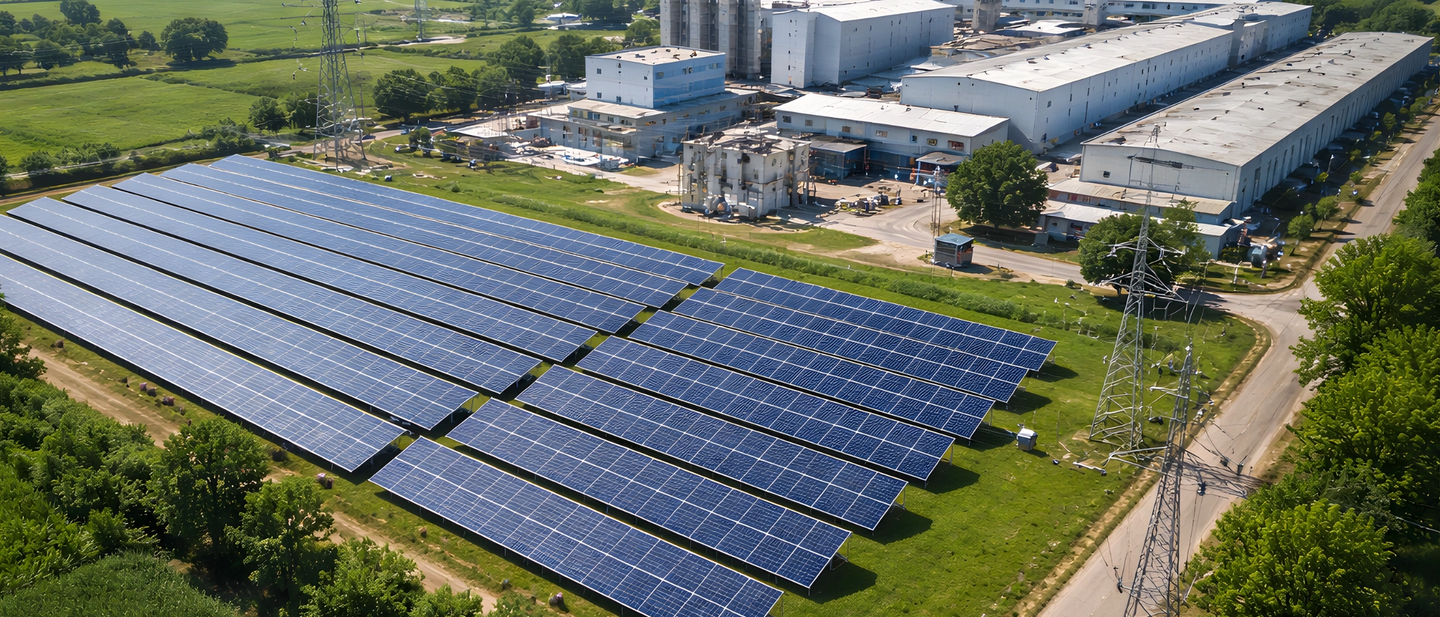
The procurement and construction steps for a 1–5 MW open access project are similar in nature to large commercial rooftop work — primarily ground-mount or elevated structure, higher-capacity inverters (100–500 kW string inverters or 1 MW central), and more complex grid integration than residential. The key differences are: scale of material quantities (requiring more structured vendor agreements and delivery scheduling), civil work for mounting structure foundations, medium-voltage evacuation infrastructure, and a more formal commissioning process that includes DISCOM testing and COD (commercial operation date) certification before PPA billing begins.
ALMM compliance is mandatory for most open access projects. Ensure your module supply chain produces ALMM-certified modules with 16-digit traceability certificates before starting procurement. Non-compliant modules will cause COD delays.
Market Context: C&I RE capacity is heading to 40 GW (FY26) and 57 GW (FY28), per CRISIL Research. 70% of C&I RE is open access. India added 7.8 GW of open access in 2025 alone (Mercom Capital). Karnataka, Maharashtra, Gujarat, and Tamil Nadu are the top states by installed open access capacity. Source: CRISIL, Mercom, PV Magazine India (March 2026).